
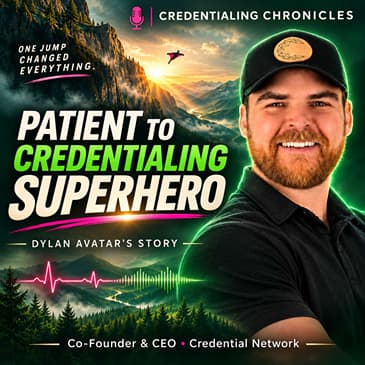
One jump changed everything. What happened afterward led Dylan Avatar toward a purpose he never expected.
In this episode of Credentialing Chronicles, Shannen Reyes-Aguayo and Nyleen Flores sit down with the Co-Founder & CEO of Credential Network for a candid conversation about survival, vulnerability, and seeing healthcare from the patient’s side of the bed.
Before the company, there was a patient with questions. Those questions opened the door to an industry whose work often happens behind the scenes—but touches every patient’s care.
For patients, this conversation offers a closer look at the people and processes behind the care we trust. For Medical Services Professionals (MSPs), it brings a different perspective to the work you do every day—and why it matters.
Along the way, we explore second chances, collaboration, and what becomes possible when someone takes the time to listen.
How does a wingsuit jump lead to credentialing? You’ll want to hear this story firsthand.
Watch or listen to the full conversation, and share it with someone who cares about the future of healthcare.
Visit www.credentialingchronicles.com for more episodes.
Content note: This episode includes discussion of a serious accident, injury, and recovery.
Stay credentialed, not cancelled.
Resources Mentioned:
🔎 Verify Your Doctor’s Credentials
✔️ State-Specific Medical Board License Lookup:
Find your state’s board here:
https://www.fsmb.org/contact-a-state-medical-board/
✔️ Medicare Exclusions List (LEIE) – Check if your provider is federally excluded:
https://oig.hhs.gov/exclusions/exclusions_list.asp
✔️ Set Google Alerts on Your Doctor’s Name:
Create your own Google Alert here:
https://www.google.com/alerts
For Medical Staff Professional:
✔️ FSMB.org – Federation of State Medical Boards Physician Lookup:
https://www.fsmb.org/physician-license-lookup/
✔️ Hospital Websites:
Many hospitals have public directories listing credentialed medical staff. Look for a “Find a Doctor” or “Medical Staff Directory” page.
✔️ Set Google Alerts on Your Doctor’s Name:
Create your own Google Alert here:
https://www.google.com/alerts
Wanna know if your plastic surgeon is actually board certified?
Check for yourself right here:
👉 Verify a Plastic Surgeon
Open Payments
openpaymentsdata.cms.gov
Verify your Nurses' Credentials:
https://www.nursys.com/
🌐 Connection Zone
Stay plugged in with your peers, share resources, and nev...
[00:00:06] Well, Nyleen and Shannon sitting there talking about you while you pull up a chair I know we have to share a microphone today because we are in New Orleans. We have just finished our NAMS live and everything that we've been doing. And our guest today is our first time ever interviewing a person live in person. I know. So exciting that we get the person in. I'm excited. And can you tell me a little bit about him?
[00:00:33] Yeah, let's talk about him. So our guest today actually jumped off mountains for fun. That's what he does. That's already questionable decision making. I don't know about that. Yes, but it led him to credentialing. So it's a good. So hundreds of jumps. He was a tech entrepreneur, still is a tech entrepreneur in credentialing now. Verified identities, startups and then December 8th of 2023, something happened.
[00:00:58] A wingsuit base jump went catastrophically wrong, but he survived. Thank God. He spent approximately six weeks in the hospital and somewhere in that hospital while he couldn't even lift his arms. This man started doing something that would eventually bring him straight into this chair. He started asking questions and somehow credentialing came up. Of course it did because you almost died and credentialing still finds you.
[00:01:29] And the thing is, is like that goes to show you how integrated we are in patient care. Yes. And that's how we see it work every day, every day. And we know that. Yes, that part. Exactly. And here's where this story gets literally crazy. He just, he, he didn't just hear healthcare professionals complaining about credentialing and say, wow, that sounds terrible. I wish I could help.
[00:01:55] He listened and he kept asking questions and eventually he decided maybe I can help fix it. Today we are interviewing Dylan Avatar, CEO, co-founder of Credential Network. But because I want to know about the man who existed before Credential Network, we have so much to discuss first. We'd like to know about the patient. We'd like to know what happened to the way you see healthcare. And when you're completely dependent on healthcare professionals to really keep you alive.
[00:02:25] Absolutely. But, um, let's talk about something that we've both personally noticed about Dylan having known him now for a while. This man does not seem to understand the assignment when it comes to traditional business competition. No, because everyone is protecting their corner. Yes, they are. Everybody wants the best, especially in this field. Right. Um, but Dylan is over here. Like, who should we bring in?
[00:02:54] Who should we partner with? Who actually knows this better than us? How do we make this better together? And I want to know why. So today from patient to credentialing Superman, the Dylan Avatar story. Dylan, welcome to Credentialing Chronicles. After seeing us at NAMS, it must be crazy to now sit down and relax with us a little bit. I don't know if this is relaxing, but it's a lot of fun. I don't know if this is relaxing, but it's a lot of fun. Yeah.
[00:03:24] We'll talk about Credential Network, but I want to know you first. We'd really like to get you to know you first. So because I started, we started digging into your story when we were talking about this. And we realized that Credential Network makes a whole lot more sense once you understand the person who truly built it. Um, so let's start before healthcare. Is that okay with you? Let's do it. Let's do it. So who was Dylan Avatar at 20? Yeah. Yeah. I guess pre, pre-career, right? Pre-career. Back in college.
[00:03:51] I think when I was 20, I was probably traveling around Costa Rica, doing a study abroad program, backpacking away. Um, and then as I, as I went back to school, finished up my, uh, my undergrad, I ended up actually just kind of bum around my car for a little bit. I always had like a little adventurer soul going on. Um, and then I ended up, a good friend of mine was interning with a tech company out of Silicon Valley.
[00:04:17] Um, he called me one day and he was like, Hey man, we're looking for somebody to, to plan this, this event for us. Uh, he was at a tech company that was scaling from about 80 people when he brought me in. It ended up getting closer to 300. And anyway, he, they brought me in, I planned one event and then I got paid, you know, a few thousand dollars for it, which for me was a lot of money at that time. And, uh, and after that, um, they offered me full-time job. And then I said, no, and I moved to Honduras.
[00:04:47] That's great. Yeah. I literally, I was like, no, actually I want to go become a scuba dive master. And, and I had already been scuba diving quite a bit out in California and, um, the Monterey Bay. And, uh, so I moved to Honduras and I, And you learned how to speak Spanish? I'm just a little bit. Huh? Yeah. Just a little bit. Good for us. Very slowly, please. That was, that was my jam. But yeah, so I, I was out there, got my scuba dive master, uh, did a lot of free diving.
[00:05:17] I actually ended up holding my breath for four minutes and 37 seconds. Wow. I would go all the way to 130 feet, uh, on breath hold, which was pretty spectacular. And I got to push my limits. Uh, but then there was this moment. Um, I was actually talking to my roommate at the time. Who's this guy who had early success on wall street and then decided to retire and be a scuba diver for the rest of his life. And he goes, Dylan, you're young man. You got to get back out there and go like, you're ambitious. Don't push it.
[00:05:46] And I still remember that vividly. And, and that's when, uh, the company had actually reoffered me the job again, with a little bit more to the package. And I decided to go back and dive into the tech scene. Didn't plan it whatsoever. Just kind of fell into it. Is this when the mountains come up? Because see, I had to learn this thing. So Shannon and, and you know, we got together, you talked about this, this thing, and it was called jumping off of a mountain. And it's, can you just, okay.
[00:06:15] So how does, how does somebody become this kind of human and exactly and say, this mountain is so beautiful. I want to jump off of it. Yeah. People say the same thing about perfectly good airplanes. That's a good question. I mean, those airplanes aren't that perfect. Right. And yeah, I think it's just a different way to experience the mountains. Like a lot of people love to go for hikes, but who loves hiking down? It's all about the hike up in the first place. Right. Uh, for me though. I prefer, yeah, I prefer hiking down. I, I prefer hiking down. I don't know who you're asking that question to.
[00:06:45] I don't know. For sure. I don't know. I like down safely. I like down safely. Up is too difficult. Yeah. I just like the elevator ride. Okay. Okay. That was my tip. So, so yeah, no, I, I actually, so right after that tech job, skydiving is pretty expensive to get into. Um, I bet. I bet. It's in the gear and all that stuff. And I had always known I wanted it. Uh, but having that job, let me get into skydiving and then skydiving after about 500 skydives or so.
[00:07:14] Uh, I said that so casually 500, Shannon, I mean, I can't even think about that. That was just the start. Yeah. And then I, I'm sorry guys. This is like, yeah, you will never catch me skydiving. No, me neither. Well, I'll go for a tandem jump sometime, you know, maybe, maybe I would, maybe. Yeah. Okay. There, everyone has heard it. You're getting spelled right here.
[00:07:44] Shannon's going skydiving. Nyleen, we got to bring you. Don't worry. All right. So, and then I started base jumping. Um, and then I took a pretty conservative approach to progressing through that. Um, and then I, you know, I think you can, can kind of. So is that you just start off with little mountains and then work your way up to big mountains? What do you mean about conservative? I'm, um, we heard about scuba diving. We've heard about the jumps out of the plane. So we understand that.
[00:08:11] But how do you climb to the top of the mountain and then say, I want to jump off the mountain? Yeah. I progression like working into it. So again, you start skydiving, but skydiving, you're up in a plane. Everything's really small down there because you're thousands of feet off the sky. You get a lot of margin for error. Um, and then when you get into base jumping, you start with a bridge. So there's a bridge out of Twin Falls, Idaho called the prime bridge. It's where most of us start our progression. There's a couple of bridges in Europe as well. One over in China.
[00:08:39] So it depends on what region you're in, but you start there. Uh, it's a little more conservative because, uh, as long as everything goes well with your parachute, if it opens backwards, you're just flying under the bridge with nothing to hit. And then you're doing it over water and there's a nice grassy landing area. So there is something in you that creates adrenaline, creates some type of, I, yeah. Okay. So for me, I think I've always like, even when I was a little kid, I was always the kid that
[00:09:08] got in trouble for going a little too close to the edge. You know, my dad, after, after actually a stint of being an entrepreneur, ended up becoming a surf instructor. And I grew up literally at summers, like my family was split. So I'd go down to, um, the ocean for the summers and my dad owned the surf shop. I would literally just surf, work at the surf shop. Uh, I wasn't very good at surfing. I was actually pretty bad at it and skating and all this, but I loved it. Uh, and that's, that's, I think what got me started.
[00:09:36] And then I've always had that extra draw to the edge, but, um, which is kind of terrifying, by the way, like being drawn to the edge of something and wanting to push beyond it. Yeah. Because you know, my personality, like I see the line, but I try to stay far away from the line. I don't want to go to the line. I love, I love, you go to the line. Seeing what's there. And base jumping definitely was a beautiful journey of, again, not just doing it day one. There's, you know, it's not regulated.
[00:10:03] Anybody can go buy a parachute, jump off a bridge, but it's, but I took that path. We should record an episode maybe doing that. Yeah. But it is illegal to kill yourself. Well, that's, you know, just apparently not with a base jumping suit. Well, you know, I think you shouldn't die. I'm not trying. I'm not trying. It's kind of the point, you know, and I will say, I think, you know, obviously majority of my close friends are base jumpers. And I think everybody has a pursuit of the best life possible.
[00:10:39] Mm-hmm. And, you know, base jumpers find a very extreme way to do so. But I think there's so much calculation that goes into it. And for me, what, what kept me in base jumping beyond the first 20 base jumps wasn't actually the risk factor. I know that that's like the, that's the easy default. That's like, oh, they're just adrenaline drunkies trying to get their rush. That's not me at all. I mean, you spent a lot of time with me. Y'all are very suave. See, you're very relaxed.
[00:11:07] Yeah, I mean, that's, I'm actually not, I'm not that level of intense, but I love the science. I love the calculation behind it. And I spent a lot of time understanding whether the different factors, the gear. The logistics of it all. Yeah, exactly. The real like science behind it. I mean, by no means is base jumping safe, right? But honestly, riding a motorcycle, driving in a car, walking down stairs, right?
[00:11:34] Like people die all the time doing pretty dang boring things. Is it competitive? Not really. I mean, you know, there are some people that try to introduce competition to it, but no, it's largely individualistic or, you know, even like group mindset. I think everyone's got their own limit to push, but I think it's much more of like an internal competition than an external one that I think a lot of people.
[00:12:02] It's so do you think this personality shows up in your business, the way you approach business? Yeah. I mean, there's no doubt that that same mindset that allowed me to jump off a cliff, right? And do so in the safest way I possibly could, um, certainly applies to my willingness and risk-taking and the entrepreneurs, entrepreneurship side of things, right?
[00:12:26] Like I have no desire to just build what already exists. I want to push beyond it. And I want to build the future of technology in my own slice. And I'm really proud to be helping out the credentialing space. And I want to build the best software in the credentialing space, right? So talk a little bit about you did the base jump, how many base jumps had you had done? And then what happened on the day of the accident? Cool.
[00:12:53] So even just starting before the base jumps, I in total before my accident had 1500 skydives. Oh, he was experienced. Sorry. I thought it was 500. I thought it was 500. Right now. You know, that was just before I started base jumping, before my accident about 15. Ali can't take it. She's already scared. Yeah. I'm holding my neck just how terrified I am right now. And pretty much a thousand of those were a bathing suit skydives.
[00:13:18] So like, you know, I had the fabric suit on, I was, you know, pushing through suit progression and really making sure I was a confident flyer in the sky. And then I had about... Does it just feel amazing? Oh, it's... Yeah. It's nothing like it. Yeah. I can imagine. You know, I'll talk a little bit about paramotoring and things like, I just love aviation. I love that kind of like energetic flow that you get, the connection that you get with a lot of these kinds of soul sports, but wingsuiting is unparalleled. I've tried all of it.
[00:13:49] Right. Right. Uh, like I said, he called it a soul sport. Yes. Explain that. Like, cause you're really, it's your soul. That's... I don't want to make it a little, I don't want to make it, you know, cliche, I guess. I just, I mean, we've never heard that. No. I guess it's, like I said, it's, it's more around being in the mountains, pushing yourself. It's not being on a sports field. Yeah. No. Yeah. I mean, for me, when you said that it kind of clicked, cause I was like being an MSP is like a soul profession. Like I love being an MSP, you know?
[00:14:18] I mean, with the MSPs we talked to, I mean, you. Yeah. Oh, you gotta love it. Yeah. Yeah, absolutely. And I think same thing. So there's a soul, there's a passion. Okay. So the accident. All right. Well, so, you know, Okay. I want to know. I want to know. Oh my God. Do it. Hangar this month, a little bit longer. Keep waiting. So 1500 skydives, 500 base jumps that year in itself. I probably had a hundred base jumps in the season.
[00:14:46] So I was, I was like pretty current. There's a, there's plenty of experts out there that are pushing harder than that, but I was definitely living it up, hiking in good shape, good mindset. Um, interestingly enough, I, maybe I was on the tail end of that season and I might've lost a little bit of stoke even, um, the day or maybe two days before it, before my accident, I was down in, well, so I was in Arizona, uh, which is admittedly a pretty technical place to jump.
[00:15:15] It's not super common. Uh, that jumps are a little bit shorter and actually the smaller the cliff, the more dangerous it is. So you were talking earlier around progression. You actually want to start with the biggest cliffs to get the most margin, actually safety. Right. And then the smaller the cliffs or smaller, the starting point from the more technical it becomes. And so I was there and I like kind of just considered it training, which was definitely ignorant on my part.
[00:15:40] Um, and, and then two days before I had done a really technical jump where I jumped into this bowl of rocks and then I, you know, it was, you know, feet off of the ground, flared up, pulled my parachute, uh, landed right on a trail. It went perfectly, but it scared the crap out of me. Like I, you know, I was like, okay, that was spicy.
[00:16:05] And I need to take a step back because I realized I was banking on luck, not on skill at that point. Now, you know, a lot of training went into it certainly to get to that point, but I had this wreck realization. I was like, all right, I was diving into my luck bucket there. I didn't like it. Um, and so I actually, in my opinion, it's weird, thought I was taking a step back to something more conservative, a different exit point that had higher margin. And then I went there on what I would have considered. Went where?
[00:16:33] So I went to the exit point, which is just, you know, maybe, uh, 500 yards away from the other one. So what state or country are you in? Still in Arizona. Oh, okay. Yeah. Same mountain range. Um, my. How do you get up to the mountain point? Did you hike up? I had a, had a camper van and I would drive it up to the trailhead and I'd hike on up. Uh huh. This one was like an hour and a half hike, an hour maybe. Okay. Right. Um, and then, but some would be five, six hour approaches, especially for the big,
[00:17:02] like really incredible flight. Okay. That was my favorite part. Because then you have to hike back up after you jump to get back to your van. If you left it up on the top. No, no. You usually start at the trailhead where you'd land. So the idea is you park at the bottom, you hike up. Oh, and then you go back down. Got it. Got it. Got it. So like the, the journey ends up once you're back on the ground. Typically. It's not always like that. Like sometimes you do drive up and I actually had a motorcycle on the back of my van and
[00:17:29] I would literally sometimes like drive up, drop the motorcycle, right? Or vice versa, drive down and then shuttle myself. That was pretty cool too. Um, anyway, so, so I'm, I'm at this exit point. I jumped in multiple times before. So you did it before at this spot. Okay. Safely. Right. Um, and I had done a lot of calculation into it, uh, like where I was gonna land, where I was gonna pull my parachute, all the different things.
[00:17:56] And then, and the weather conditions seemed right for it. They ended up playing against me. It was hot. So it was thermic. Right. When it's thermic, the wind or the air is rising because it's hot and that can create some inconsistencies around rising air pockets. And anyway, I I'm up there. I've got a few friends. Uh, one person jumped before me and I ended up jumping. I had a pretty normal flight. Like I said, it was a conservative jump.
[00:18:25] I had good amount of margin off the ground, everything like that. And then I had a small parachute malfunction, super small. We don't need to go into it, but I ended up with the tailwind. So the wind was behind me. Typically you want to be going into the wind because that slows your parachute down. So it's a safer descent. Um, and then I had about 12 seconds, which is like, you know, not very much time. It's about how much I'm talking right now to find a place to land after the parachute malfunction.
[00:18:54] I found a dirt patch. Um, and then as I'm- So you're up in the air looking? Kind of. Okay. Okay. Like with limited options. Because your calculations are all messed up now. Oh yeah. Now I'm just finding the best spot I possibly can in a boulder field. Right. And then I'm coming in for landing. Let's say this book is the landing area. There's a boulder here. There's a boulder here. Wind's coming this way. I'm coming in for landing and I hit here. And I hit the boulder right in front of the dirt patch. Like a rock?
[00:19:24] A boulder? Yeah. Oh my goodness. Maybe like knee high, big rock. And that shattered my right leg. I fell forward where I thought into the dirt patch, which would have been great, but I actually hit the boulder on top of my head. But I had an impact rated helmet on. Super grateful for it. I emailed the company afterwards. I'm like, hey, you saved my everything. Because if I was wearing a no helmet or a lightweight helmet, I would have been toast. And then it ended up, most of the impact went into my thoracic spine, which again,
[00:19:53] I like to say I had 13 seconds of bad luck, but I've had nothing but good luck. Yeah. So how many bones were actually broken? Well, I think, you know, maybe to even take it one step back. I didn't really, when I was laying there, I had no idea. I'm there. Right? Like I'm like laying there, the wind's still kind of pulling my parachute. I couldn't. Where are your friends at? They had landed where we're supposed to. So maybe like a mile away, half mile. Okay. Right.
[00:20:22] But it takes time to get to you. And I had friends up on the mountainside, but I kind of disappeared below their eyesight. So no one really knew if I was okay or not. Um, I had dislocated actually this ring finger, which is cool. Cause now I'm married and I get the ring on there. And I, um, so that's a mental. So I had dislocated it and in order to get my GPS beacon, um, I ended up having to relocate my finger. And so I kind of pulled it out, put it in place.
[00:20:49] And then I unzipped, got my GPS, hit SOS. Right as I hit SOS, um, my jump partner called me. Fortunately, like most on the cell phone, on the cell phone, most places were jumping are super desolate. So you don't get cell services. Why have the GPS? But in this rare instance, we're right on the outskirts of Phoenix and Apache junction. And we had great cell service. So she called me seriously.
[00:21:15] Cause if I was out at some of the places I loved jumping, it would have been a very different result. And in this case, so she calls me and she's like, Hey, are you okay? I said, I'm not okay. Um, I had done like a little body scan, like I had done wilderness first responder courses and stuff. And I kind of did that for myself. And I said, Hey, look, I'm definitely going to need a hell out of here. And cause I was conscious the whole time. I still remember the feeling of what it was like, like impacting that boulder.
[00:21:45] Didn't know I had hit the ball. I just remember the pain, uh, like the, like nerve overload. And then, but after that, everything was really calm. Like, how did they get you out? Well, of the ball in between the boulders, uh, they, they brought in a heli. Oh, so that's the thing. Right. So I, I'm laying there. I talked to my jump partner. She calls 9-1-1 for me. And then after that, I called my friends up top and I said, Hey, yo, sun setting, you should start hiking down. Cause the heli's going to kill me.
[00:22:14] So after that happened, like nobody else is going to jump. Well, you know, it depends on the situation. Okay. It's not, there's no like standard protocol, but in that case they didn't end up jumping. They all hiked down as a group. And then, um, I actually just called my girlfriend at the time. We just started dating at three weeks before we were on what we had called the endless honeymoon. All our friends were gone. Cause we were just going around, jumping and having a good time. I was working. Cause she jumps as well. She jumps as well.
[00:22:41] Little, little less experienced back in the day, but yeah, she's quite talented. And, and I actually, I just called her and she, she, she had, she had left the day before and I kept jumping and, um, and I called her and she goes, Hey, uh, how was the jump? Cause she knows about to jump. And I said, no, you know, yeah. Yeah. Um, how's your day going? Tell me about it. And I'm like literally laying there, like just shattered, but had nothing, you know, only I wanted to hear her voice and shocked about her day.
[00:23:11] I was like snowy and she's at Hobby Lobby. And it was like the cutest thing. And she goes, but like, tell me about your jump. And I said, well, you know, I had an accident, uh, they're sending a heli and you could tell she got really quiet. And, um, and I actually was like, Hey, you know, but I know we all these great plans. We're going to do all these incredible things. It's going to be a very different future for us. And so if you don't want that, I totally understand. And she's like, I'll be there tomorrow. And she literally changed her flights showed right on up and
[00:23:41] you know, I'm going to start crying. I know. It's a lot of Shannon. And, and she literally, I'm sorry. She literally slept next to me. I don't know. Yeah. Yeah. Yeah. It was, it was pretty, that's incredible. Pretty special. Yeah. And then I actually, you know, literally she says that in almost instantaneously, Sam get another call from Garmin. It was like, Hey, I saw your SOS.
[00:24:10] Do you need a helicopter? And I was like, yes, I need a helicopter. Please send one. Again, fortunately I had cell service. And so what Garmin was your SOS device and that's connected like, you know, like the starlight, like we have on the cars. Right. And they have a whole heli dispatch. And so they were starting the dispatch process. I'd say like eight minutes in pretty good response time. But then as I'm talking to him, the heli comes in. Cause they had already called 911.
[00:24:38] Cause they, because my friend had already called 911 for me, which here's the deal, right? Higher power. Everyone's got their own opinion. But it turns out there's a helicopter in that mountain range. They would have had to fly about 40 minutes to get to me, but they were already there saving a dehydrated hiker. And so they got to me within 10 minutes of my accident, which is like unheard of, right? They just happened to be there.
[00:25:05] And typically for a more complex rescue, they'd have to go refuel first. They'd have to come back. But in this case, it was a super quick rescue. They went in there, they got the hiker, took them to the helipad. The helipad was a minute away. They came over. And then they came in long line down, took about 40 minutes to get me off the ground. Uh, you know, they bundled me up. You're a pretty big guy. I mean, you're tall, you're very tall and, and, and the stretcher and yes, you're a pretty big guy. You're not a tiny guy.
[00:25:34] Um, so both of them, they were able to lift you up. No, there was a lot of, you know, like you had to shimmy. They had phenomenal protocol. They had to roll me because I couldn't sit up. So I couldn't really move because I had so much spinal injury. Um, but when they got there, I literally was like, Hey, look, you know, I've shattered my right. I hurt my right leg. Um, I can't sit up. So I think I'm back injury and they just went into like the most professional. You're so analytical, even in the midst of your head. Yeah. Yeah. No, I'm serious. Right.
[00:26:04] And it's funny. They would like roll me and I'd like, Oh, you're doing great. You know, I felt so bad for them because it's very different than like a car accident where you're a victim. Right. And you don't like for me, you know, I knew I put myself into that situation. And even though there was factors of bad luck, I was pretty self-aware and understanding that, you know, anyway, so I just felt bad that they had to go through that as well.
[00:26:34] There's an interesting mix of emotions. Um, meanwhile, I've got my chest cavities, 60% full of blood. I broken seven ribs, puncture both my lungs, had broken eight vertebrae, spines process. Still awake. Just still awake. Still completely awake. Like, yeah, like totally there. Fascinating how our bodies, uh, work and can tolerate. It's, it's taught me a tremendous, this whole experience has taught me how adaptable
[00:27:02] and resilient the human body is. I don't even give myself credit. Like there's a lot going on here that I'm not in control of. Plenty. I also am right. And in the human mind also plays a big role in recovery and healing. But at that point I was, I was completely at the disposal of, of kindness of others. Right. And I was really lucky. Yeah. So you're, you're there, you're hella, you're in the helicopter. Are you angry at yourself? Are you like, what did I just do?
[00:27:32] Are you, what are you thinking? Yeah. Yeah. I, I don't think, even though, again, I think I definitely have a sense of guilt for the fact that other people had to come in and save me. I never have, this whole experience felt bad for myself. I kind of just have rolled with it. Right. And, and I've always been able to see the positive. I remember, um, you know, I had once I was through the hospital experience, so they helied me down, put me in an ambulance.
[00:28:01] I guess the heli couldn't take me to the hospital. So put me in an ambulance, put me on ketamine. That was the first time where I started to lose consciousness because everything got nice, bright white. I didn't like that at all. Actually, I would have rather taken the pain, um, cause it felt very much so on the edge of death. That was the closest I felt because I just had no control mentally. Um, and then, um, I had an exchange with the ER docs. They had actually taken me to a class three trauma center and they pretty much opened the door, shut the door and said, no, take them to Banner.
[00:28:31] They took me to a class one trauma center at Banner. Definitely. Oh my gosh. I was so lucky. They had everything I needed. And again, I, if I was in the middle of nowhere, it would have been very different. Right. Right there. Yes. So, uh, what's something you, you now begin the recovery process? Cause the injury happened. We go through the helicopter. We're in the ER. We assess your injuries. We have to start fixing them and part of recovery.
[00:28:59] So what's something about recovery that no one tells you about? It happens in phases. I didn't, I didn't like it all originally felt so linear. Right. I was three weeks of getting peace back together. Um, and then three weeks of like really intense acute rehab. And from there I was like, where can this go? I know I was just going to roll with it, do my best, accept it.
[00:29:24] But I've hit these weird milestones where one day I wake up and my body's in a different stage, right? Where it felt like that wasn't going to be able to be accomplished. And then boom, I'm there. And then I'm there. And I hit these checkpoints and I think people just need to, you know, they're going through that recovery process. Everyone's got their own experience, their own injuries. Again, mine were bad, but I was lucky. Nothing wasn't like I get to come back from a good portion of it. I'm never going to be the athlete I was before.
[00:29:54] My ankle's pretty shot, but I'm walking. Y'all saw me walking around the conference booth, right? I mean, so you're a technology guy. You're very analytical. You're an entrepreneur. You're an athlete and you're used to just doing things and you suddenly you're in a hospital and you need help. You have a girlfriend of three weeks. You're not married yet, right? You're a grown man. So mom and dad, right? What does that do to somebody physiologically, mentally, physically, all the things? Yeah.
[00:30:22] Like I said, I was kind of in a place of acceptance where I was like, all right, I know I'm, I was very vulnerable. I realized how, you know, I had gone from feeling not invincible. You know, I, I had like a whole death document. I was very prepared and understanding and, you know, and actually it was used, um, like a set of procedures. If I was in an accident, I had my jump friends had it and they literally could call my points of contact and it was all organized there.
[00:30:51] But at the same time, I was good to know the jump people like prepare just in case something does go wrong. No, not everybody. Okay. I think just like in every, like with MSPs, you're going to have a spectrum, right? Um, same thing with jump people, but a lot, a lot of those are, are super prepared. And, but yeah, in this case in the hospital, I just was trusting and grateful for, for the medical professionals, for the SAR team, for my family, my close friends who showed up, you know, like,
[00:31:20] all that's what really got me through and it completely changed my perspective. And that I've, I'm very much so applying that perspective every day. I keep moving forward. Okay. So we're in the hospital. We're six weeks in, I think you say three and three, you're starting to get on the mend. And I was down in Arizona, but I own a place up in Spokane and, and Ali, uh, my, my girlfriend at the time had bought a bench seat, put it in the back of the van. Okay.
[00:31:47] And, uh, that her Sprinter van, um, and then drove me up back to Spokane, which was a nightmare. Well, we're still in the hospital. You're still wrapped up. Arms can't lift. Right. So you had told me something about when you couldn't lift your arms, couldn't move at all. And you just started talking to people. Yep. Cause you, you were even talking to the helicopter people, you know, where you're constantly talking. So what are you saying? What are, what are the hospital people talking about? What are you talking about to them? So are you watching TV? Are you eating the hospital food?
[00:32:17] Like, tell me what is that? Yeah. I mean, the acute rehab food was phenomenal. I was super impressed. You don't hear that. Right. And hospital food was, was not quite the same, but the rehab, I was impressed. Banners, you know, Banners are a good hospital. Yeah. I lived in Phoenix for a long time. And nutrition matters for healing. And they, they took it really serious. But I think to your point, like in the very beginning, I say, cause I, uh, impact my, my back so much. I wasn't paralyzed.
[00:32:43] I just like had no strength in my arms, but I torn a lot of the muscles, especially during the surgery. And, um, so I, I like to say I couldn't lift my arms, but I could ask questions. Most of those questions, um, and his friend who I had worked with before, his name is Jeff. He worked in the medical space for decades before helping join us over in the gov tech side. And he came over, he lived in Phoenix. So he'd come every few days. Um, the hospital didn't have a cot.
[00:33:09] So he brought a cot over for Ali and he brought his Roku from his TV and like kind of tried to make it comfortable. He ended up becoming my co-founder, uh, close to a year after that accident. So it took a while for us to actually decide to pull the trigger. And honestly, there was a big co-founder of credential network. Oh, amazing. And honestly, it started with me just kind of asking him questions and then me picking the brains of the healthcare practitioners who were, were helping me as well around identity.
[00:33:39] Cause that's what I knew before. Cause I spent a lot of time just hanging out and at the disposal of other people's kindness. And so I started asking those questions and credentialing did come up a few times and, um, it wasn't until the real physical therapy experience where I got a lot of time with my physical therapist. We're talking hours a week where I heard credentialing was a constant headache, but I, I, I didn't hear
[00:34:05] much, um, much pleasant communication around credentialing when I was in the hospital either. It was fascinating. So you brought it up. So what were they talking about and what were they saying they were frustrated about? Yeah. What were the problems? Yeah. I, I got a few administrative folk, um, who had come in for like different planning purposes. And I think that's where they were like, okay, let me go talk to the team. And, and then from the providers, I think what we heard a lot was that's not where that,
[00:34:35] that's not their passion. That's not their focus, but they got to go through it to start the job. Like I said, it was very, like kind of turned out interview style. Um, and that's mostly the provider perspective we got until I got to really start meeting with credentialing specialists. And that was about a year later where I got to go back into the back office. And then at that point I kind of retraced my steps, started with you district PT. And I got to hear about all the different, the delays, the impacts or frustration to providers,
[00:35:04] what they were trying to do to mitigate it. Um, like I said, Brian Cronin, my physical therapist who owned a, uh, three location group in Spokane, uh, he called it that constant headache. And I said, let's, let's see if we can build some software to help address that. I went in completely thinking primary source verification automation, but then I realized when I spent time with Morgan and then just the endless conversations with credentialing
[00:35:29] came since that we needed something that was helping drive greater efficiency and centralizing the entire workflow. And that's where credential network really is started to shine. We help with the primary sourcing. We've got great partners also that are doing some of that data aggregation, but like we really, anyway, that that's where we started actually solving problems. So when did your technology brain switch on?
[00:35:56] What was a specific conversation where you thought, wait a minute, you know, what's going on here? Maybe I can do something to help credentialing. Yeah. Um, like I said, in the hospital and if the conversations throughout that whole experience, I ended up, um, hearing about it, but honestly I had, I had my own things I had to figure out.
[00:36:20] And so for me, I, I wanted to make sure after this accident, I didn't have like a mental block because obviously trauma impacts everybody differently and it could be a large mental experience. Like I didn't want fear to start standing in my way of getting back to pushing limits. So I focused really heavily on rehab, physical therapy. Um, that was really my first six months. And then I actually, at my six month anniversary, I ended up going and learning how to paramotor,
[00:36:50] which is where you put a big fan on your back and you got a big parachute and you fly off the ground. And for me, that was huge. But honestly, it was also like this, this realization that I was a different person, not even necessarily physically. I mean, I couldn't walk yet. Not well. I could kind of hobble, um, but mentally I had different, you know, I had a big old fan on the back buzzing around, you know, I also like, I, I felt so fragile.
[00:37:19] I almost still do sometimes versus before I didn't, I felt so strong. And so it's, it's, it was very different, but I also realized I just had completely different motivations than I did before. And that the life I was living before isn't my new life, just wasn't. So I had to come to that acceptance. Then I went back to my old company. I was there for a little bit, just special because I built up this incredible team that I really adored.
[00:37:44] Um, and then almost a year on the dot, a little shy of it was that conversation with Brian. Um, and that had happened right after I had this opportunity to leave the company and start something new. So I get this opportunity. I realized that I was a different person, I had different motivations, different pursuits for my life. And then from there, I went in, had that conversation with Brian, constant headache.
[00:38:09] And I ended up drawing a, my logo, that credential network logo on a whiteboard. And I was like, this is it starting it. That's awesome. So you started talking about applications, primary source verification. You're seeing all these dedicated healthcare professionals do work, complain about a problem, about how they're irritated. You are the patient depending on qualified people to take care of you.
[00:38:33] Did that change what credentialing meant to you after it was explained of this process and what it is and how it actually relates to ensuring we have qualified people that are taking care of you while you're in rehab, while you're trying to get better, who did surgery on you? Without a doubt. I mean, that's, that's credentialing is pretty niche. It's pretty unique and it's complex. I mean, I'm still learning every single day and it's yeah.
[00:39:02] But without a doubt, it was my calling. And the moment I, I discovered that I've just been obsessed with helping it since. And I don't even want to say obsessed with solving it, but help obsessed with being a part of the solution. And I think that's been the tremendous motivation is the fact that I still, I'm good friends with my physical therapist. He's one of my closest advisors, right? I've been texting my ER surgeon who's the one that took my helmet off and did my initial surgeries, right?
[00:39:30] And my search and rescue team, huge, played a huge role. And I'm still buddies. It's like, I constantly remind myself that even though this journey is really challenging, credentialing is complex and there's so much to help with. I'm endlessly motivated because of my experience of a medical guide. And like, this is my chance to pursue it in a really passionate way. Yeah. And credentialing has come so far.
[00:39:56] I mean, we started with writing letters with stamps and fax machines. And then, you know, when credentialing... Don't act like faxing isn't still a thing. Well, we do it from our emails now, though. So it's come a long way. It's not through a machine that makes all the sounds anymore. I've been into quite a few credentialing offices that still use fax machines. It's still a thing, y'all. It's still a thing. My voice is so gone from the conference. Yeah. We talked a lot. We talked a lot. I mean, it was just so many people.
[00:40:26] But I guess credentialing was built with a little bit of suffrage. Just a little bit. You know, I mean, we work with providers that... I mean, you know, we were in a meeting yesterday and, you know, the doctor was like, well, how can I give you things where I don't have to worry about it 100%? And I was like, I can't do anything 100% because there might be a multi-factor authentication needed by you.
[00:40:55] But we can, you know, maybe do 85%. And so I really think that that's what CredNet, Credential Network does, is it really tries to give the medical staff professional, the office manager who's ever really doing the credentialing, you know, key superpowers to do their job more efficiently. And so we didn't have that back then. A lot of credentialing software still don't have it now.
[00:41:21] And so just kind of connecting what you've been through to where we're at now, you know, was... Is that how you kind of came up with building some of that transparency, efficiency in that system so that the providers, the administrators could feel more confident in the work that was being done? Absolutely. Yeah. I mean, to take it one step back. Yeah. We, you know, I went in there thinking we could build this software that was going to solve the workflow.
[00:41:49] But what I discovered, and I literally discover every single day, is how critical the credentialing specialist is in the entire experience and how uniquely AI applies to credentialing unlike everything else. Like in my own business, I virtually live in clot. I think it's one of the best productivity tools out there, but it's not designed for credentialing. It can't be. It won't be. Right? And so I feel like there's this really cool lane where we get to go in there, listen to
[00:42:18] credentialing specialists every day. Like I'm not coming up with ideas anymore. I'm listening to problems, coming up with aggregating all the problems together, coming up with solutions. Y'all are really cool parts of that too. Which is what you kind of did with a base jump, you know, the weather, the climate, the atmosphere. So I mean, you know. And honestly, base jumping, I went and I, you know, I, of course, still have my accent, but I went and learned from the best of the best. You can't control everything, but I did my best.
[00:42:47] And that same mindset's here with Credential Network. We're just trying to find the visionaries in the industry that want these changes, but also understanding that that software is an important part, but it's not the whole part of the solution. It's, it's just meant to compliment and empower the humans. And like Shannon said, you know, give us a superpower. Exactly. What was the first thing about credentialing where you thought there's absolutely no reason
[00:43:14] why these credentialers should still be doing this this way, this way, this way, this way. I, yeah. I mean, my first, say it again, Eileen, this way. My, my first conversation was literally, uh, with, with a group that had a fax machine and they did discover if they fax something in, it would happen faster than if they had emailed it. I was like, man, that makes no sense. Right. Like, how can that be?
[00:43:41] And like, that's why they still have this big fax machine. They also use it for billing and other things just fully transparently. But that was like, I was like, oh my gosh. Right. And I've talked since then, not to disclose who, not you district, but you know, like I hear about password books. I can't believe password books exist. Right. Literally physically written down, logging and passwords for providers that get that pass around again, you know, like there are, there are things out there and it's credentialing teams doing their absolute best.
[00:44:12] They just aren't being given the right. And that's where I realized. Like, yeah, they're doing workarounds everywhere. You know, if it's not a password book, it's a password Excel spreadsheet, you know? And, and I think that there's a huge gap in between what plans require, what some hospitals require. And they know that the provider is not doing this work. I mean, they know that it's an office manager. They know it's an outsourced agent. They know that, but it's, they build it all towards just the provider being able to do it and they're making it harder.
[00:44:42] So it's the provider that has to do it, which in turn is never going to get the provider to do it. It's only making it harder for the credentialing people to do it. And so I think, you know, when you're looking at the system, it's this constant loop of no help. And then when I, when we met you and kind of heard the software did the demo with you, um, and then actively have started using your software, there's not a loop. I mean, you literally are not looping around anything.
[00:45:10] You're able to, um, put your work in, watch it progress until completion. Um, and again, data is very important with that, but I think all MSPs are comfortable with data. What do you think, Nailie? Oh, absolutely. And I think that we've all been looking for a solution to just make our workflow better and then communicate with departments. And even till this day, I still have them asking, well, where is the spreadsheet that
[00:45:39] tells me and I said, you log in and you click this button and their minds are just like, oh, it's so easy. So live and on time and in real time. So as the payer enrollment specialist, they get their own login and they get their own login and we do it compliantly and we do all the things. Yeah. And last night, you know, after our meeting with Dylan, um, an idea came out of that meeting and I, cause you know, credential network is really networking the whole system.
[00:46:08] And so they have cred wallet, which is just for providers. It's their own login. They can upload documents. I mean, it's just a really good system. It goes right into the system. Uh, but I was even asking you yesterday, like, can they see the plans that they're effective on? Even if they're at five different tax IDs and you're like, yeah, we're getting that into the system. We're, we're progressing into that. Nobody offers that right now. And so I think, you know, if you're an MSP listening, don't be okay with just how it's
[00:46:38] been, you know, how you're used to like, allow yourself to think outside of the box, because I think that's something that Dylan really allows credentialing professionals all over the United States to do is like, think of what you could just be the best thing for you. Um, and, and then tell me about it and I'll, I'll figure out a way to put it in there. And nobody says that Dylan, I mean, we've been, I've been in credentialing 25 years and I've met a lot of credentialing.
[00:47:06] I've worked with credentialing software and nobody has ever said that you tell them something and they say, we don't need to do it that way. We'll do it this way. Right. I mean, you too, or it goes into an endless, endless suggestion box, right? It's a suggestion box. And a lot of times the softwares will lie to you and tell you that they have a credentialing specialist vetting the information. And the reality is they don't, they have software developers and things like that.
[00:47:33] So my question to you is as a software developer and not a credentialing person, what steps do you ensure to make sure that credentialing specialists are behind every product feature in your software? Yeah. I would say you go, you go look at our reviews and, you know, it's just starting to build here, but it, it, it's really reflective there. It all comes down to culture and mindset. A lot of the, I can't speak to everybody. Every business is different out there.
[00:48:02] But culture is typically set early on in a company. A lot of them were credentialing services businesses that built software and then made it available. Not everybody, but a lot of the times that was the case. When I came in here again, I came with a really clean slate and I said, okay, like what, what's going on with the market, I kind of saw that trend. I said, well, I don't know anything about credentialing, but I know how to listen and I know how to
[00:48:31] build thoughtful software, robust, thoughtful software. And what we've done is we've built out this like, I don't know, cult following of like, you know, of these people who were like, they give us a ton of feedback. Right. And then they see it reflected in days or weeks. I think that's indicative of how much we want to be heard because we are the end user. We are the one dealing with the problem. So when somebody listens to us and doesn't shut us down, we're used to being shut down
[00:49:01] every day by doctors, by leaders, by CEOs, by C-suite members that when somebody, even anybody listens to us, I think it's, um, it, it makes us, you know, basically overflow in love, you know, to show that. Yeah. All right. You just have all the water for the tree. But I think the other thing, um, when we're thinking about it too, is you're able to talk
[00:49:26] to credential network and it's not like, well, there's a fee to map the document. Dylan's like, give me all your documents. I want every single document to have, we'll map every single one for you. There's not a fee to create your rosters. Um, you know, a lot of times credentialing software was, oh, well, you want to customize roster. It's a fee. It's a thousand dollars, whatever it is. And so when you're looking at those types of things, again, um, you should say, is my
[00:49:51] software company collaborative enough to want to get my workflow flowing? Right. I mean, right. I mean, look, just to, you know, think about it from a software perspective. I do understand a software company that had built certain software within the limitations of their time. Software is not the easiest to continuously upgrade. Software development is never the biggest cost. It's maintenance and improvements.
[00:50:16] And for us, again, like I said, we had 13 seconds of bad luck, nothing but good sense. I mean, we're building technology. You even said it, you're building thoughtful software. And so I think a lot of times people are saying, well, we're integrating AI. AI can answer phones for you. AI can run your reports for you. AI can do this for you. And, and again, credential network, it uses AI assisted, right? But there's a human in the loop. A human has to confirm everything.
[00:50:44] And so that gives MSPs, you know, peace of mind because we're not just pulling in random documents where we know there's going to be mistakes. And so, you know, thoughtfulness is what I think is, is the big word, right? Thanks. Yeah. And again, I just think that we were in this fortunate timing because we have this clean architecture and we built that thoughtfulness in from the very beginning with a lot of listening up front, right?
[00:51:09] Rather than getting stuck with the large monolithic architecture that is harder to make nimble, right? So from the beginning, like our, our system, our, my engineering team, we're all designed to be adaptable and, and to automate a lot of the pain point of mapping forms, for example. Like they have to charge a thousand dollars because it's probably pretty labor intensive. For us, we've done it in a much more efficient manner on the back end. I can't speak to their, making assumptions here, right?
[00:51:39] But, but for us, it's okay. You're allowed to give your opinion. So what did you, what did you misunderstand about credentialing professionals, payer enrollment specialists before you actually got to know who we are and what kind of personalities we have? Because I think a lot of us pretty much, you can say we're all OCD. We're all extremely organized people. And we are all kind of, I would say detail oriented alpha female and males that are in
[00:52:08] this profession. Sure. You know, nicely put. I wish I was going to answer you directly, but I didn't really come in with a heavy set of assumptions around credentialing specialists because I didn't really know what it was before I knew credentialing existed. I knew license verifications exist. My, my past life was mostly focused on digital licensure outside of medical, like real estate and plumbers and electricians and that kind of thing. But I went in with a pretty dang open mind. Cause you got to remember, I was in this like transformative state of myself, right?
[00:52:38] Finding my, my new path. And then I've just been nothing but impressed by the credentialing specialists that have been willing to give us time. And I think that because we were. What did you think of NAMS? Oh man, I love it. I mean, that's a credentialing, that's an MSP playground. It was endless and we made so many good friendships there that like, even if they're on a multi-year agreement, there were some people there that were like, Hey, but you know, can we still have a conversation and give you a few? And I was like, yeah, heck yeah.
[00:53:08] Let's still set up some time. Right. There were a lot also, I think that just had these open minds. They want to be at the forefront. We had really healthy conversations there, but just in general, I feel like, especially in the first year, year and a half of building out the software, we found people who wanted change, who wanted to be a part of the change. They didn't want to settle for the spreadsheet or the legacy systems. So they're the visionaries. They're the believers that in us, and I feel like a debt to them to make sure we're building the best software possible.
[00:53:38] Yeah. And I'd like to make one little distinction because you were talking about the software developers and everything. And, um, credential networks, developers, I don't know what they're called because I'm not kidding, but they're all in the United States. All of them. Every single one of them. All the one. Oh, okay. He was in Seattle and he had to know. Oh, okay. Yeah. They are all here. They are all under one, an amazing woman that we've met with and love and, um, and they're not out. Yeah. She is this spectacular.
[00:54:08] And when, you know, but, um, they're not overseas. They're not some, a word that I learned code bloating. Is that the word? Um, what is it? There's a good chance though, but we have really, but is that the word? Um, what, I don't know. Dan, Daniel had taught me a word girl and I forgot it. A little more technical. Yeah, yeah, yeah. But, um, they don't, I guess code is written and charged by the line. And sometimes like when you outsource coding stuff, you know, it like, it's a lot of mistakes and you're constantly having to fix it.
[00:54:37] And because everybody's in the United States and his whole entire team that does, I accept one now. Um, you know, it creates this, um, like amazing teamwork. Danielle was saying so that things get done faster. If there's mistakes, if as they're coding and they're looking at things, they can fix it immediately. Um, and I think that makes a good difference of why maybe you guys are so fast too. Yeah. Cause again, we started with a clean database. We are, excuse me, code base.
[00:55:04] And we, we knew we wanted to make sure we had a nimble architecture. And, uh, I think code bloat is likely what you're talking about with AI, with, no, I used to, that's what you said, but, but tech debt is, is where you'll end up having to constantly be cleaning up or changing your code base because you either built it an older way or you built it wrong from the start. Cause you were moving so fast. And we've built it with that mindset where we're still trying to stay nimble and move
[00:55:31] quick, but, um, also being really respectful with our own tech debt. So when Nyleen tells you like, I don't like this, like this, I need you to change it like this. Cause Nyleen has said that you are every day of the week. Nyleen has said that and I have said that, but Nyleen says it more because she knows how she wants things to run. Um, what, what can you just give us maybe, you know, a quick description of like Nyleen says, I don't like, yeah.
[00:55:57] Tell him, tell him my, when I called you screaming and I said, oh, I need to switch. So, um, I called you. I was a little frustrated cause I had to do five clicks to get to the next provider and then it became the number one feature. Right. So talk a little bit about that feature. Yeah. I mean, so, and I can even generalize a little bit, but Nyleen, you had called and you said, Hey, I'm using your system and it's taking me five clicks because I have to keep going back and forth.
[00:56:24] I have to click out of a provider profile and then I have to click through this series to get back to the page for the new provider. And, and then we brainstormed a little bit cause I didn't fully understand the beginning. So I called you, right. Right. Ask questions, understood it, created a set of designs. Um, I still am doing a large portion of the design work. Me and Danielle, our product manager, um, we kind of share the load there. So it depends on who's got prioritization, what our task load looks like. In this case, I created a design on the front end.
[00:56:54] Um, and then ran it by you. I then actually checked with three other, um, credentialing specialists that we work with. It's kind of our protocol. Now he verified that lead. Okay. No, no. Okay. Trust, but verify even the MSB. Show up your tattoo. Nyleen, show up your tattoo. Yeah. Cause she's tatted up after names. Literally. I, I just think it's an important part of our culture is we make sure that we bring in
[00:57:19] multiple views from every feature we're building because they might've said, oh yeah, that, but then once you did this as well. Right. And then we come back to Nyleen and she'd be like, how did you think of that? Right. And like, you know, it's because it's a collaboration. That is collaboration. Yeah. Beautiful collaboration. Really. And so in your case, I did the design. I had an engineer who had just freed up. So we were lucky. And, and then, but it's, we move so quickly through our feature development.
[00:57:45] He opened up that same day, next morning after getting the designs approved by you and iterative design to make sure it was polished and it to him. And then we had it into a staging environment where we test it. And then we move things after testing, which Danielle does all of our testing. And we also use AI for testing. So we have a human and then we always have AI go through and actually hit the buttons and it actually finds a lot too.
[00:58:14] Right. And then we also do cybersecurity testing where we're using both Anthropic and OpenAI's cybersecurity tooling, right? Then hits our, our code and then make sure that it's secure from the inside out. So we literally ran it through the ringer within roughly 48 hours. We had gone through that rapid iterative cycle and then have a feature for you by day three. And then tell me, what did you see? Like when you seen the change, like that you literally asked for three days ago, like, were you like, what, I mean, what did you feel?
[00:58:44] Oh, it was excitement and it created 20 more minutes per file, right? Because I don't have to click and out click and I'm working the same thing on multiple people. So to be able to switch from one provider to the next, it was, it was great. And I love hearing the feedback at the conference and telling me that the other MSPs using it have fell up with it too. It's now a fan favorite for sure. Yeah, it really is. And that's, that is our mindset is sure.
[00:59:14] We're using AI and we're using really conservative AI to drive efficiency. And that's growing by the day as well. We just launched a really cool contract management feature. I was walking you through, but there's, there's so much data that has to be organized. So many tasks, so many steps. We're not like, there's a lot of AI companies not thinking about the visual, right? You go into like a cloud and it's just that, that chat conversation with this beautiful mind behind it, but we're focusing on making sure it's organized for you.
[00:59:42] And sometimes just develop it with five clicks, but then we get it down to one. So are you ready for the rough questions? Oh my God. Cause this has just been all too nice. Oh, I am genuinely concerned here. So, you know, I will say credentialing. Everybody has their niche. Everybody has their corner. You know, Nyleen has her corner. I have my corner. You meet Tom, Eric. I mean, you meet, everybody's got their, what they're doing, even with the software companies. Right.
[01:00:12] And it's very, very competitive. We're, even if you're not a competitive person, the person that you might be, you know, engaging with is very competitive. And so in thinking of that, um, everybody wants to protect their information. Everyone's, you know, terrified someone else is going to get a piece of their pie. And then there's Dylan, you know, you, you seem to walk into a room and say, who else should be at this table?
[01:00:42] Um, just like you were talking about with Nyleen, you, you got this incredible feedback from her. And then you asked three other, you know, credentialing specialists. So why is that important to you? Why should that be the model for everybody in this space? Consultants, CBOs, um, other credentialing softwares, you know, they're missing something. I feel like, what do you think? I definitely can't speak to their approach in, in skydiving specifically, when you're learning how to skydive, there's this thing called object fixation.
[01:01:12] And it's, it's like a pretty common pitfall for a new skydiver or even an experienced skydiver. If there's a tree right in front of you and you're worried you're going to hit that tree when you're landing, it's really common for somebody early on stare at the tree. And as a result, even if they're trying to avoid the tree, if they're staring at it, because they're so worried about it, they end up hitting the tree. Right. Whereas if you see where you're going, you see the tree, sure. But then you say, okay, but there's a question. That's what you said. Like you manifest almost doing what you're scared of. Yeah. Something happened.
[01:01:41] No, that's exactly it. Right. We don't want to hit the tree. So I think, I think that's more, you know, I've already hit a boulder. I don't need to hit it again, you know, and not a tree. Yeah. So I, there are, there's great competition in this space. There's plenty of people trying to solve the problem. It happens that a lot of the conversations I'm having with people, just they, they're really excited to be working with us and we'll take it. And did almost dying change the way you view competition?
[01:02:08] Uh, without a doubt, like I said, it gave me a whole new focus and motivation. And all I'm doing is focusing on supporting the people that are really excited about what we're doing. And I feel like that's helping us bring success to this whole mission that we're pursuing here. So, like I said, you know, I know there's competition. I'm not blind, you know, but at the same time, I'm just focused because there's so many people that want to be a part of changing the industry with us and using our software. And we're excited.
[01:02:37] So my love, what does it look like for credential network to be successful? What does it, what does that look like to you? Like, when will you know that you've hit that point? Yeah. I think there, there are certain confines in the space, like around payer turnaround times, for example, that are something we accepted early on that we're not going to be able to control. Though I do want to actually shout out to the payers. I would love to just spend some time figuring out how we could drive. We would also like for you to spend some time with Dylan.
[01:03:04] Well, I think it would be very beneficial to everybody. Yeah. So, you know, I'm not saying, not saying we're not here to help, but I think that all the portals going up, Dylan, I feel like you could really, you know, lend some collaboration to them. They might have to do one more portal for one more payer. But again, that is something that we've talked about that we're doing, you know, integrating the portals into the system so that you don't ever have to leave credential network to go into your ability, to go into your UHC. Right? Yeah.
[01:03:33] I mean, a lot of stuff on the plate for you. There's a lot to build, right? And we have a really cool scope in front of us that we can build towards because there's a lot of complexity and there's a lot of old legacy processes that need a nice facelift there. So anyway, we're working towards those. What do I see as success is I want to talk to as many credentialing specialists as possible who actually enjoy the whole process because they're not bogged down by doing the manual
[01:04:00] checks, tremendous amounts of paperwork, filling out their email 12 different times across 12 different portals. And I want them to come back to us and say, hey, we get to focus on the relationships, right? The objection handling, the true problem solving. Cause I think that's what MSPs really are is you're, you're highly intelligent problem solvers. Yes. And that's often so nice. That's exactly what they end up getting stuck typing on your computer, the same thing over
[01:04:30] and over and over again, because that's a part of the job too. Um, you should just be focusing on navigating the complexity. That's never going to go away medical. And it's, it's actually really important. It doesn't go away in a lot of ways. It's like credentialing is the front lines of making sure that serial killers and bad actors aren't in the medical space. It's super critical. And really, you know, I mean, we could take it a step further.
[01:04:58] I mean, Nyleen and I have talked about it so many times, you know, fraud can be detected. I mean, you know, early on patterns of behaviors can be detected early on. You know, if we're integrating OPPE, FPPE, I mean, we could see patterns, you know, allowing AI to show different things. I mean, so there are just so many areas that could really lend superpowers to MSPs. And not only that, right? But credibility to our companies and particularly Shannon, you know, she owns her own CBO. She deals with a lot of different kinds of clients.
[01:05:28] They are just as concerned with cybersecurity. And this is important for us as consultants to make sure that what we offer, how we offer it and what we represent, who we use and who we align with reflects the importance that we need to. Because if I'm going to suggest something to my client and I can't stand behind the product, I can't. Or I'm not using it. Or I'm not using it. Or I don't feel comfortable with it. Or I don't have a contact to say, hey, I understand this is something important.
[01:05:57] I think that is something critical. I'm just going to throw a shameless plug out there. Maybe like a really proud plug. So with Credential Network from the very beginning, because of my background, I knew we needed to get our SOC 2, Type 2 and HIPAA compliance. And that's all around policies and how you establish that protocol within your company and make sure you have the right process and procedure in place, which a lot of tech companies early stage, they don't go through until they're forced to do it. But from us or with us, we started with security in mind from day one.
[01:06:26] So we have really strong security protocol because we're dealing with sensitive provider data and those doctors, nurses, nurse practitioners, physical therapists, they want the security. They deserve it. Yeah. And so again, using spreadsheets or paperwork or actually faxes are relatively secure, but maybe we should go back. There's, but there's no better way. Let's not go back. Right. But, but yeah, I mean, you, you kind of get the point, which is I knew that from the very
[01:06:55] beginning, my team passionately understands that it's a cultural definition. I've been on a demo with you and that's like one of the first questions sometimes that come up and you're like, yep, we have it. I'll send it to you right after. Yep. We have full trust. Yeah. Yeah. Full trust center. Yeah. I mean, let's talk about it. Right. So tell me about the Credential Network. What, what is within the universe of the Credential Network? Yeah. I mean, what we're focusing on is driving as much efficiency through the workflow as possible. And we're with the Credential software.
[01:07:24] With the Credential software. Is that what we're talking about? The software. Well, it's the Credential Network, right? So you have the software. Yep. The Cred Wallet. Yep. The Academy. Yep. Oh. You're not tapping in. So tap it. You're launching it. All right. So here's the deal. We've got CredComply. And we will add the link. Can we add the link in the show notes? Of course. Okay. Perfect. Thanks. So we've got CredComply at the core, which is going to be your administrative tool. It's going to centralize your workflows for credentialing, which we're actively enhancing
[01:07:54] the CVO side of things. And we've got strong partners as well on the PSV side there. We've got the privileging and payroll modules as well to make sure you're keeping track of everything, no matter how complex your credentialing stack is. We're trying to get that all in one spot. What we did is we literally, you can think about our tool, anything you have a spreadsheet for right now. Maybe that's like, you got a little like side notepad that has every payer point of contact because you need to call them up.
[01:08:24] Boom. That's going to live in CredComply. And then you've got an AI assistant who's going to help you do some of the work, but you're always going to have to approve it. Anything that we say can take destructive action. So it's going to do something or delete something. It absolutely requires a human review and a human approval. And that's pretty exciting too. And there's tons of AI efficiency throughout the product. Then we've got CredWallet, which is provider focused. It's actually pretty lean intentionally.
[01:08:51] So, cause we all know the providers, they want to focus on patient care. And at the same time, they still deserve transparency. They deserve to understand what credentials they have when it's coming up for exploration. Yeah. Cause when they do have questions, they want to know immediately. Yeah. And so we try to help put that at their fingertips in CredWallet. That's an app they can download on their phone or they can go in their browser and type in app.credentialnetwork.com. They get a whole portal there. Again, it's lightweight intentionally. So, but everyone that's using is really enjoying it.
[01:09:20] And then what we're doing is we're working right now on spinning up a lot of additional resources. You know, there's a collaboration going on for Credit Academy where we work with a lot of smaller non-delegated groups where maybe it's a practice administrator or a billing manager where they have a credentialing specialist who leaves or, you know, something like that. And now they're stuck with it. We've got a little Academy series, no cost, no CUs or anything like that. We're not computing NAMS, but it's, it's just, you could get it approved though. And I think it helped you with that.
[01:09:50] Okay. We can talk, but yeah, we can talk. Okay. So, so excited. So many features. I love that word network, Shannon, and that you highlighted the word network because really we are all about network networking. And you saw that firsthand at NAMS, but we called this episode something. What do we call it? From patient to credentialing superhero.
[01:10:17] And we, and, and I think we came up with that just because I think maybe it did take a patient to go through what he has been through and, and really just having all of those moments that changed his life and meeting all of those people and your friend who was in the middle. I mean, really, it just seems like serendipitous that all of these things aligned, um, to kind of bring you to our space. Right.
[01:10:41] And then, um, and then when you got into this space, um, you know, the collaboration and I think the hard and, you know, the teamwork that kind of goes into everything. Um, I know from my, from me being an MSP, I appreciate it. I know that other MSPs that I've talked to appreciate it. Mylene appreciates it because when I tell people about you, it's, you need to meet this guy.
[01:11:05] You know, the technology is interesting, but it's really the man that is very nice, very collaborative. Um, and really again, wants to make a seat for everybody at the table. And so I think, you know, that personality, um, is something very different than what MSPs are used to. Right. I mean, I, we spoke with several people that couldn't even line demos up with the big, you know, the big brands that were at, um, NAMS because they couldn't get time, you know, and
[01:11:34] or you are onboarded, you pay your $40,000, whatever that fees look like. And then you're sitting for four months because onboarding is taking that long to process out. So what does it look like when somebody signs a contract with, with credential network? What does that look like? Yeah. I'm just going to correct you in one way. Correct me. It's not just the man. It's the team, the whole team of rock stars. Right. And then people love working with everybody over at our team. Cause it's, well, I met your team and I love them as well. Yeah. Danielle's hugging me like family.
[01:12:04] We went and had foot massages last night. So yeah, I mean, they're great. Yeah. I just don't want to take all the credit because this wouldn't be happening without it. And again, it goes to how incredibly collaborative deal it is. Thanks. Thanks. So yeah, with us, we, again, we built it from the ground up trying to solve these problems. And we knew onboarding was one of the biggest ones for providers, but really for groups as well. And we are actively refining that and making it as efficient as possible, but we're going
[01:12:32] to be working to get providers up into the system. Um, assuming you have a clean spreadsheet of your MPI numbers, CAQ, HIVs because of the data spring integration and some other integrations we built in a matter of minutes. Um, and so it, you know, AI goes through there, sets it all up, make sure you've got confirmation and everything. It's pretty cool. Um, and then we also behind the scenes have a spreadsheet ingestion process, but because of how efficiently we've set it up, we're getting organizations fully up and running within one
[01:13:02] to two weeks. And it all depends on your own backend process though, especially if you're using a different system that's generating spreadsheets, uh, you can pull those rosters out and away we go. Yeah. And can you just finish? I know we were talking about it and we might, we got a little, um, cut off, but can you just finish talking about, so like if you are signing for a practice manager or administrator that doesn't have a lot of experience, what exactly is the tool that you are, you have that allows them to kind of get a little knowledge base about what credentialing is?
[01:13:32] A lot of people it's just thrown at. I mean, you see that all the time in the ambulatory surgery center realm. So we're, we're actively expanding PredNet Academy, which is going to be a free resource. We've got credentialing one-on-one and one-on-two, which are going to be free to everybody. You literally, you go to academy.credentialnetwork.com. You sign up, um, for a secure free account. And then those first two modules are going to be there. We're actually going to be expanding a lot of. And did you put tests in the first two? Dylan wants to test y'all. He says they easy, but did you put tests in the first two? I did. I did. I put tests.
[01:14:01] Okay. Okay. But I made, I made the tests. Okay. Okay. Okay. I think y'all experts out there. He really wants you to have that knowledge base. Yeah. Yeah. You get a certificate, you know, not, not, not, not a certification, but you get a little, you know, certificate, you can print it out, put it on your wall, everything like that. You'll be proud of it. Um, and then we're actively for any administration, empty stuff, those stuff like that to other companies do have like a resource. It's important. Yeah. Yeah. Yeah. I think so too. And, and a lot of what we're going to be doing is just helping tie to those resources
[01:14:31] as well. Um, there's, there's a lot. They put it out for free where anybody can access it or is it just empty staff users? I think empty staff. Oh, okay. So again, the collaboration is on point. Ours will be a balance. You know, some of it behind, if you have a provider seat in our system, we're going to have a lot of enhanced training as well. Um, but again, a little bit upfront as well for anybody to sign up, give it a shot and learn a little bit. Okay. Yeah. Nylee, we got to do rapid fire with him. Okay. Go ahead.
[01:15:00] Before we get into rapid fire, because I think that's an amazing way to close out. We love doing rapid fire with our interviewees. Dylan, we talked about what an amazing Superman he is. He even has another superpower. Do you know what? He's an author. Yeah. Because while he was in the bed healing, he, he just couldn't find enough to do. Would you like to talk about your, your path into being an author? Yeah. I, I really can't sit still.
[01:15:28] I mean, credential network's giving me quite a bit. It's a little ACE ADHD. Yeah. Okay. Okay. It's pretty endless over here. So, uh, literally. Yeah. We're, we're busy. So my wife and I ended up, um, having a story we wanted to tell. And so throughout my entire experience, like I said, after the accident, I knew I wanted to do something for medical. Um, and in this case we have a for-profit credential network. So we're out there building a team, doing everything we can.
[01:15:56] Um, we also, before I started that, just literally while I was in the hospital bed, actually I would credential network was also started where I literally had enough fixer on my leg. Right. And they were like separating my joint to let it heal. And I had a big old metal contraption and I was whiteboard and drawn the logo. So, but, but this book in particular, it's called the adventures of Paha and Harley. Adventures of Paha and Harley. So here's the deal. I found a dog on the side of the highway, uh, before my accident. Her name is Paha. She's adorable. I found her when she was six weeks old. Ish.
[01:16:25] Don't make us cry again. Yeah. It was so sweet. And I, I ended up, her and I just traveled around the van. I mean. I mean. Okay. So, and, and so that was Paha. And then it kind of tells the story about how we went on all these cool adventures. And then we met Allie and Harley. Allie, my now wife and Harley, her pup, it's kind of cute. Our dogs kind of switched because now I don't really do much physical activity. And Harley also likes to chill. And Paha, Harley is a golden retriever.
[01:16:55] And then Paha is a Malinois who loves to be active. And she's just taking an obsession with Allie. She just won't leave her side. Totally worth it. Totally worth it. And so it talks about us meeting and then it talks about my accident and the important role that the pups played in my recovery and getting me back to the sky. So it kind of ends with me paramotoring again and then chasing me. It's, it's really cute. It's touching. And we ended up writing the story ourselves.
[01:17:23] We worked with an illustrator who helped us illustrate the book. A hundred percent nonprofit. So anyway, we wrote this book that tells the whole story. Um, and it's with Paha and Harley in the important role that they played. And Shannon, throughout my journey. And then actually at the end, there we go. Put my hand behind it. At the end, it actually shows that it's a real story, uh, all the way through. Wait, just show them the little, the, yeah. Look at that. Look at that, you guys.
[01:17:52] So this is Paha and Harley and this is Johnny. And if you're listening to this on the podcast, please go to the YouTube and look at the videos. Cause it is adorable. It is available. We're going to link the show notes. Yeah. You can go to Paha Harley.org. P A H A H A H A R L E Y.org. It's a hundred percent nonprofit. And so the way it works is for every single book we sell, we give one to either a child in need or a children's hospital.
[01:18:21] Um, and actually credential network has bought a nice block of these for our clients. And then we ship them out with little thank you notes in every book we buy. Also funds a book to get donated, uh, to one of the children's hospitals in the network. You brought this book. So we were wondering, could you sign this for credentialing Chronicle so we can put it up in our podcast room. Oh my goodness. And then, and so the whole point behind it though, here, can you hold this? Yes, I got you.
[01:18:47] Uh, the whole point behind it though is so that way kids can resonate with Paha and Harley. And if their parents are, are in a tough spot, they can then go through and, and, um, and be like Paha and Harley, be brave and supportive for their parents. And then we're actually in the process of saving up. We're going to make little Paha Harley stuffed animals and we'll get them all hospital ready. And then the kids in the hospital will get their own Paha Harley to get them back to the sky.
[01:19:14] The end of it tells our story through a series of Polaroids. Look how longer your beard was. Oh, that's a bum. And then, and then you go here. Where's Allie? Let me see you, Allie. So good. Look at me. She's the best. Oh my God. She's the best. Oh, look at them. Cute. You know? Paha so smart. And then, so that's us right there. Oh, look Nyleen. How adorable.
[01:19:44] I love it. Yeah. And then, um, here at the end, there's a little spot. And so what we do is when we go out and visit the kids, we take Polaroids with them. Um, and then they get their own picture to be a part of Paha and Harley's thing. I'm going to cry. I'm about to cry. I'm about to cry. I mean. It's all. Oh, no, it's all. Hopefully we'll see you guys out on the road. We'll bring the Paha so many of you. Yeah. We should have brought the Polaroid. Oh my goodness. Oh my goodness. That's so funny.
[01:20:14] Yeah. So next time we meet up, we'll have the dogs and we'll take a picture. Yeah, yeah, yeah. We gotta, we gotta go to Spokane on the way to Alaska trip. Exactly. Yeah. And I will be there. Yeah. So we're working on getting the girls, um, canine good citizens so they can actually go to the hospitals. Oh. And now we'll go to like farmer's market booths and stuff like that and sell the book and get their own, uh, pictures. Polaroid. Ah. And then, yeah, so we take it right in here. It's really sweet. We love it.
[01:20:40] And then the dogs, typically we have a stamp that we made their pods and then we'll give them little dog signatures. It's adorable. I can't. You know, it's, it's a whole different set of motivation ever since the accident. And so we're trying to find a really healthy balance. Like you said, you're a different person now. Yeah. Yeah. A lot of motivation. Superpower. You wish you actually had besides the master of technology. Teleportation. Totally would have gotten me out of my, uh, my. Oh, teleport. Would you have teleported right before you landed? Like crash?
[01:21:10] Yeah. But I will say, I don't know if I would take my accident back. It's led to a lot of good. So that's when, you know, you learned a lot from it. Okay. One credentialing process you would make disappear tomorrow. Oh, uh, definitely payroll. Pay your enrollment. The whole process. Should they just be already enrolled? One click. We're working towards it. We would too, but how do we do that Dylan? I guess I would just make them all in one portal instead of 25. All different podcasts. All different. Okay.
[01:21:40] So one thing about healthcare that still makes absolutely no sense to you coming from the outside. Yeah. Paper fax machines or paper faxing. But you said it's still very secure. So I mean, there's a positive to everything. Okay. One person from the hospital stay that I don't want to hear about the ER doctor. Cause I know you guys were texting, you just said you text him or whatever. Yeah. So that you will never forget. Yeah. So the night of my surgery for my leg, it was Christmas Eve.
[01:22:08] And, um, I ended up having my nerve block wear off and my leg was on fire. Uh, my surgeon did phenomenal. I just had a really bad injury and, uh, there's this poor nurse that I'm, I'm literally never going to forget the exchange. And she was balancing so many different people in that hospital. And yet she still gave me really incredible attention. And she had so many different patients because of the time and everything. And it was definitely the lowest of my lows.
[01:22:35] Um, but I knew that she was there and the whole, whole medical team was there for me. So she was special. Also, there was this guy, Coop, one of my first nurses. And I felt so vulnerable and Coop would come in with a smile and he'd laugh and like he'd put the IV in and the IVs were the worst because my IVs dried up eventually. I don't know the science behind it. Maybe I'm making that up, but they ended up getting really hard to put in. And I don't know, he just did it so painlessly. And I remember that really well. Sorry. Okay.
[01:23:04] So one thing the accident took from you, don't make us cry. Oh, you know, I, um, it seems like you gained so much from it. I don't know. I wish I could answer it. I don't really look at it like it took. That's I mean, yeah, I don't either Dylan. I don't either. Open your door. Okay. One thing or a million things it gave to you. Yeah. Everything we talked about, it covered the whole list. I don't think that Allie would ended up marrying me if she didn't feel so bad for me. So I get the sympathy. Okay.
[01:23:32] He got the woman because maybe he crashed just to get Allie. Allie is way too cool for me. She's spectacular. And like, yeah, there's no way I would have pulled it off. So, you know, that's so sweet. Okay. So we have the real questions now. Are you an ice cream guy or a cake guy? Cheesecake. Cheesecake. Cheesecake. Is Cheesecake Factory your favorite? Because they just have everything there. No, not Cheesecake Factory. I just like cheesecake. Is it homemade? Yeah. Okay. Oh, man. It's homemade cheesecake. It's even better. Okay. Okay.
[01:24:02] Are you a hoodie or a button up or just this green cred net that I've seen you in every day? I'm a flannel guy. Oh, okay. I'm a flannel guy. Okay. Hot coffee or iced coffee? No coffee. Iced chai. I like the tea. You know? That's why we're here to spill it. Exactly. You hear it straight from Dylan. Okay. Early bird or please don't speak to me yet? Right now, both. Yeah. It's endless. We got a lot of work to do. Right? Aw. I'm typically an early bird.
[01:24:31] I like to watch the sunrise. Me too. Yeah. Cook dinner or order dinner? It's mostly been ordered dinner, but I like to cook dinner. Do you cook or does Allie? It's funny. When I first met Allie, she was living on chips and hummus in the van and I was like, oh my God. I love Allie. That's why she's 80 pounds. Okay. No, but she's so healthy and she focuses on nutrition and she does a lot of our cooking right now because I'm so focused on Credential Network. She's a wonderful support. Nice. But like this morning, I made breakfast for the whole team at Airbnb.
[01:25:00] I like to cook too, but Allie's just phenomenal on it. Nice. Nice. It's a surprise. Okay. Your friends hand you the aux cord. What are we listening to? Yeah. Right now, I mean, I've had so many different phases of life for music. I literally just will put on a Spotify playlist, probably country or indie folk. You can jump off a mountain, but what actually scares you? Yeah. We have so many believers in this company.
[01:25:28] I'm definitely terrified to let them down. That's the honest answer, Dylan. Okay. So just be honest with me. How many browser tabs do you have open right now on your computer? You think like a hundred? Cause that's. I thought you've even organized that a little. But I was demoing all NAMs. And so I had like a very set list of tabs. So today I got those five open, demo ready. Yep. That's great. So do you unpack immediately or do you wait till the next day? I unpack immediately.
[01:25:58] It's my thing. You know, I got to close it out. You got to close it out. I was go right into this, the laundry and then. Yeah. Stay on reset. Ready to rock. Okay. So last question. Where do you store your credentialing superhero Kate? Where is that stored at? When do you bring it out? It's in the hat. Oh, okay. That's why I carry the hat around everywhere I go. You're not going to miss the credentialing. Yeah. So there you go.
[01:26:22] Now, you know, the man behind the credentialing, please check out credential network at credentialnetwork.com. Thank you, man. And schedule your demo. The 10 reasons to demo credentialing network are behind him. So if you've zoomed in close enough to read the messages, we invite you to do that. Sometimes your superpower is surviving something that changes the way that you see the world.
[01:26:47] Being curious enough to ask questions, being humble enough to just listen to people's answers and being brave enough to do something with what you've learned from them. Dylan avatar from patient to founder to collaborator to one of the people trying to build what comes next for credentialing.
[01:27:07] And to us, we're really, he's our superhero because again, for when you have MSPs that haven't been heard for so long and have been asking for innovation and somebody comes along that says, let me innovate. We just have to say, thank you so much for spilling the tea with us. And everybody listening, you already know, stay credentialed. Not canceled, baby. Shannon, that was a lot of tea. Honey, but have they subscribed yet to hear it next week?
[01:27:37] On all of these platforms, please subscribe, like, and follow us.