
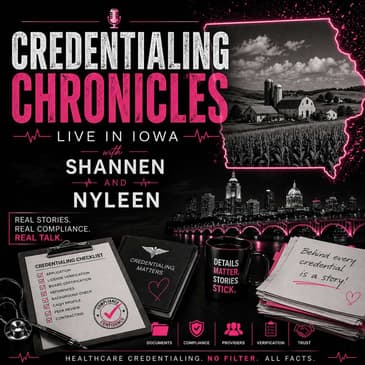
The Iowa stage didn’t just hold a microphone—it held a mirror to the industry. 🚨
In this special live recording of Credentialing Chronicles, we took the stage in Iowa to pull back the curtain on the real-time pressures facing healthcare credentialing professionals today. This isn't your standard industry update; it’s a raw, high-stakes look at the decisions made in the trenches of Medical Staff Services.
From shocking application red flags to the "MSP confessions" that had the room buzzing, we explore the thin line between administrative process and patient protection. When staffing shortages collide with rigorous standards, something has to give. We’re discussing exactly what that looks like when the stakes are at their highest.
In this episode, we dive into:
- Real-World Breakdowns: The cases that triggered instant reactions from our live audience.
- The Shortage vs. Standard Tension: Navigating the pressure to onboard quickly without compromising safety.
- Application Red Flags: The "hidden" warnings that demand your immediate attention.
- MSP Confessions: Unpacking the true complexity of the modern credentialing landscape.
Behind every file is a decision. Behind every decision is a risk. If you’ve ever looked at a file and asked, "How did this get approved?"—this episode was recorded for you.
Sponsored By:
Baton Health: Universal PSV in SecondsEliminate credentialing delays! Get 100% accurate, real-time license verification and monitoring.
Disclaimer: This post contains affiliate links. If you make a purchase, I may receive a commission at no extra cost to you.
Resources Mentioned:
🔎 Verify Your Doctor’s Credentials
✔️ State-Specific Medical Board License Lookup:
Find your state’s board here:
https://www.fsmb.org/contact-a-state-medical-board/
✔️ Medicare Exclusions List (LEIE) – Check if your provider is federally excluded:
https://oig.hhs.gov/exclusions/exclusions_list.asp
✔️ Set Google Alerts on Your Doctor’s Name:
Create your own Google Alert here:
https://www.google.com/alerts
For Medical Staff Professional:
✔️ FSMB.org – Federation of State Medical Boards Physician Lookup:
https://www.fsmb.org/physician-license-lookup/
✔️ Hospital Websites:
Many hospitals have public directories listing credentialed medical staff. Look for a “Find a Doctor” or “Medical Staff Directory” page.
✔️ Set Google Alerts on Your Doctor’s Name:
Create your own Google Alert here:
https://www.google.com/alerts
Wanna know if your plastic surgeon is actually board certified?
Check for yourself right here:
👉 Verify a Plastic Surgeon
Open Payments
openpaymentsdata.cms.gov
Verify your Nurses' Credentials:
https://www.nursys.com/
🌐 Connection Zone
Stay plugged in with your peers, share resources, and nev...
[00:00:00] Welcome to Credentialing Chronicles, where we spill the doctor's tea, honey, hotter than your morning coffee. And we're spilling it across America, state by state and license by license. Ooh, I'm Shannen, and honey, she is Nyleen, and we are just a couple of sassy credentialing pros with front row seats to all this crazy chaos. Yes, from coast to coast fraud scandals to hospital drama they hoped you'd never find. Eh, but we find it girl.
[00:00:30] So grab your coffee, your compliance checklist, and what Nyleen, and let's get into it. Yeah, oh yeah. Well, Nyleen and Shannen sitting there, talking about you while you pull up a chair, they holding everybody. So how many of you, well I know you have, probably have never looked at a file,
[00:00:55] and started onboarding requests and thought, there is absolutely no way this should actually be moving forward. How many? And that was a lot more hands than I thought. Okay, okay, okay. Oh my goodness. And so because according to the stories that we have been talked about, people have told us, you all, and then really what we've been researching ourselves, what we've been finding is that credentialing suddenly isn't becoming irrelevant, right? Right, exactly.
[00:01:25] Yes. And Iowa and Nebraska actually are really taking an active approach. Active. Active approach. Talk to us. We found some good stuff. But we did find some tea, of course. We did, we did. We did find some patterns. So Shannen, what are some of the patterns that we have found that unfortunately are the same in every single state across America? Yeah, we're not just talking about, you know, the bad actors because we all know what those are, right?
[00:01:53] What we really see as we go through this is that it's the patterns that keep getting exposed that are really creating an environment for actors to be bad, correct? I mean, that's what we kind of see. And I think what we really see is that, you know, medical staff professionals have oversight, boards, committees, you know, privileges. I mean, everything, we put everything into place and people still fall through the cracks.
[00:02:20] And so it's like how do we, are we able to help you all by exposing some of this and then you all just have better tricks and tips, you know? One of the biggest things now that we say that everybody really has been saying is set a Google alert. Yes. Set a Google alert. And so if you have a doctor that you're worried about, that you already have been having signs about, set a Google alert on him or her. And you'll get a Google alert if there's another DUI.
[00:02:47] You'll get a Google alert if there's something that's going to come out with a board action that's made public. And that's something that just kind of helps you that sits in the background, kind of like MSP or continuing monitoring on, you know, NPDB. Y'all know about that. So we're seeing, right. So we're seeing all kinds of same things. Unfortunately, we're seeing fraud. Every state. Every state's got it. We're seeing regulators under investigation. We're seeing documentation and prescribing issues. So many.
[00:03:17] Right? Yes. Are we going to talk about one later, which is crazy? Y'all do a lot of telemedicine, right? A lot of telemedicine. So we found out y'all do a lot of telemedicine. And so a lot of the rules of telemedicine lead to have a lot of billing fraud. And so we found a lot of those stories. Yeah. What about, what else, Shannon? What else did we find that's a common theme in everybody? Well, I just want to be specific to this area. Okay. Provider shortages. Yes.
[00:03:47] I think you guys are under, you know, I'm just going to say I'm an RV honey. Okay. So I have came from Washington right on over. Okay. So I'm literally passing in everybody that we've been talking about. Idaho. And so one thing that I'm literally finding is the provider shortages, the epidemic of that in middle America is crazy. And so we know as MSPs, how much pressure that puts you all under, correct?
[00:04:15] Because now you're constantly being told, get the provider through, complete the file, right? Get temporary privileges. What else? I mean, y'all, y'all don't even know, but Nyleen's actually working in a hospital right now, getting a medical staff office up and going. But I mean, what are you caring about? All the things. And everybody's trying to avoid this thing called negligent credentialing. So did y'all know that according to the AMA, negligent credentialing actually went all the way up to the Iowa Supreme Court. In Iowa?
[00:04:45] Yes. Y'all took it to the Supreme of the Supreme, y'all, like a taco. No, right? And when we found that out, we said, oh, Iowa don't play honey. They said they're going to verify it. They're going to verify it all now, okay? So they, I was very impressed. We were impressed. Look at Iowa. It's about a 25-minute conversation we had about that. Yes. Because we don't see that a lot. And when you're thinking about negligent credentialing, which what? We think about all the time. Yes, and it costs a lot of money.
[00:05:15] It costs the facility millions of dollars. Yes, exactly. And I guess the biggest thing that we're finding out is that Iowa cares. Iowa cares. You know, Iowa cares. And Iowa and Nebraska are going to do their best job. Okay. And with their oversight. Okay. With their onboarding. Good. With their checklist. Okay. But can we start spilling something? I know. We can't give them all the credit. Let's have a go. No, no, no, no. We're not. I'm not. Okay.
[00:05:45] Here we go. So we need to spill something. Can you start with the story you told me about with a baby doctor? He's a baby doctor. A baby doctor. Okay. Because I don't know what happened in Iowa about. Have y'all heard about the pediatrician that was going just through the state lines? He had a board action in California. We just looked him up on baton right now before we actually came down because we wanted to have that. That's correct. He has nine licenses.
[00:06:14] Nine active licenses? Well, no. He's had nine licenses. Yeah, say it. Yeah. They're inactive. Part of them are inactive. But he actually has one still active license. All other eight licenses are inactive and have board actions stated and posted. But then there's one. Don't tell him yet. Save it for us. Save it. Okay. Okay. So we're going to bring y'all back to about 2019. Okay. So this doctor gets licensed. It's a gentleman.
[00:06:43] We'll just say that. You know, we try to hold the names. In Iowa. He gets licensed in Iowa? Yes. Okay. He gets licensed in Iowa. Okay. And then nothing, right? There's no noise. There's no alerts about him. Nobody's talking about him. He is a pediatrician. So the license just quietly expires in 2022. So that's a very short license activity in Iowa.
[00:07:04] So when you look at it, okay, now fast forward over to 2025 and Iowa brings charges against this provider, you all. Hmm. Nyleen. What? Do you know what happened? Oh my goodness. Tell me. Something from another state followed him into Iowa and Iowa said that he were not playing. Well then Iowa at least heard about it. Yes. Yes. And I love a medical board that don't play. We love a medical board that don't play. Absolutely.
[00:07:31] And so because what happened was another state was dealing something with this provider provider. And we're talking about multiple complaints you all from pediatric patients from ranging in the ages from seven until 16 years old. And these patients are complaining about this provider in all of the other states. Complaints are happening. Complaints are happening. Board actions are being sparked. And the exams that they're talking about are literally on minors.
[00:07:59] And so you know, you say, oh, just be quiet, Timmy. That's okay. That's how your doctor acts. Yes. But the complaints just kept coming in. And so when we look at it, all together it was seven patients you all that really would not be quieted. And we love that when people are not quieted, I think, right? They have to be the parents because these are babies. Yes. Exactly. Exactly. And so according to this, it wasn't a misunderstanding when they finally brought it out, did the investigation. This is what they found out. Gross negligence.
[00:08:29] That the doctor, the pediatrician was completely incompetent. These are medical staff professionals in Iowa that brought this attention out. So really, Dylee, do you want to know what happened next? Do y'all want to know what happened next? Yes. Because really, he surrendered his license. Did not want to even be investigated. He surrendered his license and then the board actually, once they finished their investigation,
[00:08:55] I wanted to get the figure right, they winded up making him pay over $131,000 here in Iowa. This just happened out in 2025. The payment was paid out in 2026. And so because of that, you know, it wasn't the complaints that happened. It wasn't the investigation that happened. You know, really what happened is all of these investigations got reported back to Iowa and Iowa took action and said we don't want this provider practicing in our state anymore.
[00:09:21] And so when you're looking at that, that is a beautiful board because we see a lot of boards in our spilling the tea across America that do not provide... Well, apparently seven other boards, you know, actually listened and it did a board action. Yeah. But then there's the one state. Guess the state, guys. Where do you think this doctor has a license? Every... Wait, I just... Yes! You said it! Yes! Yes!
[00:09:51] Yes! He actually still has an accent clear unrestricted normal board. No just clear actions. In Florida. Every other state the license has expired or been deactivated and shows an issued board action. Where is he still practicing, y'all? Florida. In Florida. Don't retire. I'm sorry to say it. Don't retire. Yeah, yeah, yeah. Don't... I mean again, but it's not one failure, right?
[00:10:19] I mean we laugh about it because as medical staff professionals we understand that that is what we're constantly looking for, feeling for, and trying to make sure that we catch, right, out of a hundred, a thousand providers. And so how do you check the system, right? Because that is the system that is allowing him to continue to function like that. When you're...
[00:10:44] When you see he now is in no other states that have provided an action item, but now he is still practicing in Florida. So that just sounds like failure to disclose. Just keeps going. Or he disclosed and Florida says, okay, it's okay, it's okay. It's okay, y'all. We're all fine. So I guess one of the things that when we do things like this is like, what was he hiding? What was he doing? What was happening? The allegations against him was nothing sexual of nature.
[00:11:13] It was that he was rude. He was... He had very poor customer service, very poor bedside manner. And again, it doesn't have to be something that is reportable all the way up to sexual aggravation, major fraud, things of that nature. If just a patient feels uncomfortable with you as a provider next to the bed, that's something that a medical staff professional needs to take very seriously. Mm-hmm. Right? Can I tell you my story? Oh my God. Let me, let me tell you that. Let me tell you that.
[00:11:43] Oh no. Wait. We have an interruption. Oh my God. This is confession session. Confession session. So we have... Straight from Iowa, Nebraska, baby. These are the calls and the tips and the tricks that came straight from y'all. Oh, all right. Here, you read one. Okay. You want me to go first? Yeah, you go first. No, no. I'm gonna tell the story and then... Okay, okay, okay. Okay. So, here is what it is.
[00:12:07] We approved a provider with missing items because operation said we'll get it later. Guess what she said? What? We didn't get it all later. We didn't say no names. We didn't say no names. We didn't say no names. We didn't say no names. Uh oh. Okay, so can I start my story? Okay, go ahead. Okay, go ahead.
[00:12:34] Okay, so I don't know if y'all heard about this but a licensing board member faces disciplinary actions. So this is a doctor and unfortunately this doctor, guess what specialty? I'm gonna say OB-GYN because all the time. It's always OB-GYN. Okay, okay. So of course it's an OB-GYN. Now, this physician is actually charged with improper prescribing practices and management of medical records. Okay.
[00:13:03] So I said okay that's pretty bad you know. Well, this doctor serves as a member of the Iowa Board of Physician Assistants since 2022. She does. And it's a four year term. So her term is up and down. But you know, let me just pause. So she's sitting on to approve the physician assistance going through the work. Okay. So the board, well side note, so just in case y'all didn't know, the Board of PAs here in Iowa is composed of five physician assistants, two doctors, and two members of the public.
[00:13:33] She tells the story so much better. I mean I just love her. Okay, but listen. So then I'm like, okay, that's kind of scandalous, you know, facing charges for improper prescribing. Girl, but that's not all. Tell me. You're not going to believe this one. Oh my God, I'm so excited. I had to put them in baton. No. And I put it in baton. And you know what happened. What a baton. Blink, blink, blink. 28 licenses this doctor has. 28. 28.
[00:14:00] And now he has a formative board action only in which state? Iowa. Iowa. So 27 states still haven't caught up. But with Iowa, but what did this doctor do, you say? Oh, they have a lawsuit pending. Why did they have a lawsuit pending? Alleged workplace injury. Hmm. Workplace injury. On the doctor? Yes. Okay.
[00:14:29] He's being sued by his assistant, his surgical assistant in the OR. She had a workplace injury. Yes. Yes. Okay. So she's suing because, check this out. During a procedure, she took the overhead surgical light, threw it, swung it in her directives, knocked her in the back of her head. And now she has a permanent injury. The OB doctor.
[00:14:59] Did this. To her assistant. To her surgical assistant. Yes, she must have been doing it. She did. And hit her in the back of her head. Now that she said, I'm a baby. Get it right. Oh, Lord. This lady. Now I have a severe permanent injury. I am a true. I am injured. I can never do surgery again. She was assisting in the surgery. I can never be an assistant. I'll be right here collecting my millions from you, sir. This is a woman. Sorry.
[00:15:29] It's a woman. Sorry. It's a woman. It's a woman doctor. It's a woman doctor. It's a woman doctor. It's a woman doctor. She was having a bad day. Oh, boy. Oh, no. She was having a bad day on this one physician. But now, of course, she has 27 other licenses. Of places she can practice. Although for an OBGYN, isn't that quite a red flag? Why do you have so many licenses? Right? How are you? You're not doing telemedicine on OBGYN. Right. Right. Is it a can?
[00:15:56] I'm a privilege for that you all. I don't know. The CEO will be asking for one next week. Okay. The way AI is coming in. Okay. This doctor has medical record problems. Behavior problems. Closuit problems. It's basically the credentialing nightmare for any MEC or surgical assistant. Or surgical assistant. Or OR manager. Yeah. Or all the things.
[00:16:26] Yeah. Or all the things. That is insane. Okay. I got one more. One more. Nani, I can't stop you. You're all here. I got one more. Oh, my goodness. Because I think we got to do our game. Okay. Okay. Confession. Confession. Confession. Confession. Confession. Confession. Okay. I got this confession. Alright. The repeat offender. Nyleen. This one. The provider had a history of short ten years at multiple facilities anyway. But no red flags.
[00:16:56] So, we approved. Would y'all approve? What y'all doing over here? Would y'all approve? That's the question. Okay. Real quick. Before we get into our game. Let's go. We have an unlicensed counselor. Did y'all hear about that story? That was all over the news. Oh, my gosh. Okay. That was all over Iowa News. We pulled that one right off of y'all news. I know. Department of Corrections. At the end of the day, they ain't watching the news. Okay. Well, they go out. They're on the street. Yeah. They have their Google alert. No, they have.
[00:17:25] That's because they're putting their Google alert. Yeah. Okay. So, the Department of Corrections, which is a state agency. So, who's supposed to be doing credentialing for the state? Don't they have like- The state? Isn't the state? Yeah. Apparently, they don't have MSPs. So, anyway. They can't. They can't. Not like this, bro. No. So, the Iowa Department of Corrections said they could not explain how or why it hired
[00:17:50] an unlicensed mental health counselor as a program coordinator. He had a complaint in 2023 and his license had expired in 2022. So, he had already an expired license, but girl, it gets worse. The website was still promoting him as a licensed provider, right? As a licensed counselor. Counselor, yeah. Then he was charged in May of last year with falsely representing himself as a licensed therapist. Yep.
[00:18:20] And then he failed to cooperate on investigation. January, he was found guilty. And then, oh yeah, now we're going to permanently, you know, revoke his license. So, my question is, hiring without verifying. That is a really big problem. Right? Okay. So, really quick, just let us sum it up. Because I think too, some people, you know, mental health is getting everywhere. Everywhere. Mental health. Everybody's pushing, put mental health here. Put mental health there. And, and it's needed.
[00:18:49] Because I need a lot of mental health. I know y'all need a lot of mental health. I'm sorry. So, but really it's like, oh, it's not a doctor. Oh, it's not a provider. Right. But they are. It is a provider. It is. You know, anybody that has access to a patient with an NPI that, you know, is billable under is a provider. We know that term. We know that definition. And so, again, if you're HR, again, you guys are a power. You are the gatekeepers.
[00:19:14] You are the superheroes of medical staff, hospitals, and clinics everywhere. So, you have to be able to say that this person is a provider. You all, we have to go through the credentialing process and not the HR process. Because a lot of people, as y'all know, just want to stick it as an HR function. And it doesn't work because there are things that need to happen in the credentialing process. So, by the time things like hit the medical boards, which were, which is what we're finding.
[00:19:42] Because again, nobody really has taken credentialing all throughout America and looked at each state and did a comparative analysis and really said, you know, what are they seeing? What are we seeing? And so, what we're always seeing is that, number one, there are warning signs. Everybody has warning signs. Every provider, everybody is giving warning signs. And so, when you're starting to see those warning signs, you know, what do you always say? Documentation is what every medical staff, professionals, you know. Yep.
[00:20:12] And I always say trust but verify. I don't trust nobody. I don't believe no diploma. And behavioral patterns are another thing that you're constantly looking at. So, you know, with your OPPEs, it's good to, you know, put things in that for that are, you know, behavioral patterns are you seeing, warning signs that you're seeing, moments someone questioned something and didn't escalated. And so, we just are just constantly advocating, I guess, on our show to make sure that you listen to your gut.
[00:20:41] Your gut is your most important tool in this whole process. I've been credentialing for over 25 years. You've been credentialing over 20 years. I mean, when we're looking at just credentialing as a whole, as you all know, our gut is everything. And it lets you know immediately, like, hmm, I don't feel good or ooh, I do feel good. And this is one of the reasons why we made this game. So, this game looks like this. We are going to ask a couple of questions and there's four answers.
[00:21:10] Either to pass the file, you're going to stop the file, you need more information to investigate. So, first one. Provider surrendered a license in another state, but nothing shows in Iowa yet. Do you pass the file? Do you stop the file? Do you need more time to investigate? Or does it just feel off? So, the QR card isn't working, so we're going to have you raise your hands. So, let's go, guys. Alright, let's see. If the provider surrendered a license in another state, but nothing shows in Iowa.
[00:21:39] First of all, how'd you find it? But, okay. So, pass the file, stop the file, and need more time to investigate? Who's passing? Or escalate? Who's passing? No, the Iowa knows. Okay. Who's stopping it? Who's stopping the file? I just stopped it. Stop, okay. Okay. Who needs more time to investigate? And you did! Oh, and you do! Exactly. Exactly. Okay, can we get the next one? Provider didn't disclose prior discipline, but you find it in another state. What are you doing?
[00:22:09] You're passing the file, you're stopping the file. You need more time to investigate that file? Stop it. Stop it. Stop it. And what are we asking for them to update? The application. Which is the disclosure questions. I always think NCQA, you know, so I break the application apart. But yep, you guys got it. Alright, next one. What documentation didn't look perfect, but all verifications came in usually fast. Stopping the file or passing the file?
[00:22:40] So, they give you information, but let's say they give you two peer references instead of three. Mm-hmm. And then those two peer references take forever to reply. Is that a red flag? Would you stop the file? Or there's gaps in the CV, so they're kind of, you know. Is that a red flag? Would you pass the file and just keep going? Or would you stop the file? Or would you investigate? Investigate. Investigate. Investigate. Investigate. Investigate.
[00:23:08] Okay, because we find a lot of things out in the live verifications, which I like to call, rather than the online verifications a lot of times, because that's where you kind of spot the gaps at. Okay, one more. One more, and then we're going to do our PSA. Provider has multiple mail practice claims, but all were settled. We pass in the file, we stop in the file. Need more time to investigate? More time. More time. Right? Why? What? Where? How? Exactly.
[00:23:39] Yeah, what's the craziest malpractice case that y'all have seen? How, what's your longest NPDB? That was one of our questions on Facebook. How much? Shout it out! Yeah, let's go! 50! Who's seen 50? Who's seen 50? 50-50? Has anyone seen 50 pages? 40 pages? 100 pages! You've seen 100? No. Have you seen 100? You've seen 100? You've got 100. Was that provider on staff? Sold. Yes!
[00:24:07] That's how it is in the board of directors. Exactly! We got 100! Yeah, yeah. So a really interesting thing that just happened with the credentialing girl that I had to teach is multiple residencies and fellowships. When we train our credentialing staff, the one girl that I never thought about this. Mm-hmm. So when I was trained, I was taught like, hey, if they change from one residency to another, you know, ask the question. Mm-hmm.
[00:24:37] This girl thought, oh, he had three extra years of training. And I said, no, that's not what that means! That's not what that means! I said, no! It means he tried general surgery, failed out of that, did neurological surgery, failed out of that, went back and did orthopedic surgery, and said, well, I want to do back's anyway, so they went ahead and he does back surgery and has horrible outcomes. Mm-hmm. What do you want to say, the state? Georgia.
[00:25:07] Georgia, okay. Sorry. Yes, but not Florida, not Iowa. But not Florida, not Florida, and not Iowa. But my, but, you know, training. Yeah. Training our staff and going from there. And I think the biggest thing too is now that we're seeing... Oh. It's confession session! Stop! Okay. Okay. Oh, Nyleen. Okay, y'all ready? This one had kind of bothered us a little bit when we had seen it, but we're going to talk about it anyway.
[00:25:34] So everything y'all had checked out on the paper, but something had felt off. That's what we're talking about. The person said she ignored it. Months later, there was a huge issue that came out. And that's all she wrote. That was her, y'all. Is she here today? Is he or she here today? No. Can we get the rest of the story? I don't know, I don't know.
[00:26:03] It was her confession session. Do you want to do another one? Let's do another one. Yeah, do another confession session. Okay. Maybe we'll get a little more. Okay. Alright. Let's see. We try to get you guys to do some confessions, but apparently nobody wants to spill the tea a lot. That's what we have to do. Yeah, a lot. Everybody's scared about some money. Everybody wants to do another mistake. Nobody wants to do an idea. Yeah, I know. Okay. Gotcha. It's all right. It's all right. We'll do it for you. We'll spill it for you. Okay. We got an email that said, leadership told me to approve the provider and stop overcomplicating the file.
[00:26:34] Anybody heard that before? Even though it was mistaken. Key verifications. So, I know it's more than one person that's heard that. Okay. Again. It's not complicated. It's anonymous. Oh, but maybe she's... It's allegedly. Oh, it's allegedly. It's allegedly. It's allegedly. It's allegedly. It's allegedly. Okay, got it. Yeah. We got y'all. Don't worry. Y'all don't know where that's from. Listen to the Epstein episode. It's allegedly.
[00:27:04] We won't do it. Okay. So, I think the one thing that we just kind of... I mean, should we really break down the patterns? What do you think... What does Iowa need to hear from us? I mean, I think that's the question, right? Iowa... Because we have a lot. So, I checked out your licensing board website. So, y'all have a really good board website. I liked the design of it. Very good. It's very simple. Very simple. But it had the very key things very prominently. Where it needs to find...
[00:27:31] Although, I didn't like this thing where you have to like log in or something to verify the license or something. It's very weird. It was a little complicated to verify. Nyleen likes an easy... I like easy. Where it's like public verify here. And I think she took the log in approach instead of the public approach. But again, if it's not easily identifiable to somebody like Nyline with 97 certifications... And I don't...
[00:27:57] It is very not easily identifiable for our patients and the public. I know. And we're trying to list the site to educate patients to let them know where they can find the resources that they need because it's our right as a patient to be able to look up on our doctor at the very least to see if they have a license. I think that's only fair. Yeah. And what we find every time is that patients don't know that. They don't know that they can look up their license. They don't know... Has anybody heard the PBI episode?
[00:28:27] PBI Education that just dropped? Yeah. Okay. Let's talk about PBI. So, the PBI Education, one of the big things that they were talking about was disclosure and advocating and chaperone. So, they actually now have a chaperone program that they train chaperones to go in with all specialties of providers so that providers aren't there alone with the patient.
[00:28:56] Again, to reduce risk of something being said or something not being correct that should have been correct. And so, when we're just thinking about that, it's like what factors are we always putting into play in practice that allows for reduced allegations? Well, the first thing that we said is... The first thing we can agree on is don't just check Iowa. Mm-hmm. Don't just check Iowa. Do we agree on that?
[00:29:25] I don't want to answer. So, if you don't do it now, figure out how you can budget for that because you're not finding out all the T. You have to get all T. How many people use FSMB? Or a system like BATON. Or a system like FSMB. One person? For real? Two people? Guys, that's terrifying. Three? Wow. So, if your organization is not using a system like FSMB or BATON, I mean, that is really
[00:29:52] one of the biggest systems that can be incorporated into your organization. And it's cost-effective. Because it is really on the providers to disclose everything to you all. And if they're not disclosing it, you're leaving board actions or other licensors or something like that or an issue on the table. Yeah. And perfect example. So, I currently... I'm sitting right now. I'm investigating with an attorney.
[00:30:18] I got hired as an expert witness to check on a doctor. He had an action on his license where he was not able to see a patient unsupervised. Went to a different state, got a license in that state. The one state did not report it to this new state. He started doing procedures at the facility. Not only did the facility never credential him, never check his license, but he ended up assaulting the patient.
[00:30:49] In 2026? In 2026. Mm-hmm. And it's not... Because at the very least, they should have at least checked his license in that state. Mm-hmm. But if they did, it wouldn't have showed anything anyway. They had to do all 50 states. He was actually told not... He was not allowed to be in a room with patients. So, PSA for patients, we always say, I don't care what kind of doctor you go to. If it's a male physician, please bring somebody with you. Mm-hmm. And we don't want to say that because all, you know, doctors are bad or anything like that.
[00:31:18] But working with an orthopedic surgeon, he just does orthopedics. He will never go into a room with a woman by himself. Well, I say all doctors. All doctors. Men, women. I mean, it's always good to have a chaperone. It's always good to have somebody there as an advocate. Yeah. You know, if the patient can't have their own family member come in, it's just nice to have somebody there that you don't feel pressured or you don't feel, or I don't understand what he's even saying.
[00:31:43] I mean, what we have really found, again, spilling the tea all over America, is that patients are not as informed as we think they are. They're not. You know, doctors are not as informed as we think they are. You know, if a doctor has a DUI, they literally don't know what to do. You know, they're panicked. They're, you know, scared for you all to see it on, you know, Monday or Friday night's news. And then when they come in in the morning, they are just worried about the board.
[00:32:10] And we always are advocating go to your medical staff professional. If you're at five hospitals, the MSP that you trust the most is the person that you could go to, and they will take you through that entire process. And, you know, they'll be able to advocate for you and really kind of walk you through it. And that is one of the most, you know, amazing gatekeeping things that MSPs can do for a provider. Great. Look them up. Check the license. Ask the questions. And then do what you guys do best, which is be the private investigator that we are. Mmm. FBI.
[00:32:41] Hey. Healthcare FBI. That's what I'm saying. For real, for real. So, doctors, they should disclose everything. Be upfront. Everything. Upfront, transparent. Nothing should be off the table. Hidden. Documentation to the nines. Okay. Right? Yeah. MSPs. MSPs. Number one. Google alert. Google alert. Number two. Number two.
[00:33:09] Just make sure you have all your T's crossed in your eyes. Document, document, document, document. Even if you, for example, you know, like some of our confession sessions that even came up, when somebody does tell you to go ahead and push that file, get that file through, stop being so difficult. Note it on the file summary. I was instructed to push this file through. Da, da, da, da, da. I ain't trying to be difficult. You know?
[00:33:37] I mean, and I know, but when it goes to the board of directors and Shannon's ray, his name is attached to that file, what they're going to see is that I did not agree completely. But I was told to do this and I am listening to what my superiors are asking me. Mm-hmm. But again, it protects you because you all work very hard for your certifications. Yes. You work very hard in the areas and the fields that you all, you know, are in.
[00:34:06] I mean, to be honest, we have taken it to the streets of Miami, right? At PodFest, which is this podcast thing that we still really don't even know what it is, to be honest. It's like a, it's like a... Yeah. We're MSPs. We're not podcast people. Yeah. But anyway, but when we ask, you know, people on the street, what is a credentialing committee? Oh, they didn't know what to do. What is an OPPE? They say, oh, we down with OPPE. Wait, wait, wait. Not that OPPE.
[00:34:36] It's the OPPE. They say, yeah, the OPPE! I know. It's how they're monitoring doctors, you all. That's, that's what that is. And they didn't even know that. Oh, what comes out of an OPP? An MPP-ing, you know? And they're all, you know? And so, all of these things that they're learning just through credentialing chronicles, because I know you guys around here as MSPs, and we love you, and we are going to advocate for you 100%.
[00:35:02] And so, that's why I say, give me your tea, because if you don't want to spill it, baby, we'll spill it. Right. Because there's, well, y'all are two states, right? So, there's 48 of the states of people that are in the same boat that y'all are, and that every piece of tea that you all have will help them become better MSPs. And I mean, to be honest, we ain't getting no much younger, honey. I'm about to be 50 years old, okay?
[00:35:26] And so, when I'm thinking about 50 years old, I'm trying to train the new generation of MSPs, because they're not going to get what we had, y'all. How many y'all had it from envelopes? How many? Thank you. How many was using fax machines with the cover sheet? And wait a minute, how many y'all had to send the return envelope with the stamp? With the application? With the reappointment?
[00:36:00] That's where we come from? But I'll tell y'all that the MSPs today will never understand that. They'll never understand that. And how are they going to understand that? From these people, y'all women and men in this room today. Understanding the way we were trained. We were trained this way for a reason before NAMS ever came around. We was trained for this reason to be able to spot bad actors and pick up patterns and pick up behaviors.
[00:36:28] And why do we get that gut feeling that everybody keeps telling us to shut up and don't worry about too much? It's because it's all there you all, but now it's just coming out so much more rapidly because we're able to kind of have these real conversations. And just remember, y'all are the gatekeepers. You all have that power. Keep your voice, right? Absolutely. Okay, I think we need to talk. Okay. And transition. Let's do it. Well, as we always say, stay credentialed. Not canceled. Ah, that's our Iowa.
[00:36:58] That was a whole nation's worth of tea, girl. Ooh, and we are just getting started. More states, more scandals, and definitely more receipts. And if you love the tea we're spilling, you gotta like, you gotta comment, follow us, share, do everything. Where can they do all that at, Nyleen? They can follow us on LinkedIn, Instagram, TikTok, Facebook, on all the things. And share it because the tea is going coast to coast. Ooh, I love it.
[00:37:27] See you next time on Credentialing Chronicles. Remember, you gotta stay credentialed, but not what? Not canceled. Not canceled. Bye.