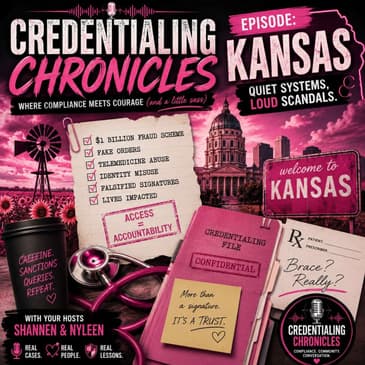
🌻⚕️ Credentialing Chronicles: Kansas Edition — Quiet State, National Lessons ⚕️🌻
The tea is officially served, Kansas!
In this episode of Credentialing Chronicles with Shannen and Nyleen, we're heading to the Sunflower State to explore the healthcare challenges, credentialing lessons, and oversight conversations shaping organizations across America.
From telemedicine and provider monitoring to patient safety, healthcare fraud, compliance, and medical staff oversight, this episode examines how healthcare systems balance access, accountability, innovation, and trust in an increasingly complex environment.
We'll be discussing:
☕ Telemedicine and the future of healthcare oversight
☕ Provider monitoring and ongoing surveillance
☕ Credentialing blind spots and compliance challenges
☕ Multi-state licensure and operational complexity
☕ Patient safety and quality improvement
☕ Healthcare fraud and system vulnerabilities
☕ Rural healthcare pressures and access-to-care challenges
☕ Why credentialing is more than a one-time event
As always, Nyleen is spilling the tea while Shannen asks the questions we're all thinking.
Plus:
✅ MSP Corner
✅ Credentialing Insights & Lessons Learned
✅ Healthcare Compliance Conversations
✅ PSA for Patients
✅ PSA for Providers
✅ Takeaways for MSPs, Healthcare Leaders, and Organizations
Whether you're in Medical Staff Services, credentialing, provider enrollment, compliance, quality, risk management, administration, or simply interested in how healthcare systems operate behind the scenes, this episode delivers education, conversation, and plenty of thought-provoking moments.
Because one thing became clear:
Healthcare risk isn't regional.
It's national.
⚠️ Disclaimer: This episode discusses healthcare topics, publicly available information, and industry trends for educational and discussion purposes only.
🎙️ Subscribe for more Credentialing Chronicles:
Healthcare scandals. Credentialing challenges. Compliance conversations. Patient safety lessons. And the stories shaping healthcare across America.
Eliminate credentialing delays! Get 100% accurate, real-time license verification and monitoring.
Advanced Quality Compliance & CVO
Credentialing. Contracting. Compliance. Handled. Completely. Concierge-level credentialing, payer e
MedElevate Solutions
Bridging the Gap Between Software and Clinical Reality E.L.E.V.A.T.E.™ your healthcare experience.
Disclaimer: This post contains affiliate links. If you make a purchase, I may receive a commission at no extra cost to you.
Resources Mentioned:
🔎 Verify Your Doctor’s Credentials
✔️ State-Specific Medical Board License Lookup:
Find your state’s board here:
https://www.fsmb.org/contact-a-state-medical-board/
✔️ Medicare Exclusions List (LEIE) – Check if your provider is federally excluded:
https://oig.hhs.gov/exclusions/exclusions_list.asp
✔️ Set Google Alerts on Your Doctor’s Name:
Create your own Google Alert here:
https://www.google.com/alerts
For Medical Staff Professional:
✔️ FSMB.org – Federation of State Medical Boards Physician Lookup:
https://www.fsmb.org/physician-license-lookup/
✔️ Hospital Websites:
Many hospitals have public directories listing credentialed medical staff. Look for a “Find a Doctor” or “Medical Staff Directory” page.
✔️ Set Google Alerts on Your Doctor’s Name:
Create your own Google Alert here:
https://www.google.com/alerts
Wanna know if your plastic surgeon is actually board certified?
Check for yourself right here:
👉 Verify a Plastic Surgeon
Open Payments
openpaymentsdata.cms.gov
Verify your Nurses' Credentials:
https://www.nursys.com/
🌐 Connection Zone
Stay plugged in with your peers, share resources, and nev...
[00:00:00] Welcome back to Credentialing Chronicles, where we spill the tea on the doctors you see. And we're spilling it baby all across America. Well Nyleen and Shannen sitting there talking about you while you pull up a chair. They holding everybody. Welcome back Nyleen. Oh my God, we've been doing so much.
[00:00:26] Oh my goodness. I know it's been so crazy and so exciting, but man, I want to be where you are now. Sounds exciting. I love your hat. You look so amazing. Oh my goodness. Thank you so much. You know, I'm still traveling all around the United States. So that's what I'm doing. Credentialing Gypsy at large. Oh yes. But are you in the state we're going to talk about right now? Ooh, would that be Kansas baby? Hey, Kansas. Are you in Kansas?
[00:00:56] No, we're not in Kansas. We're down in the great state of Texas. But if you are a Kansas MSP listening to this, please drop us a line, a comment, a like, a follow. Tell us your favorite thing about Kansas. We'd love to know that. Absolutely. Okay, Kansas. So probably not the first state. I know it's probably not the first state that you think about when you hear healthcare controversy, right? What do you think about when you think about Kansas?
[00:01:26] What do I think about Kansas? I think sunflowers like my hat. I love the sunflowers. Oh, I know you love sunflowers. That's the first thing I think about. I don't think about fraud. I don't think about, you know, murders. I mean, I just, I don't, I just criminals. I mean, I just don't think about any of that, Nailene. You know what I think about? I think about Dorothy. Oh, yes. The Wizard of Oz. She's from Kansas. She said, we're not in Kansas anymore, Toto.
[00:01:54] Exactly. But, you know, honestly, that's why this episode matters because today it's not really just about Kansas is bad or Kansas is good or Kansas is perfect. It's actually the opposite. Kansas is a reminder that healthcare systems across the country, whether you're rural or urban or massive or small, everybody is navigating the same pressures, right?
[00:02:17] And we're facing the same kind of problems. And as we have mentioned, we're seeing the same things from state to state to state. Provider shortages, telemedicine expansion, credentialing strained, fraud vulnerabilities, access issues, oversight gaps, right? I mean, really everywhere we're seeing it. And I think what's happening is a lot of the different cuts that are also coming down, Nailene, you know, we've been hearing it out in Oklahoma.
[00:02:46] They have been affected so much. And then Kansas as well. I mean, the rural areas are just getting all of their funding cutting. But now the government has made an initiative to provide grants this year. So I just came back from ASCA. You know, I'm a little traveling gypsy too, not with an RV, but I just came back from ASCA and I got the opportunity to hear Dr. Oz speak. And he did talk about the rural healthcare initiative to really try to bring additional funds.
[00:03:16] Now, in order to access those funds, you do have to apply. The facilities. Yeah, you have to show the grant. And there has been allotted, I guess, buckets on different rural health carriers to see if we can try and improve this. So I would say that's something to look forward to and see if this flood of income, whether it's small or great, makes any change.
[00:03:39] But when we get things out of balance, what happens is it exposes the areas and the problems really start appearing because it's not that people don't care. It's not that MSPs don't know what they're doing. We know that they do. It's just that the healthcare system is truly under pressure everywhere. Under pressure everywhere. And I mean, I guess that's what we're going to be talking about today, right?
[00:04:04] Because what keeps happening is it keeps putting people in these situations where we're hearing a lot more fraud stories, right? I mean, that's what it seems like, you know. I guess people, you know, can emotionally separate themselves and say, well, that's just a criminal doing criminal things. But I guess it's really not when people are under such hard pressure and huge funding cuts. What do you think? Exactly.
[00:04:33] And one thing we keep saying over and over is that healthcare risk is not regional. It's truly national. Yes, yes, definitely. And I guess one, a cut to one state is a cut to all states, right? Mm-hmm. So where are we starting with today, Ms. Nyleen? I'm ready. Take me there. Take me there. Well, you got fraud for me. You got murder. You got legislation. Listen, I got a Kansas anesthesiologist, girl.
[00:05:02] Should I say allegedly? Well, what's our disclaimer first? Our disclaimer is that we do not credential any of these providers that we talk about. We do not know any of them. We don't want to know any of them. And we just are looking up all the public information that is accessible to everybody. And then we put it together in this beautiful, Tiffany, gorgeous package that we like to call Credentialing Chronicles. And bring it to you. Absolutely.
[00:05:32] All right. So we are going to start with a Kansas anesthesiologist, a licensed doctor. Recent story, March 2026. He was sentenced to three years in federal prison tied to a health care fraud scheme involving medically unnecessary orthotic braces and testing. How was he even prescribing braces? That's a great question.
[00:06:00] I mean, this case really becomes an example of how technology can outpace oversight because telemedicine itself is not the problem. Telemedicine has expanded access tremendously. And we love that. Yeah, because it helps the rural health care, right? It helps underdeserved communities. So we're not saying telemedicine has to go away. No. What we're saying is that people, honey, are finding those cracks, walking in the cracks, putting a swimming pool up in the cracks and collecting millions of dollars.
[00:06:31] Exactly. Exactly. And so according to federal investigators, this doctor participated in the scheme where medically unnecessary orders were signed for thousands of patients. So, oh, I have a license. Doesn't matter what my specialty is. Hashtag anesthesia. Right. I'm just going to say, well, I'm a doctor and I'm going to just prescribe and say, yes, you need a brace. You need a brace. You need a brace. I mean, were the patients even assessed, my love? Did they come in? Were they looked at? Nope.
[00:07:00] They've never said that they were properly examined by a physician. Again, we're not even going to talk about the specialty of this doctor. And wait, what's the part that makes people stop? You know, that's the part that just makes people say, how does this even happen? Right. How does this happen? Because we're asking, how does this happen? Right. And the problem is healthcare is built on trust. Patients assume if I'm seeing a doctor, if I see somebody with an MD or a DO, I assume, well, a doctor is a doctor is a doctor, right?
[00:07:29] So if a doctor signs an order, then there was a legitimate medical reason I needed it. At least you think. Mm-hmm. Mm-hmm. Yeah. And, you know, Shannen, I just want to take a second. I know that this is happening because I have had patients that we are evaluating and say, they come in, they broke their wrist, and we give them a brace. Maybe it's just a hairline fracture. They don't actually need a cast, and they don't need surgery. So we put them in a brace.
[00:07:56] I have had claims denied because they're telling me that a patient already has the brace. When we go and ask the patient if they've ever been given a brace, they tell me no. Where did the brace come from? I don't know. So somebody had billed for a brace because you only have a certain timeline. Like, you can't have a brace every month. Like, there's timeframes that you have to wait. To get another brace. That's the problem.
[00:08:22] So patients are suffering because they're being ordered or, quote-unquote, prescribed these fake braces. And now when they really get hurt or they need a real brace, they can't get one. Yeah. And I mean, when, you know, this case, they said that the prescriptions were being ordered. The orders were being done at scale. You know, large amounts of braces. And then on the other end, the patient gets an EOB. They don't know how to read it. They don't know what to do.
[00:08:50] You know, they don't know, understand that 63 braces are being billed to them. Right? Exactly. And so he received payments from Medicare, just millions and millions of dollars connected to these approvals. And this is where credentialing professionals immediately start asking, right? How does someone remain operationally trusted while this behavior literally develops? Exactly.
[00:09:15] Because this wasn't necessarily about having initial qualifications to prescribe a brace. You're not an orthopedic surgeon. No. It was just, I want to get paid and I'm a doctor. Doesn't matter what kind of doctor, I just want to get paid. Outright fraud. I mean, which are two very different things, right? Because if we are doing credentialing, why do we do credentialing? We do credentialing because education, training, licensure, eligibility.
[00:09:43] Credentialing alone doesn't automatically identify changing behavior patterns. It's not just done for no reason. It's done for a purpose. Yeah. I mean, and you know, I think sometimes, you know, when you have these surgery centers or other facilities that don't really necessarily require to credential to that limit, then, I mean, it creates this problem. It creates this gap where people are able to kind of fall through, right?
[00:10:10] You know, I mean, I think in a big hospital system, if an anesthesiologist is, you know, prescribing braces, that would be flagged. Absolutely. Absolutely. So, you know, that's a national challenge, right? I mean, it's not a Kansas challenge. I mean, everybody's suffering from these type of frauds. I mean, we just found this one in Kansas, y'all. Right. Especially as providers start adding multiple licenses. And that's where the story gets really interesting.
[00:10:39] This anesthesiologist, okay, held licenses in 22 states. Oh, my goodness. That sounds impressive operationally until you think about monitoring complexity, right? Exactly. Multi-state practice expands access, sure. But it also, you know, increases oversight complexity. Who is oversighting? Yes. Exactly. How are you doing continuous monitoring?
[00:11:06] Are you sure you're verifying all 50 states to make sure that this doctor is legitimately practicing or has practice locations at all of these different places? Right. How do you keep track of behavior problems? Yes, very true. How do you strengthen telehealth oversight? I mean, that's a true problem we need to face. Yeah. I mean, I'm just saying NCQA, Joint Commission, this might be a whole other type of certification that you guys should be thinking about as telemedicine expands.
[00:11:31] Maybe there's some type of telemedicine certification that kind of addresses these areas where organizations can really, truly provide that transparency. But really, that's where the conversation is happening everywhere right now. How do we keep integrity inside healthcare? That is the question. And I can tell you one way that we're doing it is we have partnered with BATON. We have partnered with BATON, baby. They throw in the BATON up in the air.
[00:12:00] Robert, just a good old friend of yours and mine. But we just honestly, BATON represents something that healthcare organizations desperately need right now, right? You know, do you want to name some of those things, Sexy Mama? Let the people know. Because credentialing today is not simple. And the law of minimum effort is not what we want. Oh, it's not protecting patients. No, no.
[00:12:26] So we need to have a system that we can check all 50 licenses, all 50 states all at once. So we want to get their DEAs. They want to have everything all at once. Yes, yes, yes, yes. And BATON definitely provides that and can provide that to our customers at whole. So, again, go into the show notes. You can definitely check them out. Tell them the pink girl sent you. He'll know who you're talking about. Yeah.
[00:12:49] So, Shannen, if that case did not highlight a provider-level vulnerability, a statewide, nationwide vulnerability, then this next story is really going to highlight a system-level vulnerability. We got a doctor out of a county, a county in Kansas called Johnson County. So if you're from Johnson County, you're listening to us. Give us a shout out. Follow us. Give us a like, a comment. Let us know. How did the sunflowers grow out there?
[00:13:18] Exactly. According to federal prosecutors, he participated, again, in a massive health care fraud conspiracy involving now an internet-based platform called DMERX. Oh, I've heard of that. Okay, okay. And this case was enormous. We're talking allegations tied to more than $1 billion people in fraudulent billing activity. The billion.
[00:13:48] And you ask yourself, how do we get to the billion, Nyleen? Nyleen, take me. How do we get billions? Exactly. It's staggering. The numbers are staggering. And according to the prosecutors, the platform allegedly connected marketers, telemedicine companies, pharmacies, DME suppliers, and doctors to generate medically unnecessary orders again. Are you kidding me? And that's important, right?
[00:14:18] Because it's like you would think a system like that connecting everybody in the medical family is a good thing. But again, the people find the cracks. The fraud begins. And that's, you know, not a Kansas problem again. I mean, so really what Kansas is showing us is that Kansas is really showing us what the United States health care is really looking like. This was a national fraud infrastructure issue, you all. This was not specific to Kansas.
[00:14:48] Exactly. Federal investigators described offshore call centers. They got an international, girl, misleading marketing and fraudulent doctor orders tied to this whole telemedicine workflows. Oh, my goodness. Yes. Nyleen. And this case really demonstrates how health care fraud has evolved technologically. Right? I mean, if that's the word. Yes. It's like high tech.
[00:15:17] We could get bots now to just do it. Right? And then who's getting the blame? Right? I guess the person that set the bot up. Right. Which means oversight strategies have to evolve. We have to change what we're doing. We have to, mommy. Come on. This is getting crazy out of hand because health care organizations now have to think beyond does this license the provider have a license. Now they also have to think about stuff like what? How is this provider practicing?
[00:15:45] What behavioral patterns exist? We always talk about the patterns. Are there unusual utilization trends? You know, the plans love to throw the utilization in our face, Nyleen. They need to start using the utilization. Exactly. And many health care systems across the U.S. are still developing those capabilities. And I think that's why. It's not fast enough. It's not fast enough to really bring provider enrollment and credentialing together. So there is some kind of RCM oversight.
[00:16:14] You're just like a credentialing fairy. Like you just always take it and turn it into like a positive. You know, you're like now they're coming together. And they will work together. And you're right. No, you're right. I just love how you say it, you know. I mean, you're right. It is. And so we're going to talk about the human combination because humans are balancing.
[00:16:43] And we're going to talk about patient access and staffing and financial realities and community expectations all at the same time. Look at everything that MSPs have to accomplish. Now we got to worry about billing and making sure that our doctors are not only credentialed with the payers, but that their billing practices are accurate so that they don't get arrested for fraud. Yeah, I would say, my lovely, that one thing this episode really highlights for me is that healthcare systems are built by humans.
[00:17:10] And I just don't think that they're building, you know, the technologically portion of it fast enough. And so really, that's where really some of these software companies should be focusing. Some of that effort, you know, is maybe using these bots to run, you know, testing on utilization and see if you could spot an anesthesiologist billing out millions of braces. You know, that would be a helpful thing, right, Nylee? Mm-hmm. Yeah. And it's not usually just one evil person or one perfect system, right?
[00:17:39] It's so much more complex than that. Yes. We find that. You know, there's fragmented processes and there's communication gaps. I mean, to be honest with you, you as a CDO, do you ever get to see a bill go out for the provider that you created a file and sent it to your client? Never, ever, never, never, never. But on our contracting department, you know, because we do a lot of contracting for clients, they will send us like their bills and say, they're saying it's rejecting for this and that.
[00:18:09] But that's only that. Like, we don't see like you see on a, you know, operations level. Yeah. Exactly. And so that's why Kansas actually demonstrates some positive movement on this direction too, because for example, Kansas implemented, yes. So Kansas implemented centralized verification efforts through the Kansas license verification portal to improve public accessibility and transparency.
[00:18:36] So they're working on some kind of things and visibility wise. So that's a good thing. Yeah. Especially because, you know, health care improvements require honest conversations, right? I mean, we can't turn the states and organizations into villains. You know, that is not what Credentialing Chronicles ever wants to do. I mean, but we just do want to shine a light and say that transparency tools matter, right?
[00:19:02] Patients should be able to verify their providers at the level where they can feel comfort. I agree. Agree. We agree. We agree. Absolutely. No verification portal right now is perfect. We know that. There's a lot of very smart people that are trying to work on it, but these kind of modernization efforts or at least realizing that they are needed is very, very important. Yes, definitely. I mean, and if you ever need some consultants, me and Eileen are available.
[00:19:31] Please call, you know, find us at credentialingchronicles.com because we could definitely help you. Yes. So let me shift from fraud, girl. I got another story that's completely different. I'm like tired. I'm like, they're siphoning billions out of Kansas. I'm tired of fraud too. We need to save some money for the U.S. Okay. How about intentional misconduct, financial exploitation, but this, this is completely different
[00:19:56] kind of a healthcare nightmare, girl, because this isn't about somebody allegedly gaming the system. It's about what happens when the very equipment to save lives becomes part of the system. Oh, oh, oh, oh. And honestly, that's what makes this one hit differently, right? Because fraud makes people angry and patient safety breakdowns, those make people deeply uncomfortable and shatters the trust in the community. Exactly. Exactly.
[00:20:24] Because this story is going to center around allegations involving an open heart surgery patient at a very big health system in Kansas. So we've got open heart surgery. Those are vulnerable, girl. I mean, you got your whole chest open. Yes. You're on a bypass machine. I mean, you are in the doctor's hands. Yes. And before we even begin though, we have to be clear on this story. These are allegations.
[00:20:51] So this is allegedly, allegedly, allegedly in litigation and healthcare associated infections are incredibly complex events with multiple potential contributing factors. Okay. So the lawsuits themselves raise some really hard questions about infection prevention, equipment oversight, system accountability, and all the things that keep patients safe in a hospital.
[00:21:16] But Nyleen, Nyleen, those questions are relevant for every hospital in America. That's not just Kansas, mommy. Every hospital CEO, you know, compliance, quality, you know, improvement department should be asking themselves these questions. Yes. Okay. So let's tune into the story. Here's what the families alleged. Okay. So allegedly patients underwent open heart surgeries using a heater cooler device.
[00:21:46] Now, if this, if listeners are wondering what is, what in the Grey's Anatomy is a heater cooler device, right? Let me explain. Okay. These are specialized surgical devices used during cardiothoracic procedures to help regulate a patient's body temperature while they're on bypass. Oh, yes. If you die, you get cold, right? Okay. So when the blood is going in and out, they, they, they, they need to regulate your body temperature. So yes, these are critical pieces of equipment. Yes.
[00:22:16] And there's the perfusionist that runs the machines. And those are the people that bypass the blood out so that your blood is still getting oxygenated. Yes. This is not optional gadgetry. This is not go, go gadget comes out of the doctor. This is serious operating room infrastructure. Exactly. Exactly. I mean, the hospital has paid for this equipment, right? A lot. Yo, you have to maintain and get trained and the whole thing. Yeah. The hospital bought it.
[00:22:46] Then I like the doctor didn't buy it. Right? No, no, no. This is the hospital. Yeah. This is only changed and monitored by the hospital. Okay. So according to the lawsuit, contamin, contaminated heater, cooler devices, allegedly exposed patients to you ready for this one. Okay. I'm going to read it. Okay. It's called Mycobacterium chimera. Oh, what is that, Nyleen?
[00:23:11] It's a slow growing bacterial infection that can take years to fully reveal itself. In other words, it can just like stay in your body. And that's terrifying because imagine this, you survive open heart surgery. You go home. You think you made it. Nyleen, you recover. You start rebuilding your life, but you're saying this is slow growing. So then months later, maybe years later, you start losing weight. You start feeling exhausted. You have unexplained fevers, mommy.
[00:23:41] You're having symptoms nobody can even explain and they wouldn't connect it back to your open heart surgery. Exactly. One of the most haunting aspects of these allegations is the delayed nature of these infections because families described loved ones deteriorating long after what should have been a successful surgery. So you're not even being monitored after this long time. It's done. It's done, right?
[00:24:07] I mean, so, I mean, the whole thing is, you know, you're now, I'd say what, continuing on with your life. This is psychologically brutal because then nobody's immediately connecting that symptoms, you know, back to years earlier. Exactly. The delay makes detection incredibly difficult, which is part of the why that these cases are so emotionally devastating. Devastating. Yeah.
[00:24:33] So according to reporting lawsuits, allege that multiple patients developed the serious infections later on with several deaths associated with the cases being litigated. And this is where the story stops being about devices and starts being about people, about families, about spouses, children, patients who thought they had survived the hard part. Yeah. And that's the part listeners need to sit with you guys. Listen to that. Okay.
[00:24:59] You go back in, you're telling your doctor and they're not connecting it back to this bacteria that was in a machine that was not properly maintained. And they're calling you crazy, you know, because open heart surgery is already terrifying and enough. Nobody consents to successful surgery now, mysterious infection years later. I mean, I don't feel like that's okay. And then nobody knows even where to start to help you. So let's talk about the uncomfortable question.
[00:25:27] How does something like this happen, Nailene? Well, the answer is, unfortunately, it's very complex and it's not an excuse. It's just a reality. There's equipment maintenance, right? Sterilization protocols, manufacturer's guidance, engineering controls, infection prevention oversight, surgical operations, clinical escalation pathways. There are many, many, many moving parts into what happens not only in an operating room,
[00:25:56] but the maintenance of every part of everything that is used in such a massive operation like open heart surgery. And when any one of those layers fail, patients can be harmed. And that's what it seems like organizations keep forgetting about. Exactly. And that's not just unique to Kansas because it's a national patient safety concern. Hospitals everywhere really rely on these very specific sterilization techniques, reprocessing
[00:26:22] workflows, protocols, and true safe infection prevention programs. There's a reason why certifications for infection preventionists exist. Exactly. Now, someone might be thinking, wait, what does this have to do with credentialing, Nailene? What do we tell them? Well, it has a lot to do with, actually, because credentialing professionals hear patient safety event and immediately start asking who had the oversight? Who was responsible? Were privileges aligned? Were competencies current?
[00:26:52] Was training documented? Were protocols followed? How were concerns escalated? Exactly. And because credentialing is not just did the doctor go to medical school, you know, that's one thing that, you know, keeps getting confused. It's not just that. No. Credentialing really intersects with patient safety throughout your organization. Privileging, competency validation, peer review, quality oversight, medical staff governance, and stories like this remind us how interconnected all of these systems really, really are.
[00:27:21] And let me just tell you, I want to be clear. The story is not pick on Kansas. This big health system is a major academic health system in the state caring for highly complex patients. These kinds of procedures are high acuity, high risk, and operationally complex by nature. And they pretty much know that. Healthcare-associated infection risks have been a national issue across multiple institution and device-related investigations.
[00:27:51] This is not isolated in one geographic area. And that's why the story matters, because it reminds us that patient safety is never passive. You don't get to say, we have protocols, and then stop paying attention. Because protocols without monitoring are really, you know, they're just paperwork, right? I mean, I think you need to put that on a hoodie. Okay, one last story I got. Unlike the fraud stories, okay.
[00:28:22] Well, this one feels different because, girl, this is about a labor and delivery case. Almost everybody knows someone, right? Either we've given birth, or we know somebody who has given birth, or we have been given birth too, so, you know. We have been given birth too. Right? We came from somewhere. So, some women have scary labors, right? Yes. And we've trusted the monitors. We've trusted our care team. We've trusted the process.
[00:28:51] And this story is what happens when that trust breaks down. Definitely. And this is one of those cases where the facts make your stomach drop, everybody. Because when you hear the timeline, you start asking, wait, nobody stepped in? Girl, well, let's go to the Kansas City metro area. A laboring mother. A hospital delivery. What should have been one of the happiest days of their life, right? Yes, yes, yes.
[00:29:18] Instead, it became a devastating medical malpractice case. Okay? A lawsuit was filed on behalf of the daughter. The defendant was a family practice physician. The allegation was excessive pitocin administration. Ignored fetal distress. Negligent supervision of a resident physician. And the outcome girl?
[00:29:47] A $25.4 million jury verdict. Which is the largest medical malpractice verdict in Kansas City metro area during that time. And that number alone tells you the severity of it, Nyleen. Because juries don't hand out verdicts like that over minor mistakes, baby. Mm-hmm. Well, let me break it down. What is pitocin? Maybe some people are wondering, what is pitocin? Before we get into the timeline, quick healthcare explainer.
[00:30:16] Pitocin is a synthetic oxytocin. It's commonly used in labor and delivery to induce or strengthen contractions. And when it's used appropriately, it can be incredibly helpful. But from my experience, it's extremely painful, extremely painful to use pitocin. But it's not a casual medication. I mean, I think that's what you're trying to say. They don't just slip you a pitocin pill. No, you guys. This is put into your IV. This is monitored. This can be very damaging, hurtful to the baby if it's not monitored correctly.
[00:30:45] Correct. Pitocin is considered actually a high alert medication. If it's used improperly, the consequences can be catastrophic. Because too much pitocin means contractions can become too frequent, too intense, too prolonged. And when contractions don't let up, the baby's oxygen can actually become compromised. Yeah, so can the mothers. I'll just say that, right?
[00:31:09] So basically, the very medication meant to help labor progress can become dangerous if not monitored obsessively, basically. Exactly. Exactly. And that word matters, right? The word monitored. Because pitocin administration is not just hang the medication and vibe. We'll watch you later. So according to trial evidence, this laboring mother was administered excessive doses of pitocin for more than six hours. Oh, poor Resita.
[00:31:40] Six hours. That's not a brief judgment call, Nyleen. I mean, that's literally sustained management. They should have been monitoring her correctly. Exactly. And during that time, fetal monitoring strips reported showed signs of uterine hyperstimulation, which means excessive contractions, which means reduced oxygen delivery risk, which means alarm bells. Ding, ding, ding, ding.
[00:32:03] And, you know, for the listeners that are unfamiliar with fetal strips, these monitors are literally telling clinicians how the baby is tolerating labor. I mean, we all have had it, you know, they put it on with the jelly and with the, you know, rubber band and it falls off, right? The baby slips off and they got to come and put it on. Real-time physiological warning information, boo. Exactly. And according to the allegations and verdict findings, those warning signs were ignored.
[00:32:32] And that's the part that absolutely wrecks people emotionally because hindsight is one thing, but actually literally ignoring the signs, that feels different. It feels like the woman was not being taken care of. Well, and you know what's scary here is the supervision aspect of it. Or the baby, yeah. But what's scary is this case also involved allegations of negligent supervision of a resident physician, meaning this isn't just about medication management. It's also about oversight.
[00:33:01] And when our facilities take on the responsibility to have trainees, to have resident physicians, these things are very scary that could happen because you as a supervising, you know, chief doctor or chief resident, and then supervising physician over these residents take on a huge liability. Yeah, and which is a huge healthcare system issue, right? Because teaching hospitals depend on layered supervision structures. And residents learn by what?
[00:33:29] Doing, not just, you know, reading about it. And you can't do it alone. You have to have somebody right there supervising you. And that is what is always, you know, laid out in a lot of these supervision agreements. Exactly. And according to the findings in this case, this doctor was found to have violated the duty of care by failing to properly supervise the trainee physician and then failing to intervene when the fetal monitor indicated danger. Exactly.
[00:33:59] And that's where this stops, you know, again, being just a clinical error conversation, Nylene, you know. It becomes a systematic accountability conversation because supervision is, again, what? Patient safety mechanism that, you know, we need to make sure that we are monitoring, right? I mean, all of these things relate back to patient safety.
[00:34:26] If you're listening today, I mean, really what we are talking about in all of these situations is patient safety. Well, then let's talk about the human cost of what happened to this poor mama and this poor baby. Because behind every legal case is a family. Unfortunately, the excessive contractions caused severe fetal oxygen deprivation, which means hypoxia. And it resulted in injuries that were devastating.
[00:34:53] The baby was born with severe cerebral palsy, permanent brain damage, and the need for 24-hour care. Poor baby. I mean, that is life-altering. You have to mourn the loss of thinking that you're going to have a regular, you know, typical child. And, you know, this happens. You know, this is not just sad for the child. This is sad for the parents, the siblings, the grandparents. I mean, literally the entire family system. You know, this provides ripple effects through it forever. Mm-hmm.
[00:35:22] And that's what makes birth injury cases emotionally devastating. And that's why the settlements are so large. Because what should have been a beautiful birth story becomes truly a trauma story. So the jury awarded $25.4 million, approximately $19 million of that for medical care and future support over the lifetime of this child. Over $5 million for pain and suffering and disfigurement.
[00:35:49] And so the final judgment was reportedly about, you know, $20.7 million for, you know, stuff. So it was just a lot, a lot of money. And listeners should understand this isn't winning for the family, okay? No family wants this. No. Yeah, verdicts like this really represent recognition of lifelong need and not celebration, you know? So I guess let's ask the hard question, Eileen, right? What do you think? How does this happen?
[00:36:17] Well, the answer is uncomfortable. Healthcare is very complex. Labor and delivery is very dynamic. Clinical decisions evolve rapidly. The complexity makes vigilance more important, not less. Because this case raises national questions about what is high alert medication management, right? What is the escalation culture? Were the nurses truly monitoring to alert the physicians? What is the role of a resident? Of a resident? What is involved to be?
[00:36:47] Have resident supervision. So there's communication breakdowns throughout your organization. Yeah, I mean, definitely. And I mean, none of these are Kansas only problems though. You know, let's be honest. Every hospital in America should hear this story and ask, would our escalation systems catch this? Would our teams intervene? Would supervision structures work? And this, again, ties exactly into credentialing. I mean, huge credentialing implications.
[00:37:14] Because this isn't just about whether a physician had a license. This touches privileging, right? Confidency validation, peer review, supervision requirements, quality oversight, medical staff governance. Yeah, and I think a lot of people treat privileging like it's some ceremonial, you know, routine of things. But I mean, really, those privileges, those, you know, case logs really need to be evaluated.
[00:37:41] All right, let's move to our PSA segment and wrap this episode up because I think those stories were devastating enough. Let's fold this episode with something important because at the center of all these conversations are real people, real patients, real providers, real health care workers. And the takeaway from today is not fear. It's truly awareness. Yes. So for patients, ask questions, understand your care, know what's being prescribed and why. Exactly. And for providers, protect the integrity of your license always.
[00:38:10] Remember that your signature matters. Your oversight responsibility matters. Everything, your monitoring matters. You know, you are an important pillar in the health care team. And for health care organizations, credentialing is not just a one-time event. Monitoring matters. Communication matters. Behavioral oversight matters. And for policy makers and health care leaders, I mean, we really need to start adding you to our PSA section. You know, technology evolves quickly.
[00:38:38] Oversight systems have to evolve too. Mm-hmm. Because health care risk is not unique to Kansas. It's not unique to rural communities or urban systems or one organization or another. It's a national health care challenge. Yeah, but the good news is health care systems can improve. Transparency can improve. Integrity can improve. Monitoring can improve. And of course, collaboration can improve. And every state, including Kansas, has the opportunity to keep building stronger, safer systems for us.
[00:39:09] Yes, yes, yes. So, Nyleen, I'd say what's the final verdict on Kansas? Well, I think Kansas is a reminder that health care systems across America are navigating the same challenges everywhere. They're trying to do a balancing act between access, innovation, trust, accountability, all the things. Yeah, and really, no matter where you are, everybody, oversight still matters. Like, patients deserve very strict, obsessive oversight.
[00:39:36] Yes, because patient safety is never, ever passive. Exactly. So, as we always say, stay credentialed and not... Canceled. Till next time. Bye. Oh, Shannon, that was a lot of tea. Honey. But have they subscribed yet to hear it next week? On all of these platforms, please subscribe, like, and follow us.