
Spillin' Tea Across America: Michigan | When the System Looks the Other Way
What happens when warning signs are ignored...
When trusted physicians abuse that trust...
And when the very systems designed to protect patients fail?
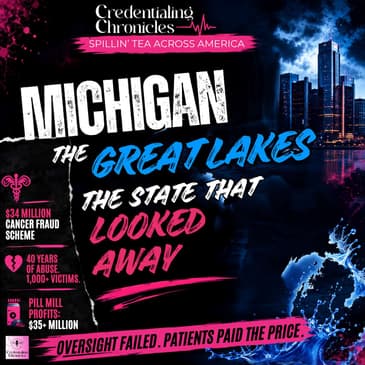
This week on Credentialing Chronicles: Spillin' Tea Across America, we're heading to Michigan—a state with a healthcare history that will leave you questioning how some of these cases were ever allowed to happen.
From one of the largest healthcare fraud schemes in American history to institutional failures that lasted for decades, and a massive opioid operation hidden behind legitimate credentials, this episode uncovers real cases that changed lives forever—and exposes the lessons healthcare can never afford to forget.
But this episode isn't just for Medical Services Professionals.
If you're a patient, parent, caregiver, healthcare worker, provider, hospital leader, compliance professional, or simply someone who trusts the healthcare system, this conversation is for you.
We'll discuss:
☑️ The real-world consequences of missed red flags
☑️ Why credentialing is so much more than checking a license
☑️ Michigan's credentialing and regulatory landscape
☑️ Recent legislative and compliance updates affecting providers
☑️ The critical role of verification, oversight, and ongoing monitoring in protecting patients
Because patient safety doesn't begin in the exam room.
It begins long before an appointment is ever scheduled.
Whether you work behind the scenes in healthcare or you're simply choosing a doctor for yourself or your family, this episode will change the way you think about trust, verification, and the people responsible for protecting the public.
🎙️ Grab your tea... because Michigan's story is one every healthcare professional—and every patient—needs to hear.
Stay credentialed... not cancelled.
Eliminate credentialing delays! Get 100% accurate, real-time license verification and monitoring.
Nimble:Surgical Revenue cycle Management
Accelerate growth. Leverage intelligent analytics. Achieve powerful financial results.
Advanced Quality Compliance & CVO
Credentialing. Contracting. Compliance. Handled. Completely. Concierge-level credentialing, payer e
MedElevate Solutions
Bridging the Gap Between Software and Clinical Reality E.L.E.V.A.T.E.™ your healthcare experience.
Disclaimer: This post contains affiliate links. If you make a purchase, I may receive a commission at no extra cost to you.
Resources Mentioned:
🔎 Verify Your Doctor’s Credentials
✔️ State-Specific Medical Board License Lookup:
Find your state’s board here:
https://www.fsmb.org/contact-a-state-medical-board/
✔️ Medicare Exclusions List (LEIE) – Check if your provider is federally excluded:
https://oig.hhs.gov/exclusions/exclusions_list.asp
✔️ Set Google Alerts on Your Doctor’s Name:
Create your own Google Alert here:
https://www.google.com/alerts
For Medical Staff Professional:
✔️ FSMB.org – Federation of State Medical Boards Physician Lookup:
https://www.fsmb.org/physician-license-lookup/
✔️ Hospital Websites:
Many hospitals have public directories listing credentialed medical staff. Look for a “Find a Doctor” or “Medical Staff Directory” page.
✔️ Set Google Alerts on Your Doctor’s Name:
Create your own Google Alert here:
https://www.google.com/alerts
Wanna know if your plastic surgeon is actually board certified?
Check for yourself right here:
👉 Verify a Plastic Surgeon
Open Payments
openpaymentsdata.cms.gov
Verify your Nurses' Credentials:
https://www.nursys.com/
🌐 Connection Zone
Stay plugged in with your peers, share resources, and nev...
[00:00:00] Welcome back to Credentialing Chronicles, where we spill the tea on the doctors you see. And we're spilling it baby all across America. Well Nyleen and Shannen sitting there talking about you while you pull up a chair. They holding it. Welcome back to Credentialing Chronicles. Hey my love Nyleen, how are you doing in this hot summer?
[00:00:27] Girl with National Heat Advisories going across all the US, we can't escape it no matter where we go. No matter where we go, but I had to bring y'all some sunshine out here today. Get us out the office medical staff professionals. I know that's right. You're so good at that. I need to work on that a little bit. I know you need to get out the office Nyleen. Okay, well I figured let's say welcome back to Credentialing Chronicles. As you know, I'm Shannen and this is my fantastic beautiful co-creator, co-host,
[00:00:56] co-everything Nyleen. Yes, I'm Shannen. I'm so excited for this episode. It's a big state we're talking about today. We are going to go to Michigan, the Great Lakes State, Motown, the Motor City. I mean there are so many accomplishments that have come out of Michigan. And on the other hand though, it's home to some of the most jaw-dropping, stomach-turning,
[00:01:22] unbelievable healthcare fraud cases in the history of the country, Nyleen. I mean, I want to start with just the fact that really set the stage for me. And that's that the Eastern District of Michigan, which covers like Detroit and the surrounding suburbs, has been one of the most active federal healthcare fraud enforcement districts in the entire United States for like over a decade.
[00:01:49] The most active federal healthcare fraud enforcement districts? I know. I wonder if they're just like picking on them, you know? Nyleen, that seems like a lot. I know. Well, let's just take a second because we've got some disclosures. Before we pour today's tea, we just want to make one thing crystal clear, guys. Crystal clear. The information that we are discussing in this episode is presented solely for educational, informational, and commentary purposes. We have not credentialed.
[00:02:19] We have not been involved in. We have not worked. I don't haven't worked in Michigan. I don't know how you haven't worked in Michigan. I worked in Michigan. Well, so we have clients in Michigan, but nope, nope, nope. We ain't doing that with these people. Yeah, exactly. So none of us or our companies are affiliated, organized, credentialed, privilege, enrolled in any of this stuff. All this information is really derived from publicly available sources, and we found it
[00:02:43] online, publicly reported, references to allegations, investigations, charges, disciplinary actions. Court docs. Yes, it's legal proceedings reflect information contained in those at the time of recording. Credentialing Chronicles does not determine guilt, innocence, liability, or professional competence of a physician or a healthcare entity. But we have an opinion. Yeah, exactly. Allegedly. Allegedly.
[00:03:13] Listeners are encouraged to review the original source materials and really conduct your own independent research if you want more information. Because as always, the receipts are definitely public. So I guess, you know, over 60 Southeast Michigan doctors, you know, have been charged or convicted of running yet another pill mill operation, right? In just a five year span alone. 60 doctors, you all, out of Michigan.
[00:03:43] And that's before we even get to the cases we're covering today, Nyleen. Goodness gracious. So today there's three stories that individually would each be like the worst thing you've ever heard about. But together, they really paint a picture of Michigan that the credentialing professionals need to understand and that we kind of like feel your pain, right? Because we do, we work so hard to make sure that we do such a great job that a lot of the
[00:04:13] things that we are finding sometimes aren't happening. Well, actually, they, majority aren't happening at hospitals. So, which is really great. So that means our hospitals are doing 100%, right? Or 99%. A lot of these things that we're finding is really where the gaps of MSPs are, which is private offices, right? Surgery centers, home health care.
[00:04:40] So it's where our MSPs are needed the most. So guys, if you're out there, if you're an MSP, please know your job is to know so much. And we are so smart. And we know all the little nuances we need to get out there and take over the world. Because when we don't, and when credentialing isn't taught to our office girls staff, anybody
[00:05:08] that has, that is not in the hospital, we get stories like this doctor, the oncologist who deliberately told healthy patients that they had cancer, put them through chemotherapy that they didn't need, girl, and build Medicare and other insurers to the tune of over $34 million. And unfortunately, he was called the most egregious fraudster in the history of the U.S. girl. I mean, honey.
[00:05:36] Tell me about it. I guess story number two is all about, you know, a doctor named Dr. Anderson. He was at the University of Michigan, honey. He's a sports physician who sexually abused patients for nearly 40 years. While the university literally looked the other way. The settlement was $490 million. And there were over a thousand victims. Story, I mean, it just goes on and on.
[00:06:02] And so when we're looking at the stories today, I mean, just take note, right? Because there's a lot of areas in credentialing that we're going to talk about. What do you think, Nyleen? Yeah, exactly. So we need to also talk about, before we get into delineating and going into the details of all of our stories today, we do have to shout out to our sponsor, Nimble. So whether you lead an ambulatory surgery center, an anesthesia group, or a surgical practice,
[00:06:32] today's reimbursement environment is way more complex than ever. Keeping up with payer requirements, coding changes, and managed care contracts, and obviously collections, takes the right expertise and the right technology. That's why organizations across the country partner with Nimble Solutions. Nimble combines experienced revenue cycle professionals, intelligent technology, analytics, really to help surgical providers strengthen financial performance, improve operational efficiency,
[00:07:00] and maximize your cash per case safely. If you're looking for a smarter approach to revenue cycle management, please visit them at nimblercm.com or visit them on the link on our website that you can look or on our show notes. They would love to hear from you. Tell them that Credentialing Chronicles sent you, baby. So expand on your story.
[00:07:23] Yeah, I wanted to talk about this story because I was trying so hard, Nailene, to get a guest for today's story because this thing with Dr. Fata, I'm just going to call him Fata. I'm not even going to call him doctor. Fata, he was just out of control for so long. And there was a whistleblower in the story that really was able to help the office manager. We just really did a big, deep dive into this.
[00:07:52] And unfortunately, because the story is a little older, it seems like a lot of people have just went incognito. They're not doing any more interviews, you know? So I'm sorry about no guest appearance, but I'm going to make it worth it, y'all. So let me tell you about the story. I want to paint the picture of, you know, Fata. Was publicly, he was trained at Memorial Sloan Kettering Cancer Center in New York. Oh, that's a fancy one.
[00:08:21] It is, honey. It's one of the most prestigious cancer institutes in the world. He built, okay, Michigan Hematology Oncology. They called it MHO. He built it, honey, into the largest private cancer practice in the state of Michigan.
[00:08:40] And at its peak, Nyleen, MHO had seven locations across Metro Detroit, Rochester Hills, Bloomfield Hills, Clarkson, Sterling Heights, Troy. I mean, honey, he was everywhere, Nyleen. It was estimated, my love, that he was treating 16,000 to 17,000 patients at these clinics. That's a lot of patients.
[00:09:08] It's for cancer in the neighborhood in one state, right? I mean, he had his own pharmacy. He had his own radiation treatment center, Nyleen. His own diagnostic testing facility. His own charity, Nyleen. He called it Swan for Life Foundation. He had an apparently amazing reputation because if you're seeing that many patients, you pretty much got the entire state of Michigan covered.
[00:09:36] Patients, I guess, yeah, had described him as like world renowned. He was known as an aggressive oncologist, though, who like pushed hard for patients to get treatment. And he kept calling it a European protocol. So, I don't know. And patients then, you know, I guess in fear for their lives were relieved to have a doctor who was willing to fight so hard for them because he was telling them and telling them,
[00:10:06] this is the protocol and this is what you need and this is what we're going to do. Right? And he made people feel like he was the one in their corner, which that's what you should do as a doctor. Yeah, yeah. Yeah. Except the problem was they didn't all have cancer. Nyleen, exactly. So, here is where Fata was actually, what he was actually doing, you guys.
[00:10:27] According to federal prosecutors and his own guilty plea from 2007 through 2013, six years, Fata deliberately diagnosed patients, you all. He told healthy people that they literally had cancer. He told people with blood disorders that they had specific cancers that they did not.
[00:10:51] He took patients who were in hospice, patients who were in the end of life care, you all, and he pulled them off a hospice to put them back on chemotherapy. That he then billed, who do you think you all, to Medicare. He administered over 9,000 medically unnecessary injections and infusions to at least 530 identified patients.
[00:11:18] And he submitted approximately 34 million in fraudulent claims to Medicare and private insurers. You know, chemo is not a benign treatment, mama, right? It's literally poison. It kills cancer cells. And, you know, I don't know if a lot of people know, but it's very destructive to healthy tissue as cells as well. I mean, everybody knows that when a person gets cancer, they usually have hair loss, nerve damage, you know, immunosystem damage. They're throwing up.
[00:11:48] I mean, we know that just without even, you know, having this. I mean, people have lost teeth, Nylee, the ability to even walk normally. One patient, an auto worker, was falsely diagnosed with a rare blood cancer and literally spent months receiving chemotherapy and radiation before Fata was arrested. That was right before. He found out he never even had cancer. Girl, you know what he told NBC News?
[00:12:17] Every day I wake up and I don't know what's going to happen to me. He said he was so much hatred towards Fata that even hearing the man's name, girl, gave him an instant headache. Oh my goodness, the families, the families going through all of this with the patients. Let me tell you a little bit about the families. Well, the family stories from the sentencing hearing really are devastating.
[00:12:39] One family, they testified anonymously, described how the doctor diagnosed their mother with advanced cancer and then kept pushing her towards this aggressive treatment at the expense of pretty much everything that she had. He told her she would die without him. He discouraged hospice, was clearly passing away. And he told her, I will not let them stop the treatments you need. And then she died.
[00:13:09] And then she just died. She died. Yes. Another patient worked in an emergency room. She went to the doctor because her white blood cell counts were low. He told her she had the fancy syndrome, myelodysplastic syndrome, and needed her to start chemotherapy immediately. And she didn't have it. Yeah.
[00:13:34] She found out when her doctor was arrested on live television and her coworkers made her come watch the news. This is the part of the story that I need every credentialing professional and every health care regulator to hear. Right, Nylee? Because in April of 2010, three years before Fata was arrested, an oncology nurse named Angela went to Fata's clinic for a job interview, Ms. Nylee. This is who I was trying to get on our show.
[00:14:04] She was a certified oncology nurse. And you know nurses, if you're a nurse, you're listening to our episode, shot us out to you because she had 19 years of experience. So she was not dumb. Okay. So she had worked at a couple of the places, a couple of the cancer centers, and she knew what proper oncology practice looked like, Nylee, right? What did she do, boo? Exactly. Well, she immediately saw that something was wrong.
[00:14:31] She saw 16 or 17 patients all in infusion chairs at the same time. And she had like a term, she would call this place like a chemo mill. Ooh, okay. And then she saw chemotherapy drugs that should be pushed through a syringe in 30 seconds being administered like through an IV bag over a full hour because, of course, you can bill more for a longer infusion time. Girl, he thought of everything.
[00:14:59] She saw a human growth factor being given immediately after chemotherapy instead of the required 24 hours later. When she mentioned it to another nurse on the staff, she was like, I don't know if that's just how they do it here. And really, that's a fundamental problem that everyone has. It's credentialing, not just nursing.
[00:15:20] I mean, when we know that something isn't being done right, you really should feel safe to speak up. Anyway, so she left the interview and filed a formal complaint. She went right to the board, the Bureau of Health Professions that same month. Like, she went right away. And she said, you've got to do something about this guy. Okay. Mm-hmm.
[00:15:49] So what happened to the complaint, Shannon? What happened after that? Well, you know, on May 13, 2011, more than a year later, honey, Angela received a form letter from the Michigan Department of Licensing and Regulatory Affairs saying that, quote, quote, violations of the public health code could not be established, that the investigation was literally closed, Eileen. The state claimed interviews had been conducted.
[00:16:17] Angela knew that no one meaningfully had followed up with her. She knew that no one called her. She never saw the details of what they did or didn't investigate because Michigan law protects the confidentiality of the licensee investigation records. And so Fata kept practicing, honey, for three more years. Nothing on the licensing board when you're going out to check in. Three more years of people receiving chemotherapy they didn't need. Got it.
[00:16:46] Nyleen, three more years, baby. It was not the state complaint that stopped him, not even, you know, looked at it. Girl, this is the other guy I was trying to get. It was an office manager named George. George at the Cretans Cancer Center. I'm shouting them out because they was doing the right protocol. They were in the Rochester Hills area and they had noticed something was off because doctors were leaving the practice. The treatment to consultation ratio was wrong.
[00:17:14] And a nurse told him, honey, that 38 out of 40 patients receiving specific immunodrugs in one week didn't qualify for it. So that office manager, honey, he went straight to the FBI. And on August 6 of 2013, federal agents arrested Fata. Wow. Kudos to that office manager and that nurse. Yes. You know, and so do y'all want to know, you want to know what he pled to?
[00:17:44] In, in September of 2014, the doctor pleaded guilty to 13 counts of healthcare fraud, one count conspiracy to pay and receive kickbacks and two counts of money laundering. What? Yes. Yes. The kickbacks were specifically for referring patients to a guardian angel hospice and a guardian angel home healthcare. He was getting paid to actually send dying patients there.
[00:18:14] Prosecutors sought 175 years. The defense sought 25 years. On July 10th of 2015, the U.S. district judge sentenced the doctor to 45 years in federal prison. That's it. Yep. Yep. He was ordered to forfeit $17.6 million and ordered to pay restitution. Cause you got to pay Medicare back if you, if they find that you had fraud. Yeah. Yeah. Well, that and the other payers too, you have to pay them back.
[00:18:44] Uh, yeah, you're right. The U.S. attorney actually called him like the most egregious fraudster in the history of the country. Now, obviously we know that he's not cause there's a lot of other fraud happening, but it just makes me sad because we trust our doctors and we love our good doctors and they work so hard and our credentialing experts work so hard. Our healthcare professionals work so hard that it's not fair to the people who are doing it right. Yeah. Yeah.
[00:19:13] Her exact words and Eileen were that, that Fata did not care for patients, that he exploited them as commodities, honey. And prosecutors wrote in their literal sentence memo that in many ways he was worse than Bernie Madoff because Madoff damaged his victims bank accounts, but Fata damaged their bodies. And at sentencing Fata wept you all.
[00:19:38] He said, I just can't even believe it as we're like quoting it. I misused my talents and permitted this sin to enter me because of power and greed. I'll let the audience decide how much weight to give all of that apology. Oh my goodness. So, all right, well we're credentialing professionals. What does this mean for us?
[00:20:03] I mean, the first thing it means, I guess, is when a nurse files a detailed specific clinical complier report about a provider. I guess, you know, maybe board should really listen to her. I mean, it says that she literally detailed specific administrative protocol, specific violation. She said the complaint like deserved a real investigation, not a form letter.
[00:20:26] A nurse with 19 years of oncology experience who had worked at top cancer centers who described in specific clinical language what she observed. That is a high credibility complaint. And the response that she got from Michigan's Laura was not proportionate to the seriousness of what she had reported. Right. And that's a gap in the system. And again, we don't want to just call out Michigan, right? And maybe this is going to fall out.
[00:20:54] But most state boards are just under-resourced. So, maybe it's because the funding isn't going because there's all these continuous health care cuts. And the result of that is not providing the appropriate oversight. Yeah, definitely. And when we think about, you know, the privileging and the doctor death case out of Texas, this is the case that they think about out of Michigan. You know, drastically under-resourced. And here's the credentialing specific angle, right?
[00:21:24] Fata was credentialed with health plans, Nylee. He was credentialed at hospitals, mama. He had credentialing hospital privileges. And at the practice level, someone should have been looking at the treatments to consultation ratio.
[00:21:37] When a practice is purchasing $45 million worth of drugs annually for a staff of three doctors, when the medium oncologist spends around $1.5 and $1.9 million on drugs annually, that is a data anonymously that should have triggered a review somewhere. Health plans that are doing utilization management, peer review, and quality oversight should have caught a pattern like that. Did any of them flag it?
[00:22:07] That question has never been fully answered public. And that's one of the things that we talk about all the time. These fraud and cases that keep coming up have a pattern. Right. So the lesson is credentialing isn't just about a license or whether or not they went to medical school. It really is about this ongoing monitoring of patterns. Every time you say it. I mean, credentialing opens the door, which is what we will say forever. I mean, we are just, you know, over and over. Quality and utilization data tells you what the provider is doing.
[00:22:36] Once they're through that door. Both matter. And if your credentialing committee is not in communication with your quality and utilization teams, this case is exactly why that integration, you guys, needs to happen very soon in your facility. Exactly. So let's move on to story number two because we're running short on time here. I, Nyleen, it's just so, has so many layers of lessons, mama. I know. I know. So we told them about this other doctor.
[00:23:03] Well, what can you tell me about this other doctor out of the University of Michigan? Well, story two takes place in Ann Harbor, beautiful little town to the University of Michigan. One of the most prestigious universities in the world. And to a physician named Dr. Anderson, who served the university from 1966 to 2003, 37 years, Nyleen. He was the head of university health services and started in 1968.
[00:23:31] The team physician for the University of Michigan athletic department. He was responsible for the medical care of the student athletes, the football players, the wrestlers, the swimmers, all of them, right? He had a medical degree from the University of Michigan. So this was where his alma mater, he was there. He was the most prestigious employer in, he had the most prestigious employer in the state, sorry. But he was a predator from basically day one.
[00:24:01] I mean, wow. So the independent investigation conducted by this law firm, commissioned by the university, concluded that this doctor's sexual misconduct began almost immediately after he joined the university back in 1966. And then continued until his retirement in 2003. That's nearly four decades.
[00:24:27] Attorneys for the victims say this might be the largest case of sexual abuse. By a single individual, okay? Potentially surpassing even this Larry Nassar at Michigan State, whose $500 million settlement in 2018 involved more than 500 women. That was the gymnast, yeah. So how many victims are we talking about here, Shannon? Oh, Nyleen.
[00:24:55] The University of Michigan agreed to pay $490 million in settlement, Nyleen, in 2022. With 1,050 identified victims. Over 1,000 people. Anderson died in 2008, Nyleen. So there was never like a criminal prosecution for this. But the consultant report that you were talking about is 240 pages. And it is thorough.
[00:25:24] And it is so damaging, Nyleen. Wow. Okay. So let's just go down a little bit. Tell them the team. We're out here investigating the team for you. We're going to let you know. Listen. So let me tell you what happened. So the university received some reports that this misconduct was happening, right? So like 70s, somebody starts opening their mouth, right? It's been a typo. It was like 1978, right?
[00:25:51] Then the then assistant vice president of student services received reports and later claimed that he conducted, you know, he confronted the doctor and fired him. But he didn't actually fire him. Instead, he let him stay there. And then in 1981, the doctor was transferred from the university health to then the athletic department.
[00:26:16] So he was just moved from like one unit to another where there was like less oversight. And then that's how the abuse continued. So they just transferred him instead of terminating him. They moved the problem. And the university kept moving it over the course of Anderson's 37-year career. More than two dozen University of Michigan employees were alerted to reports of his sexually inappropriate behavior.
[00:26:45] Coaches heard about it. Athletic staff heard about it. Even legendary football coach Bob heard about it. Multiple people have stated. Of course, because people talk. I know. I don't even know. And he is legendary. Okay. The players talked about it. I mean, it's like he knew about it. His own son later said that Anderson had abused him. And Anderson kept getting recredentialed through all of this. I don't understand it, Eileen.
[00:27:15] Make it make sense, mom. I know. Well, the thing is, is what made me stop and really think about it was in 1995, a woman filed a lawsuit against the doctor after feeling violated during a medical exam for employment. So he was not only athletic, but he was doing like the exam when people come in. So, of course, that lawsuit became public record.
[00:27:37] And then according to this report that this company did, in the report's own words, Dr. Anderson himself disclosed that lawsuit on an application for Michigan Medicine credentials in 1996. What? So he did self-disclose that he had this lawsuit. It was right there on his credentialing application. Yeah.
[00:28:04] He disclosed the lawsuit about inappropriate conduct. I'm just saying. Red flag. Right? We're talking about red flags. The application was processed. His credentials were renewed. He continued practicing until his voluntary retirement in 2003.
[00:28:20] I mean, the consul report specifically recommended that after this investigation, Michigan Medicine should, quote, literally, ensure that self-disclosures matters receive appropriate attention and inquiry. That recommendation exists because it clearly wasn't happening before. And that's something that, as credentialing professionals, we're always asking providers. Please explain this yes answer. Right? Mm-hmm.
[00:28:48] So the credentialing file had a red flag. And I'm sorry, but I'm just going to say it wasn't the credentialing. It was the doctors that were reviewing the file that just accepted it anyway because I'm not blaming my MSP. I'm not blaming it either. I mean, all I know is nobody acted on it. And this is not me speculating. This is in a 240-page independent investigation report commissioned and released by the University of Michigan.
[00:29:15] The system that is supposed to catch these things had the information. The law school disclosure was on the application, and it went nowhere. There was no follow-up to that. So then what did that $490 million settlement cover? Well, again, like we talked about, it covered 1,050 victims. They will share in that settlement. The average payment is over $438,000 per victim. And through individual amounts varies based on circumstances.
[00:29:44] The university's own investigation described Anderson's misconduct as occurring in his exam rooms at the University Health Services Center and in training rooms at the athletic department facilities and in treatment rooms at the Michigan Medicine. So men and women, students of different racial backgrounds and undergraduate and graduate students, student athletes and medical students. He was responsible for teaching. He had access literally, Nyleen, to all of them. Wow.
[00:30:14] He had even received a medical newsletter feature in the VA practitioner. Like, he was like a model physician. He received public recognition throughout his career. The credentials were clean. The institutional reputation was sterling. And not one review? I mean, not one privilege renewal? Not one credentialing committee ever questioned what he was doing? Never followed up? Nobody received any other complaints? I don't know.
[00:30:41] So what are we telling credentialing professionals to take away from this? Well, I guess several things, right? I mean, first, self-disclosure questions on credentialing applications, as we all know, are not formalities. I think when a provider discloses an actual legal action, a complaint or a disciplinary inquiry onto their application, that disclosure must trigger some type of real review. Not a file and move on. Not a, you know, just look at it. No, an actual review, you all. Appropriate attention and inquiry.
[00:31:11] And, again, that's what the language on the consult report, and it has to truly be built in the process of your organization. I mean, this is something that should be part of your bylaws and your credentialing manual. Right. And then, secondly, you know, institutional reputation is not a credentialing credential. The university is one of the most prestigious institutions.
[00:31:33] And being employed there, being able to practice there, you know, none of that is a substitute for an actual investigation if there's a complaint about the patient. The prestigiousness of an institution can create an idea of, like, a halo effect. Like, there's nothing really going on. So, oh. All the time, Nyleen. We see that all the time. Yep. Absolutely. And, I mean, third, you know, this one is the systematic, right?
[00:32:02] I mean, we talk about this. The transfer instead of the termination, instead of the investigation. When an institute transfers a provider with a complaint history to a different department, rather than investigating and literally resolving the complaint, they are not protecting patients anymore. They are protecting themselves. And, really, truly, it's only a temporary protection, right? While creating downstream liability and literally continuing harm to patients.
[00:32:29] So, if a hospital health plan or credentialing body discovers that a provider has transferred rather than investigated, that needs to be a red flag and somebody needs to be speaking up in the credentialing review. Ask the hard questions. Why are they being moved? It's okay to ask that if you are on a credentialing committee board. That is very, very interesting. Okay, Shannon. Well, that story was really, really heavy.
[00:32:55] So, how about we move to something like a little bit of legislation before we close out? Sure. You know, take me there, Nyleen. Take me. I'm always ready. Because we can talk about all these crazy stories. But, you know, let's just shift a little bit. Let's shift a little bit. Let's start with Lara. Okay. And, when you, like, go online and you search Michigan, you have that little symbol and it has Lara on it. Because that name does come up constantly.
[00:33:25] So, Lara, which is the Michigan Department of Licensing and Regulatory Affairs, is the state agency that licenses and disciplines healthcare professionals in Michigan. They regulate 26 health professions under the Michigan Public Health Code. That includes the Board of Medicine, Board of Nursing, Board of Osteopathic Medicine, Social Work. I mean, a lot. So, if you are credentialing a Michigan provider, Lara is your primary source. She's your friend. I hope it's on bookmark in your crow, right?
[00:33:55] Of course it is. Why wouldn't it be? And they publish disciplinary action, right? Michigan law specifically, MCL333.16241 requires that Lara... Not to get into the digits. Not to get into the digits. I said, let me be specific in case anybody wants to fact check us, baby. So, it requires Lara to publish a list of disciplined individuals after administrative discipline actions is final.
[00:34:25] It also requires the department to report disciplinary actions to the Department of Community Health and to the Department of Insurance and Financial Services, state and federal healthcare program agencies, and appropriate professional associations. So, disciplinary information is supposed to flow through the state of Michigan. The question, as we saw with the FATA case, is the speed, is the rigor of the investigation, Eileen? I mean, how fast is it happening, right? Yeah.
[00:34:55] Sounds like a pretty big, massive entity. So, you've got to have a lot of... I get the purpose of the law. It's just, is it working? Right. Okay. So, tell you about CHAMPS. I know our listeners who do Medicaid work in Michigan deal with it constantly. CHAMPS, which is the Community Health Automated Medicaid Processing System. It's Michigan's Medicaid enrollment claims and prior authorization platform.
[00:35:20] If you are enrolling a provider with, like, MassHealth or whatever, Michigan Medicaid, you go through CHAMPS. And there are some Michigan-specific things that credentialing professionals really need to know. So, first of all, the CHAMPS enrollment baseline is 60 to 90 days. That is a little bit longer than some other states, but I'd say about 60. Yeah, but I'd say 60 is pretty... I don't know. That's my experience.
[00:35:50] But anyway. Second, there is now a 35 update rule, meaning if your provider's information in CHAMPS is not updated within 35 days of the change, you can face claim denials. And then third, the federal application fee for 2026 is $750 per service location. If you have multi-site practices, that can add up. Oh, they say you're going to pay.
[00:36:18] And post-payment audits, you guys, are intensifying. I mean, I hear Nyleen. MDHHS issued a reminder January 2026 that all Medicaid reimbursed services are subject to review for conformity with acceptable medical practice, you all. Post-payment audits are actively escalating. And if you are a credentialing professional at a Medicaid-participating Michigan organization, heed our warning.
[00:36:48] Your documentation game has had to be airtight, y'all, because the auditors are coming. Right? I mean, really. Nyleen, my regulation queen, tell me. What changes and recently, you know, what do our audiences need to know? Tell me, tell me. Well, a few things that are relevant, right? And 2024, Michigan extended physician assistant license renewals to a three-year cycle. Up to two years. Nice, nice. Nice.
[00:37:14] PA licenses and controlled substance licenses now both renew on the three-year cycle and expire concurrently. If you're doing recredentialing on a PA and your system is still set for the two-year verification cycle, then you would need to adjust for that. The license timeline changed also. That's kind of a compliance trap waiting to catch people. So I say continuous query every month. Make sure your licenses are checked. That is best practice.
[00:37:43] Just saying. And our sponsor, Baton Health, don't play with them over there, baby. Because if you get their system, you can literally upload your providers to that system and it can keep monitoring. It can check all the states. Yes, you get an alert. Every time there's a change, every time something happens, you will get an alert. You will get a report. So visit BatonHealth.com.
[00:38:08] And let them know that Credentialing Chronicles sent you, baby, the pink ladies. And tell them that you need your doctors monitored, not just for the state that they're in, but for any state that they might actually be actively practicing. It's important to monitor all states. That is correct. Best practice. So I guess for credentialing committees that verify board exam history on initial credentialing, understand that the Michigan rules around DO exam attempts changed, right, this year.
[00:38:39] So, you know, that took effect, I guess, around May of 2025. Among the changes, the maximum number of the complex USA exam attempts per level were reduced from four to six. So you just can't keep on trying. From six to four, you mean? Yeah, four to six to four. Sorry, sorry. And then the seven-year completion required for all licenses exam levels was eliminated, y'all.
[00:39:05] So there's something that's also happened with behavior health. Oh, that's important. Right. So beginning in 2025, October, Michigan Medicaid now requires qualified mental health providers serving children under 21 to use. It's called MichiCans, which is super cute, MichiCans Screener and Locus for Adults. Plans can verify certification in these tools as part of their network participation standards.
[00:39:36] So if you're a health plan credentialing behavioral health providers for your Michigan Medicaid network, this is a new element that you may need to incorporate in your processes. It is definitely true. And the self-reporting requirements, because the Fatha case and the Anderson case both had reporting failures, Michigan law requires a provider to self-report to their employer and to each hospital where they have had privileges within 10 days, y'all, of a final disciplinary order. Okay.
[00:40:04] So that means a conviction might be self-reported to Laura within 30 days. And Michigan's health code, um, 333-16241 requires that when a license is revoked or suspended, the provider must notify every patient they saw in the preceding 120 days within 30 days of that order.
[00:40:27] Honey, that notification requirement exists specifically to protect patients and organizations receiving those notifications, hospitals, health plans, those trigger immediate credentialing review obligations. So don't let those notifications sit in anybody's inbox. So Michigan, good job. Y'all are doing a really good job. I really feel like Michigan is trying to be for the patient baby. Mm-hmm. Mm-hmm.
[00:40:55] Well, Nylee, tell us, how are we at Credentialing Chronicles for the patient? We know we love our patients. But your healthcare is way too important to leave it to assumptions. Before you choose a provider, you take a few minutes to do your homework. Verify their license. Verify their board certification. Review any public disciplinary actions, you know. Ask questions about your treatment plan. And if something doesn't make sense, just ask again. A good provider always, always welcomes informed patients.
[00:41:23] Yeah, I mean, we have to remember over and over, trust is earned, you guys. You don't just look at somebody and say, boom, I trust you. Don't do it, okay? Because verifications are free. And you are your own best advocate. You are your own best advocate. Providers, let's talk about it. Your license gets you through the door, baby. But your integrity keeps you there. Practice within your training. I mean, document honestly.
[00:41:51] Respond truthfully during credentialing and recredentialing. I mean, one of the biggest things, report changes when and where they're required. And protect your reputation by protecting your patients. Protecting your patients will be the best thing that you ever did. And it will be part of your legacy as a doctor. Mm-hmm. And so to our MSPs, y'all know we love you. Y'all know credentialing is in paperwork. We love what we do. We love to investigate. And we love to keep patients safe.
[00:42:20] We want to make sure that we query every time that we, everything that we need to query. Meaning, every verification matters. Every MPDB query check matters. Every sanction check matters, right? Every reference. And then, of course, every red flag. But Shannon, before we close out the episode, I just want to take a minute to highlight our other sponsor. Now, we love HST Pathways. And so let me tell you a little bit about HST.
[00:42:46] So HST is actually a EHR and practice management system focused on surgery centers. Now, they've got a lot of really cool bells and whistles. And girl, they've even got this thing called forecasting. And at a surgery center, they can look at what your week is expected revenue. So we need that at surgery centers. That sounds amazing. HST for the win, baby. Yes.
[00:43:14] So if y'all are looking for an amazing EHR platform for your surgery centers. Now, there's a lot of other little bells and whistles that they have. If you have any questions, please visit our show notes and go to our website. Click on the link and go to their website and find out. If y'all have any other questions, please feel free to DM me and I'll answer anything that you need to know. But we want to thank HST for their sponsorship. And we want to make sure that we give them their time here with us at Credentialing Chronicles.
[00:43:43] So Shannon, close it out for Michigan. Today, y'all, we poured every drop. If this episode hit different for you, share it, please. That helps us so much. Send it to your credentialing colleagues. Send it to your quality team. Send it to your compliance director. And if you have a story from your state that belongs on this podcast, reach out to us, baby. We love to hear from you. We want to hear from you. But our biggest thing we say is what? Stay credentialed. Not canceled, guys. Till next time.
[00:44:14] Woo, Shannon, that was a lot of tea. Honey, but have they subscribed yet to hear it next week? On all of these platforms, please subscribe, like, and follow us.