
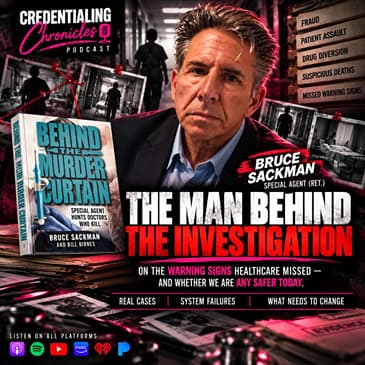
What happens when the person trusted to heal the patient… is the person harming them?
This week on Credentialing Chronicles, Shannen Aguayo-Reyes and Nyleen Flores sit down with Bruce Sackman, renowned healthcare fraud investigator, author, and former Special Agent in Charge with the U.S. Department of Veterans Affairs Office of Inspector General.
For more than three decades, Bruce stepped into healthcare environments after something had gone terribly wrong—investigating fraud, corruption, false claims, theft, patient assault, drug diversion, suspicious hospital deaths, and some of the most disturbing cases involving medical professionals.
But this conversation isn't just about the cases.
It's about the warning signs before the investigation ever begins.
Bruce takes us behind the investigation: what his instincts noticed before the evidence caught up, the case that permanently changed the way he viewed healthcare, the responsibility investigators carry long after a case closes, and what the public may never fully understand about investigating someone entrusted with patients' lives.
And we ask the question healthcare can't afford to ignore:
Have we actually gotten better at recognizing dangerous providers—or have technology, fragmented systems, staffing pressures, and endless box-checking simply created new places for the warning signs to hide?
This is more than true crime. It's healthcare. It's patient safety. And it's a conversation every medical staff professional, healthcare leader, provider—and patient—needs to hear.
🎙️ Credentialing Chronicles
Stay credentialed, not cancelled.
CredNet is the AI-native credentialing and payer enrollment platform built for credentialing service
Baton Health: Universal PSV in Seconds
Eliminate credentialing delays! Get 100% accurate, real-time license verification and monitoring.
HST Pathways
One Complete Solution for Your Surgery Center’s Success From scheduling to billing, manage your ent
Disclaimer: This post contains affiliate links. If you make a purchase, I may receive a commission at no extra cost to you.
Resources Mentioned:
🔎 Verify Your Doctor’s Credentials
✔️ State-Specific Medical Board License Lookup:
Find your state’s board here:
https://www.fsmb.org/contact-a-state-medical-board/
✔️ Medicare Exclusions List (LEIE) – Check if your provider is federally excluded:
https://oig.hhs.gov/exclusions/exclusions_list.asp
✔️ Set Google Alerts on Your Doctor’s Name:
Create your own Google Alert here:
https://www.google.com/alerts
For Medical Staff Professional:
✔️ FSMB.org – Federation of State Medical Boards Physician Lookup:
https://www.fsmb.org/physician-license-lookup/
✔️ Hospital Websites:
Many hospitals have public directories listing credentialed medical staff. Look for a “Find a Doctor” or “Medical Staff Directory” page.
✔️ Set Google Alerts on Your Doctor’s Name:
Create your own Google Alert here:
https://www.google.com/alerts
Wanna know if your plastic surgeon is actually board certified?
Check for yourself right here:
👉 Verify a Plastic Surgeon
Open Payments
openpaymentsdata.cms.gov
Verify your Nurses' Credentials:
https://www.nursys.com/
🌐 Connection Zone
Stay plugged in with your peers, share resources, and nev...
[00:00:00] Welcome back to Credentialing Chronicles, where we spill the tea on the doctors you see. And we're spilling it baby all across America. Welcome back to Credentialing Chronicles. As you can see me and Nyleen are still together. We're together.
[00:00:27] But we are so excited about who we have today because today's guest has spent a career you all investigating what happens when the system literally is designed to protect patients, fails to really recognize what is happening right in the OR, the hospital, the clinic, right in front of them. Right?
[00:00:49] Yeah, absolutely. So Bruce Sackman is here today as most of you on MSPs know who he is. Follow him on LinkedIn. He's a former special agent in charge with the U.S. Department of Veterans Affairs Office of the Institute. We're so excited. Uh, where his career included investigations involving health care fraud, corruption, false claims, Tell them girl.
[00:01:17] Theft, patient assault, drug diversion. Bruce, everything. Everything. Bruce is full of the tea. He's full of it. So you know we had to have him on. Yes, of course. We need to share some stories with you, our listeners. Every state has a different story, but one thing doesn't change. Health care organizations across the country are facing increasing pressure to navigate a more complex reimbursement landscape.
[00:01:47] Whether it's evolving payer policies, managed care challenges, staffing shortages, or just the need to improve your overall financial performance. Today's surgical providers are being asked to do more than ever before. In order for you to get some practical assistance, please visit nimble rcm.com and let them know credentialing chronicles saying. What makes today's episode and conversation. We're excited. Yeah. Yeah. Yeah.
[00:02:14] Especially important for us credentialing chronicles is that Bruce's work takes us far beyond the individual investigation. I mean, when you're thinking about really bringing an insider in, I mean, this is who you want. And so we just want to say, Bruce, thank you so much for being on with us today and welcome. Well, it's absolutely my pleasure.
[00:02:41] And as we were talking before, I do periodically listen to you ladies. I think you do a fantastic job in educating the public as well as members of your profession to what's going on. And I love the way you do it because you do it with humor, but also very serious at the same time. So we can't lose our sense of humor, even when some of these stories are so horrific and so terrible. You know, so that's what I really appreciate what you do.
[00:03:10] And I really appreciate what the people in your profession do. You know, because sometimes they think, oh, I'm just moving this piece of paper and checking this off. No, no, no, no. You are actually saving lives. You are saving lives in your job. And it is so important. And don't let anybody ever put you down for what you do, because your work is just as important as anyone else in the hospital. Maybe even more important to some extent.
[00:03:40] I know. And I'm so happy that you say that, because really, it forces us to ask what health care organizations knew, what they didn't know. I mean, and why sometimes no one really connects the dots, right? Yeah. And, you know, it's always management sets the tone. And you can have the management that is very, very concerned about the integrity of all their programs. And you could tell from day one.
[00:04:08] But I've also, unfortunately, interacted with some management that they really couldn't care. It was all the bottom line. It was all the dollar. It was all the revenue. But in the long run, those are the ones that got hurt the most. It took a time, and it usually took some kind of tragedy, unfortunately. But in the long run, it's those that poo-pooed the compliance and those that set aside the work who did really suffered in the end. Right.
[00:04:38] I'm just telling y'all, Bruce is bringing us the tea. Okay. Are you ready? And you know why I'm so excited? Because did you know that Bruce is also the co-author of Behind the Murder Curve? Y'all know I'm the murder girl. She is the murder mystery. Which chronicles, and your book, right, chronicles investigations involving, like, healthcare professionals. Who, like, deliberately harmed. And Bruce, feel free to talk a little bit about your book. Yeah, tell us. I mean, it's incredible that you... Why do we all need to read it?
[00:05:07] Why should MSPs everywhere read it? Because, right? Well, you know what? When I first started with the Inspector General or the VA, I had done every kind of case in a hospital you could imagine. And people sometimes forget that hospitals are like small cities. And they have a lot of potential for wrongdoing. That's true, yeah.
[00:05:29] Of course, the overwhelming majority of healthcare professionals are the most honest, hardworking, dedicated people I have ever met. In fact, the way I catch the bad guys is from the honest, hardworking, dedicated people that would tell me about them. Without them, I would sit in my office, you know, like a Maytag repairman, and the phone would never ring. What?
[00:05:56] It would ring because of the hardworking, dedicated people who used to call me up and say, Hey, you know, Bruce, I've been working on this job for a long time, and something just doesn't feel right. Something doesn't look right. I'm not sure what it is, but something's not right. And in my experience of over 50 years of doing this, the overwhelming majority of these people were correct. Something wasn't right.
[00:06:24] And I think the best skill that I brought to the job was the ability to sit down with people like yourself and kind of incorporate you onto my team. So I would say to you, teach me. Teach me what I need to know. Show me what I need to know. I don't know your job. And together, I would sit down with a whistleblower or just a concerned employee, and they would take me by the hand.
[00:06:53] And sometimes I'd spend days just learning what they did and incorporate them on my team. And then they would feel good. They would feel that they were doing the right thing. It was so important to these people. Yeah, that actually listen to the gut, right? Because that's what it was. It's the gut, you know? And I mean, you know, Bruce, we're not talking about doctors or PAs or nurse practitioners or whatever, you know, providers
[00:07:21] that had, you know, little infarctions. I mean, you looked up medical serial killers, right? I mean, you are passionate about that area, correct? You know, it's something I never planned on being involved with because, you know, I'm sitting in my office and I'm doing all my otherwise routine cases. There were thefts, you know, there were drug diversion cases.
[00:07:46] There were people going into medical records they shouldn't be going into. You know, the whole smorgasbord, if you will, of cases that could happen in a hospital. Then all of a sudden, one day, I get a call from the chief of psychiatry at the Northport VA out on Long Island. Oh, tell us what happened. Tell us.
[00:08:07] And she says, hey, Bruce, you're not going to believe this, but there's a doctor working here who actually spent time in prison for poisoning his coworkers. And I look at the phone. I look at my calendar. What is this, April 1st? Like some kind of April 4th day or something. How could somebody pass a government background investigation and become a doctor treating our nation's heroes?
[00:08:34] And that's exactly what happened. His name was Michael Swango. Thank God he's in Supermax Federal Penitentiary now, and he has no opportunity to get out whatsoever. Can maybe we get an interview with him, you think? I mean, maybe we can do an interview. Oh, yeah, yeah, yeah. I'll tell you the story. So I start doing some research, and I see, yeah, this guy was in prison for poisoning people.
[00:09:01] But he got out, and he somehow convinced people that he wasn't in jail for poisoning people, that he got in a barroom brawl. But the governor of the state had waived all crimes against him and restored his civil rights. He has a piece of paper. And nobody questioned that piece of paper. And the next thing you know, he's working at the VA. So I go to talk to him.
[00:09:32] And I'll tell you something. This guy was one of the most handsome, charming men you'd ever meet. It's the same situation as, right? It's the same charm that Dr. Death used, of course. You know. You know what? If my daughter had brought him home and said, hey, Dad, here's my new boyfriend. He's the doctor at the VA. I'd say, welcome to the family. When's the wedding? You know? I mean, this guy.
[00:10:02] And so I started to ask him about it. And he gives me this story, the barroom brawl story, the whole bit. And then the next thing you know, he's gone. And he goes to Africa. And in Africa, he kills women and children and pregnant women. No. Oh, yeah. And I had no evidence at all that he had murdered anybody at the VA. Now, like I said, I had never done a case like this before.
[00:10:32] I had done every other hospital case you could think of. Research fraud. I mean, I could go on and on with the list. But I had never done anything like this. So what happened was my boss said, hey, don't worry, Bruce. He says, I'm going to hook you up with somebody. And he hooks me up with Dr. Michael Bodden. Have you ever heard of him, the medical examiner? He used to have a show on TV called Autopsy. I don't know if you remember. He was like, you know, he did all the movie stars and everything.
[00:11:02] So I said, hey, look, Doc, here's the situation. What do we do? And he says, this is what we're going to do. We're going to assemble a team. And part of that team is going to be doctors who are expert in chart reviews. So they can take a look at a chart and they can determine whether, in their opinion, the patient should have expired when he did. Then we have to get a toxicologist, right, to find out. And around what year was this? This was back in the 90s, 1990s.
[00:11:32] 1990-something, all right? And then this is where the hospital people came in. He says, then we're going to put together a team of, which was relatively new at that time, forensic nurses. And these are nurses that are trained in both forensic science, right, and nursing science. They were phenomenal. You know, between me and you, they were actually even better than the doctors.
[00:12:01] Between me and you, the doctors that were amazing. They were amazing. They were amazing. They know what to look for. Yeah. Yes. And you know what? Because they understand not only the science, but the politics of the hospital. Where all the records are. What do you need to get records? You know, look, most cops didn't become cops because we're good in chemistry and biology, all right?
[00:12:29] So we're very, very dependent on you folks to kind of teach us. And most cops, I can tell you this, do not want to do an investigation in a hospital. They have plenty of other work. And the last place they want to go is in a hospital. They say, you know what? I don't really understand the science. And what's this HIPAA thing? You know, this health insurance, accountability, accountability. What's peer review? Yeah. And do I need a court order?
[00:12:59] Does a judge have to sign it? Are there some records I could get, some records I can't get? I don't understand the science. I don't understand the law. I don't know where the records are. Let the hospital do their own little internal investigation and get back to us because we don't really want to go in the hospital. And that's true throughout the world, by the way. Yeah. Oh, my goodness. Makes sense. All right. So we put together this team.
[00:13:23] And then the next thing we know, because all these victims had been buried, well, we would have to go to the cemetery and exhume the bodies. That's something I had never, ever, ever done before. But first we had to go to the families and say to the families. Oh, my God. Yeah. And the amount of money, I mean, to exhume a body, I can imagine it's not cheap. The red tape. This is the federal government. So, you know. Oh, yeah.
[00:13:52] So money wasn't an issue. Yeah. You know, for a local police department, everything's an issue with money. But for the federal government now, a million, billion. What the hell does it make? So we went to the families and we'd have to say, like, you know, I'm like, excuse me, sir. You know, my name is Bruce Sackman and I'm with the VA. And we have reason to believe that your father's death was of a suspicious nature.
[00:14:19] Could we have permission to go to the cemetery and pull up his body? I mean, could you imagine getting a visit like that? Right. Well, the families were terrific. They were terrific. You know, sometimes they actually wanted to go to the cemetery and watch and see us do this. And, you know, my agents would bring flowers and we'd be super respectful. And the next thing you know, I found myself at the Suffolk County Medical Examiner's Office.
[00:14:49] I had never done anything like that before. And, you know, they're cutting the bodies open and they're taking out the body's parts and they're measuring this and they're checking that. And it's a cultural experience if you've never done anything like that before. Some people can't handle it. They just can't handle it. I was able to handle it. I was okay with that. And then came a question about, well, what's the murder weapon? All right.
[00:15:18] I mean, what's the cause of death here? And that came down to the toxicology. And we had asked the FBI to run the test. They didn't want to run the test. No. No. But they had a similar case that didn't work out well for them. So they didn't want to get embalmed. Okay. They didn't want to get embalmed. We had to go to a private lab called National Medical Services in Pennsylvania. And I said, listen, are you going to be able to find these poisons and embalmed tissue?
[00:15:47] After all this time? And they said, yes, Bruce, don't worry. We have this brand new machine. You do? What is it? Yeah, it's called the High Performance Liquid Chromatography Tandem Mass Spectrometer. What? That requires its own. And I'm impressed you remember it. Dictionary. Holy cow. I said, how does it work? Ah, you wouldn't understand, Bruce. Eee, that's the science. You know, it's sort of like Willy Wonka.
[00:16:16] You put a little sample in and it goes around. Yeah, yeah, yeah. Bing, comes out. First thing. So you guys found that it all was that, right? I mean, it came out. Wow. Were you shocked? What are you feeling like at this point? It's very interesting. For some reason, it didn't really, it really didn't have any emotional effect on me. I'll tell you when the emotion comes in. I'll tell you when the emotion comes in.
[00:16:42] So we determined that he used succinylcholine. You know what? Succinylcholine is a drug. You know what that is? Because you're in the medical. Yeah. If they want to intubate you with paratechopel. Yeah. You know that because you have a surgery. Yeah, yeah. And they used epinephrine, adrenaline epinephrine. And that's, so Swango, by the way, if you're wondering what happened to him all this time. So he's in Africa. He comes back from Africa and then we arrest him.
[00:17:09] But not for murder because we didn't have any evidence that he murdered anybody. We arrested him for every federal agent's favorite crime, lying to the government. He lied to me. Right. Conspiracy? What is that called? Conspiracy? No, no, no. This is false statements. False statements to the government. So he lied to me. And because he lied to me as a federal agent, he got sentenced to three years in jail.
[00:17:37] So you have three years to finish the rest of the investigation. This is what I used to tell my kids. I used to say, if you lie to me, you know, you could go to jail for three years. Hey! It didn't work. It didn't work. Come tell my kids that too, Bruce. It didn't work. I tried. So you were able to separate that. You clearly said that you were able to not necessarily carry the cases home.
[00:18:01] But what did it cost you to become the person capable of seeing things other people did not want to believe were actually happening? Yeah. And the follow-up it took. I have to go back a little bit because when this thing first surfaced, the management of the hospital was not very eager to help us on this thing. I could imagine. And they never are?
[00:18:28] They never are because they're concerned about the reputation of the hospital. They don't want people to drive by the hospital and say, you see that hospital? That's where that serial killer is. I would never go to that hospital. So they're very, very concerned about that. So it's not like they obstructed, but they didn't really help. And I've seen a lot worse on other cases where they actually did pretty much obstruct. But not in this case. They just kind of took a hands-off approach.
[00:19:00] Now, so, you know, we arrest him and he pleads guilty to make a long story short. But this is where the emotion comes in. Because in the federal government, you know, we have the death penalty. Some states do not have the death penalty. I think in order to avoid the death penalty, he pled guilty. Also, to avoid being extradited back to Zimbabwe, where they were ready to try him.
[00:19:29] And that would have been a whole different situation. So he pled guilty. Now, at the sentencing, I don't know if you've ever been to a sentencing. This is where the family gets up and has an opportunity to talk about the victim. You know, usually they're dead. And this is where it gets emotional. Because this is where you take all the science, all the statistics, all the investigation, and just put it aside. And the whole human element comes in here.
[00:20:00] And this is where the children and the wives get up. And they say they talk about dad and his time in service and all he did for the community, only to be murdered at a VA hospital. And that is very, very emotional. Not for Swango, though. Not for the killer. He just sat there. And I've seen this on numerous occasions and numerous trials I attended.
[00:20:28] No emotion whatsoever. No emotion? No emotion whatsoever. Really? So that's like a... Wasn't that what's... The narcissist? No. The psychopath. Psychopath. Oh, yeah. Oh, yeah. Definitely. You know, so that case was successful. And it really wasn't until the families got up and spoke did, like, the whole emotional side kind of hit me like a ton of bricks. Like the human portion of it.
[00:20:58] This is when it all just kind of dumped on me. You know, when the... And I'm saying to myself, you know, listen, I can't really think about it at all during the investigation. But now that it's over, there's a whole human side. You know, we talk about medical serial killers. They kill 30 people, 100 people, 100 people. These are human beings. These are families. They have wives and children. And all these stories are compounded.
[00:21:26] But the only way I can really get through it is to kind of block that out. In a little box, yeah. You know, but eventually I know it's going to hit me. It's going to hit me really hard. How many state board tabs do you have open right now, Nyleen? Oh, Shannon, way too many. And that's exactly why our sponsor, Baton Health, exists. Search, verify, monitor, and keep the receipts, honey, for the auditors. BatonHealth.com.
[00:21:55] So tell me about that. Like, what does that look like? You got it. You did the sentencing. You leave the sentencing. He gets sentenced. Where do you go? Like, do you cry? Like, do you talk to your wife? Do you have a martini? I mean, what do you do? You know, I guess everybody handles it differently. I want to tell you a story about these detectives. You know, in England, there was the Lucy Letby case. Are you familiar with that? This is a nurse that killed babies.
[00:22:25] The nurse that went around and killed people. Yes. Yeah. Okay. She was convicted. There were appeals. She was convicted again. So my wife and I, we actually met with the detectives in England who handled that case. And we had dinner together. And let me tell you something. They were emotional wrecks. Wow. They really were. You know, these cases can take years from the start to the finish, then the appeal, then another appeal.
[00:22:56] And they were just emotional wrecks. And sometimes the press comes down on the police, like they're inhuman, Gestapo types and all. These people were really affected by it. I mean, we practically had to hold hands. That's how affected they were. At a therapy session. Yeah. At a therapy session. Maybe they felt like they could vent to you too, because like not a lot of people are in that situation, you know, and you can understand.
[00:23:23] And imagine they're dealing with the families of babies that were murdered. Oh my God, I know. You know, that were murdered. How could that not have an effect on a human being? But these people, I mean, they're wonderful and they did a wonderful job. But I'm telling you, and I've met a lot of police that have done this. This group, and I think in large part it's because of the victims who they were, the baby,
[00:23:48] sometimes twins, you know, they really, it was a real emotional toll on them. But you know, the one thing good to come about Swango, the one thing good is your jobs. Because after Swango, the medical establishment woke up and they said, whoa, how did we ever let this guy in? You know, when Swango was in medical school, his fellow students referred to him as 00 Swango
[00:24:18] licensed to kill. They actually thought this guy was capable of killing people in medical school. But the dean poo-pooed it. He completely poo-pooed it. And the guy went on to kill people all over the world. But there's people like that now, Bruce. Like the guy out from the Hawaii medical school that we talked about that's now at Fort Hood with the OBGYN taking the pictures.
[00:24:46] You know, there's over 200 people that, you know, complaints against him. I mean, so it's even happening now. Oh, it's happening. You know, it's happening a lot with sexual assault. A lot. Assault of sexual patients. You know. Where do you think that's coming from? How does, how does it, you know, in the one, let me, let me, I'm sorry. Let me just preface it as a question. People always want to say, well, how can a credentialing file tell you that?
[00:25:16] You know, well, of course. And look, you only know what the previous provider or previous location with a personal work will disclose to you. The most famous, remember that movie, The Good Nurse? The Good Nurse was about that nurse that went to numerous hospitals, admitted murder. They all suspected something, but they never said anything. They never said it. Yeah.
[00:25:47] Yeah. So what happened was The Good Nurse, he started in Pennsylvania. He wound up in New Jersey. The first hospital did a pretty good internal investigation, but they were so happy he was leaving, they gave him a good recommendation. Yeah. Right. Yeah. And then he went to the second hospital and killed people. The third hospital, he killed people. The fourth hospital. The fifth hospital. Wait, the sixth hospital? The seventh hospital? The eighth hospital? The ninth hospital?
[00:26:17] Finally, finally, after 10 hospitals, this guy got caught. And when the police went back to the first hospital, you think they were cooperative? You think they wanted to help the police at all? No, just they don't. No, they don't. They don't. So here is it. So one of the things that I think is exactly what happened to me the other day. Okay. I went, I went to the department of radiology and I said to the girls, I need to know what you guys are actually doing here.
[00:26:46] And so we go through the list. They're like, no, we're not doing this. We're not doing this. Right. They said, well, what did the doctor say? I said, I know he didn't look at it because he just said it was fine. The response from the nurse said, well, if the doctor said it was fine, I said, no, no, no, no. See, that is your mistake. Yeah. Because we have a culture of obedience of whatever. And that's the, I think credit for MSP is that we have to be the ones to stand up and say, no doc or, Hey doc.
[00:27:16] Hey, when's the last time you did this? And so when there's those gaps, how do you think we can get to the nursing team to say, we need you to, yes, do the doctor's orders. But at what point does a nurse have to say, you're not a robot. Yeah. You're not a robot. And like, Hey, this question, the order or question what this doctor is doing there when they weren't supposed to be there. Take the ego out of it. You know, this is, this is a challenge that I faced throughout the career.
[00:27:45] The last hospital, the last private hospital I worked with, we used to do these rounds and we went to every department we could go to, to preach exactly what you just said. And we would give them examples of what happened when people didn't come forward. All right. At the last hospital I was at, and let me tell you something, management there was excellent. They were excellent.
[00:28:11] The last hospitals I was at, the direct, a pharmacy director in one of the hospitals stole, I'm trying to think how much it was now, but thousands, thousands of vials of oxycodone. And people suspected it. They were afraid to say anything. They were afraid. How do you change the culture? So he's the director of pharmacy. He knows the president.
[00:28:41] They go out to golf together. You know, who would ever think? Finally, an anonymous letter comes to my desk. And eventually says, hey, Bruce, we don't know exactly what's going on, but we're ordering a hell of a lot of oxycodone. All right. And what's going on? So I went to interview this guy, you know, and he's, oh, yeah, you know, I'm best friends with the president.
[00:29:11] And I know that's where he's coming. That's where he starts. That's where he starts. We play golf and we have dinner. Oh, that's terrific, sir. That is really terrific. But you know what? Maybe you could help me. You know, I got this letter here. And he says, I said, it says that we're ordering a much more oxycodone than we need. Can you explain it to me? He says, oh, yeah, yeah, Bruce. You see, there's a study going on for oxycodone.
[00:29:37] And I'm doing all the ordering myself and checking everything because it's a special study. I said, thank you very much, Mr. Fong. I so appreciate it. But can I see this study? You know, my boss, he's very, very strict. And I'm going to have to document to him exactly what this study is and, you know, all the purchases and everything. He says, you know what, Bruce? It's locked away.
[00:30:05] But come back next week. Come back next week. So I come back next week with the chief of the pharmacy for the entire hospital system. All right. I said, OK, Mr. Pharmacist, you know, I really appreciate you taking time. Can you show me? Can you show me this? And he says, fine. He says, well, Bruce, there really wasn't a study. And I took the drugs myself.
[00:30:33] The chief of pharmacy was next to me. I thought she was going to collapse right there. I almost collapsed. I had to wake up. I said, that is some tea. She was going to collapse right there on the floor. And it was the largest theft of oxycodone by a pharmacy in the country at that particular time. All right. And I thought the guy was going to jump out of the window. I'm glad he didn't because he was twice my size. I would have never been able to stop him.
[00:31:04] And so I presented this to the board. And I say we had really good. These are the people that golf and do everything. That's right. And they said, well, thank you, Bruce. We really appreciate it. But two things. How do we know this is not going on in other pharmacies? And what can we do to prevent this from happening again? And I was really happy to hear that because I thought that was a really positive response.
[00:31:33] I could see there were a couple of other people that were thinking, how do we cover this up? How do we keep this out of the newspaper? How do we do this? But I didn't hear that. I could see it. I could see it. But they didn't say anything. Next thing you know, it got in the newspapers. As a matter of fact, it got in the newspapers worldwide. Somebody called me up and they said, hey, Bruce, I read about your case in New Zealand. I said, New Zealand. So this is what the hospitals are terrified of.
[00:32:03] They're terrified of another hospital. I guarantee you would have not called the police, would have fired this guy and would have covered it up. And you know what's interesting? He was so clever. Even when DEA came around to do their audits, they bought his bull. They bought into his story. Yes, they bought into his story. Okay. Okay. So we see that there's a problem, right? We all see that there's a problem, you know?
[00:32:29] And I feel like I always talk to Nyleen about, you know, how do we... Wouldn't it be better for a hospital to see a process, see a problem like that, disclose it, go through a process, and then come out on the other side like, hey, public, we're safe because we've learned from this process. You are 100% right.
[00:32:51] The hospital has to show that once the problem occurred, they are now part of the solution, not continuing the problem, which has been the case with a number of these physicians who have sexually assaulted people. Like this Dr. Robert Hayden from Columbia University. You know how many victims he had? 250 victims! You know, how many women have to protest until you wake up? What's the number? Is it 5? Is it 10? Is it 100?
[00:33:21] Apparently, it's over 200, of course. Well, my love, we could really get into that on a whole other episode. You're not kidding. Because that really boils my... I mean, don't these people have wives and daughters? I mean, don't they look at it that they could have been women's victims? It's just at what point does money become more important than humans, than your integrity, than what you're doing, you know? And I don't know where it became a point to let's immediately cover it up, you know?
[00:33:49] Which is, I guess, human nature to hide, to cover it up really fast. But it's like, it's only hurting more patients. And I guess that's another reason why we really created Credentialing Chronicles. Because it's like, we could talk all day to the hospitals, to the doctors, but... And we could teach credentialing all that we want. All day, right? You could talk everything, but how do we get to the patients? Like, how does a patient verify a doctor when they feel uncomfortable?
[00:34:15] When they want to get up and walk out because the doctor asked a really inappropriate question? You know, so if you were looking at it from that kind of angle, what would you say to the patients that listen to us, Bruce? You know, it's something interesting. I think when Swango, I'll give you an example. When Swango attempted to kill people, sometimes it didn't work. Sometimes he failed.
[00:34:38] And in Ohio State University, if I had, when I give this lengthy presentation, I have a video. And the video shows a woman that says, you know, I'm laying in bed. This blonde-haired, blue-eyed doctor comes over to me, injects me with something, and waves bye-bye. What? Luckily, they saved her. Fast forward to Zimbabwe.
[00:35:03] This patient says, this blonde-haired, blue-eyed doctor came in my room, injected me with something, and waved bye-bye. In both instances, they complain. You know what the hospital chart says? Hospital delirium. Have you heard of hospital delirium? No! Oh! Tell us what that is. Well, let me tell you something, ladies. This is something. Spend a little time reading about hospital delirium. Hospital delirium is a real condition. It's a real condition.
[00:35:33] It's the result of numerous medications that have a bad interaction with another, and they could actually make people start to hallucinate. It's true. It's true. So, if a patient says, that doctor, you know, tried to rape me, that doctor tried to kill me, well, we'll just make a little notation in their chart that says they're the victims of hospital delirium.
[00:35:59] As a matter of fact, and I forget the percentage, but a very high percentage of patients in critical care actually exhibit hospital delirium at some point. We've got to look that up. We're going to look that up. Yeah, I've seen it in a show that they did about a murder nurse, like one of the angel nurses. And it's the same thing. And the police come, and you have these doctors and nurses. Because it was charted.
[00:36:28] And they say, listen, I want to explain to you about hospital delirium. How does a patient go all the way to being a CEO of a credentialing software company? No, tell me about it. I know. So, Dylan Avatar, he is the CEO of Credential Network. He is building the most collaborative, amazing credentialing software. I'm talking payer, facilities, CVO. Honey, you want DOPs in the software.
[00:36:56] You want your software to help you gain accreditation? All of it. Check them out. Credentialnetwork.com. So, we know about that. So, what are we telling our patients, Bruce? Our patient is there. You know, we always say Google Alert. We always say, you know, verify your doctor. But from you, like, can you say something to our patient community that just says, this is something that you really should look at? You know, look at. This is what I tell my own family.
[00:37:25] Don't go in alone. Don't go in alone. We say that all the time. Don't have somebody with you. Polite. Always be polite. Polite. You know, don't be the opposite. But be polite and question everything politely and take notes. Because if I'm going to harm somebody, I'm not going to harm somebody who has an advocate there. Jotting everything down. Making notes. You know, and all that. And keeping those notes.
[00:37:54] That has their withers about them. That's right. That's right. Right. Yeah. I say, you know what? Oh, this this person is to protect it. I'm going to go on to somebody who's not so protected. So I understand that that is that is something. Right. But, you know, we talked about an ENT that was doing prostate exams on men. OK. What state was that? It was in our spilling tea series. Remember?
[00:38:22] I don't remember the state, but you remember the story. An ENT? Really? An ENT. But yes. But come to find out this. Yeah. He was sexually assaulting these men. And the men were sitting with this guilt. And I think I know about this case. Yeah. It took 98 of them to be sexually assaulted before, you know, the medical board started getting random, you know, complaints. So what do you say to that patient? You know, I'm going in for an ear and a nose.
[00:38:49] You know, I and they're telling me I need a prostate. I mean, you know, I feel uncomfortable. What do I say to the doctor? You know what? If it doesn't pass the smell test, you know, pardon the pun. But if it doesn't pass the smell test, just don't do it. I mean, and just go for a second opinion. You know, people are always intimidated by doctors. When I grew up as a youngster, doctors were like, God, you didn't question anything.
[00:39:18] You know, whatever they said was right. You never questioned anything. You never thought that they were in it for the money. You just thought they were completely dedicated to helping people, you know. But most of them are that way. But not all. Certainly not all of them are that way. And we just have to open up our eyes. And I think all the education we could give to the public and to our own staff is the best way to do it.
[00:39:47] That's sort of what I'm dedicated to now, you know, because I go all around the world doing this. You talk about the doctor. Have you ever had to then investigate the actual institution? Oh, good question. Yes. And you know what? I'm so glad that you asked that question. I am too. That's why I love her. I'm going to tell you my biggest frustration in doing this. Nothing ever happens to the managers. Nothing.
[00:40:18] And I'll tell you, you know what? Even with these sexual assault cases, even where sometimes it costs the hospital like a billion dollars, nothing happens to them. And you know what? Until we change the law and hold these people accountable for what happened on a criminal basis, we're going to be having this conversation continually. Now, I want to tell you something about what happened in Germany.
[00:40:46] In case I was involved in Germany. I was working with the German police on the case, a nurse called Niles Holger. Not the international. Yeah. You know, he probably killed close to 300 people in number of hospitals throughout Europe. Okay? So the German police, to their credit, in one or two hospitals, they say, look, these managers, they did an internal investigation. They had a good idea what was going on. They didn't call the police.
[00:41:15] They gave this guy a great review and sent them on to the next hospital. That should be a crime. So they arrested these guys. Nothing happened to them. Nothing happened to them. The law in Germany protected them. And nothing happens here in the United States. And I say, if the law doesn't apply, we have to change the law. To me, it's like aiding and abetting the murder. Aiding and abetting the sexual assault.
[00:41:43] If I know this doctor is sexually assaulting people, he may be bringing in millions of dollars. But, you know, if I know that he's sexually assaulting somebody, and I didn't call the police, and I didn't do the right thing, I should be held criminally liable. And I agree, but, you know, also it's a culture of the good old boys. And, you know, like your pharmacist said, I golf with them. I do this. Our families are—everything's so intertwined conflict of interest. Right.
[00:42:13] Until we make one successful case. Until there's a successful case, we're one of these bad, really bad managers who intentionally, intentionally covers things up and gets sentenced to jail. Then the other manager's going to go, oh, wait a minute. Wait a minute. It's a different ballgame now. So maybe I won't get my bonus, but I'll still keep my job, you know.
[00:42:38] But now you're telling me I could go to jail for a couple years for this? Oh, wait a minute. Until we change the law, that is never going to— So does that happen as well for a lot of our cases, especially recently going state to state? Something that we've exposed is pretty much all 50 states have massive multimillion-dollar fraud cases. Billion-dollar now. Billion-dollar fraud cases. Yeah.
[00:43:07] And a lot of the times it's the people in the office—we're not even going to say hospitals. We're going to say clinics and smaller clinics. They have to be aware—and what question I always ask is they have to be aware of what's happening. Are they criminally prosecutable for being part of the process of doing the fraudulent billing? Or why are we only going over the doctor or the nurse? On the billing part and then on the part of the paying that bill where you see it's a fraud, you know, it's obvious.
[00:43:36] Well, I'm glad you mentioned fraud because are you familiar with the term key tam lawsuit? It's a word we have to study for the CPCS exam. That's okay because that's what I'm here for to teach you this. I know that's why. Teach me, Bruce. Yes. Key tam. Now, key tam means it comes from old English common law. It means he who sues on behalf of the king and himself. This is the way it works.
[00:44:04] Let's say you're working at the XYZ hospital and you know that they are intentionally defrauding the Medicare or Medicaid system. Okay. Now, there's a couple of things you could do. You could go to your supervisor and say something. And if they may say, oh, thank you very much. We'll take care of it. Here's a nice certificate suitable for framing. And that's the end of it.
[00:44:28] Or you could do what many other people do is they go to an attorney and the attorney files sort of like a secret lawsuit. It's called the key tam lawsuit. Q-U-I-T-A-M. And this is the way it works. You say, I know that my hospital, the XYZ hospital, is defrauding the Medicare system. This is how they're doing it. You know, the codes are wrong. This is wrong. That is wrong. All right. And the attorney files this lawsuit.
[00:44:57] It's a secret lawsuit on the seal. And only the government sees it. And the government takes a look at it and they could decide a couple of things. They could decide we're going to pursue this case in the civil court. We're going to pursue this case both criminally and civilly. Or we're not going to pursue it at all. Okay. Now, if they decide to pursue it, the person who filed that lawsuit, which let's assume it's you,
[00:45:24] to get up to 25% of the money recovered. Okay. When I was at the VA, I had seven of these cases ongoing. It was a greatest gift to investigators because of the financial incentive. I had one case where a relator worked for a pharmaceutical company that was cheating the government. And he got rewarded $25 million. Look at that. Yeah.
[00:45:54] You're a credentialing lady. But also, aren't you certified as a whistleblower and stuff at that point? Does that mean you're a whistleblower? Yeah. Yeah. Okay. But I'll talk about whistleblowers in a minute. All right. But now what happens if the government decides not to pursue the case? You could pursue it on your own. And if you win, you get up to 35% of the money recovered plus legal fees. That I didn't know.
[00:46:24] Now we can get rich uncovering some of this. Girl, listen. Hold on. We're about to do some oddening over here. You don't understand some of the patterns we've uncovered, Bruce. Well, you know what? I would say go for it. But you notice I just said... He's not encouraging us. You notice I just said... Oh, by the way, I want my commission. I just... Yeah, yeah, yeah. You got to get the fantasy. Yeah, yeah. You notice we were talking about fraud.
[00:46:51] Let's say you know that Dr. X is sexually assaulting people. Can you go to court? No. Can you file a key term? No. Can you collect any money? No. That's another problem with the system. Why is it just profitable when it comes to fraud?
[00:47:10] We should enable people who know that this abuse is going on to file a similar kind of lawsuit and collect money from the hospital that knew it was going on and didn't do a goddamn thing about it. Okay? Okay? So all the incentives are for reporting fraud and not for reporting crimes like sexual assault or murder. God knows why.
[00:47:35] Well, we really hope to start some of these conversations, Bruce, because they're really not being had. And there's just so much stuff happening that it's like maybe if we just bring it out, bring it out, it allows more of these conversations to kind of happen. And it allows, you know, hopefully for some systems to change. So should we do our rapid fire session with Bruce? Yeah. But before I do, before we get into that, I do want to address one more thing. Yes.
[00:48:01] How now that technology and pretty much everywhere has some kind of credentialing software or AI is out there trying to build some more monitoring. What I want to know is do these automated alerts really matter? Does web calling of your OIG and your SAM every month matter? And what is something and what do you feel is important about those alerts that we do?
[00:48:28] Well, I think it's an important tool, but I don't think it's the end all be all for everything. You know, it's just another tool that's in the toolbox. And if used properly, I think it could work. It's a good thing. But, you know, sometimes we get lazy and then we depend on this. Exactly. And that's not going to work. Correct. You had mentioned whistleblower. Do you mind if I just talk a little bit about it? No, yeah, yeah. Go ahead.
[00:48:58] Because whistleblowers are very important. If it wasn't for whistleblowers, we wouldn't even be having this conversation now because that's how I learned about all these cases. But many of them do not fail well. Honestly, they do not fail well, even when they're proven right. You know, in my book, I talk about a nurse, Kristen Gilbert, who killed about 30 veterans at the Northampton VA Medical Center in Massachusetts.
[00:49:23] And two whistleblowers, very, very brave whistleblowers, because when you become a whistleblower, you're sort of under investigation yourself. Yourself, yeah. So you're saying, nurse, that, you know, you think this doctor sexually assaults people. Can I ask you a question? Is your license, is all your training up to snuff? I mean, if I drug tested you today, are you going to be positive for anything? You know, I'm just asking you this for your own protection.
[00:49:52] I just want to make sure, because when you make allegations like this, well, you could be sort of kind of like under investigation yourself. So how many people is that going to scare away, first of all? But one of the worst cases that there was, was in a place called Plano, Texas, which is down in the oil basin in Texas. And it's very hard to find doctors and nurses down.
[00:50:20] So these two nurses that were the entire compliance department, they go to the president of the hospital and they say, Mr. President, we think this doctor is harming patients. And the president said, excuse me, did you actually see him harming patients? Well, we didn't see him, but this happened, that happened, and this happened. You know how hard it is to find doctors in this part of Texas? You know, we have to go all the way to the Philippines to find that. So you know what?
[00:50:49] Unless you're 100% sure, do me a favor. Keep your mouth shut. Go back to your office and be happy you have a job. Yeah, yes, yes, yes. And these two nurses said, what the hell do we do now? We went to management. So nurses, I have an idea. Let's send an anonymous letter to the state medical board about this doctor. Yeah, which is a good idea. Yeah, yeah, yeah. Well, anyway, the doctor finds out about him. Boy, is he pissed.
[00:51:20] So he calls the local sheriff, who happens to be one of his patients, and he says, Sheriff, I think these two nurses over here are intentionally trying to harm my reputation. And the sheriff says, don't worry, Doc, I'm on the case. And he gets a search warrant for their hospital computer and finds that they were the authors of the anonymous letter to the state and has them arrested and prosecuted for misuse of official information, which is a felony in those parts.
[00:51:50] And these two nurses, they get fired. They have no pension. They have no income. They have to pay for their own attorneys. You know, the case goes to trial. The jury is out for about a half hour. They come back and say, what, are you kidding me? These nurses deserve a medal for what they do. Oh, no. Not to be criminally prosecuted. But what kind of message does that send out to other whistleblowers out?
[00:52:20] It sends out the message, hey, you hear about those two nurses in Texas? Did you hear what happened to them? And nobody wants to whistleblow. When my two nurses went back to Northampton after Nurse Gilbert was convicted, you think they were treated as heroes? No. And it's so sad that somebody has to suffer that bad to make this happen, you know? It's, yeah. And the patients and everybody. I mean, your professional career, you know?
[00:52:49] But you really have to have something inside of your spirit that is saying, I must say something. And it's like, listen to that. I mean, that is the one, right? I would say that to everybody. You know, if there's something in your spirit saying talk, then talk. Yeah. You know, there's a great organization called Whistleblowers of America. We'll put the link in our show notes. Whistleblowers of America. Whistleblowers of America. And, but it does take a lot of courage. I understand.
[00:53:18] At my last hospital, we used to treat whistleblowers like Fort Knox Gold. You know why? Because we didn't want them to file a key TAM suit against the hospital. So, we treated them like gold. And they said, well, they treat me so nice. They're so respectful. They're so helpful. So, I don't want to cause any problems. You know? But those hospitals that kind of give them the middle finger. Oh, bad policy. Very bad policy.
[00:53:46] Well, I think what we've learned is we need to do another episode with you, Bruce. That's what I feel like. I feel like that's number one. And then I think number two, you want to do our rapid fire questions for Bruce? Ready? Okay. So, one of the questions I love to ask, are you a cake guy or an ice cream guy? Is the third answer all of the above? Yeah, sure. Anything.
[00:54:13] I hope my wife's not listening because she's always saying, don't eat that stuff. You know? You got to have something, Bruce. You know, did so much for the world. I mean, you got to have something. I know. Okay. Your favorite season? I guess it's probably the spring because I just came out of the winter, you know, and it's cold. And now I can look forward to warming up and getting outside. So, I'd say the spring. Just something happy about the spring, I think. It is. It is.
[00:54:43] Birds are chirping. Yeah, yeah, yeah. The babies are being born in the farms. You know, I get it. I love spring. Okay. So, next one we wanted to ask you. Are you an early bird or a night owl? Oh, early bird. Early bird. Okay. I love it. We're early birds too. Early bird. Yeah, yeah. Usually by 6 a.m. or so. I'm up. Feet on the ground. Yeah. Okay. Get going. You know. Okay. All right.
[00:55:12] Police department or fire department? Ooh. Well, you know, my whole background is police and law enforcement. But I respect. Yeah, I think he's got a bias. You know, yeah, I am. But I have so much respect for fire. You know, remember, I was down there at 9-11. Oh, yeah. I was down at Ground Zero at 9-11. It's in my book, you know. Yeah, yeah, yeah. I saw the firemen down there and what the firemen went through. And, of course, the police as well.
[00:55:40] So that always left a little piece of my heart for the firemen, you know, and what they do. But all first responders, I think, are terrific. Yeah, no. And then last question. Are you subscribed to Credentialing Chronicles everywhere? You know, if I'm not, shame on me. I should be. Shame on you. Yeah, yeah. Because you guys are terrific. You know. Oh, my God.
[00:56:04] People could listen to you because you are very, very human in your presentations. You know, and you add both the important legal aspects, the science, but you also the humor and the human side. That's why I enjoy listening to you. Because, look, how many times we've gone to presentations. And although the information that's imparted is good, but, you know. You have all sleep. Say it louder, Bruce.
[00:56:33] Get us the live sponsorships. We need them. Nobody's going to fall asleep with you two. I guarantee it. Nobody's going to fall asleep. No. And you learn something. And, hey, you might learn something. We have to have fun on our jobs, too. We make sure that there's NAMCE credits available. So wherever we go. Well, Bruce, it's been so amazing. It's been so great. We're going to ask you back. I feel like we can talk for a whole other 45 minutes. And we might even contact you about some maybe other people to interview and stuff. Because I think that would just be so good.
[00:57:02] We may ask for a signed copy of your book. Of your book. I mean, you know. To add to our collection of CreadCron trophies that we're collecting. Well, you know what? I hope one day we can meet at one of these conferences. I do. Yes. You know, because I'd like you to hear my presentation in person. It will be my goal for 2027. I am pre-booked for a couple of locations. But I'm going to make it a point to make sure that we make that connection. And even with NAMS.
[00:57:32] We've got to get your name out to NAMS. Because we'll be at NAMS next. I'm doing one of their chapters in Michigan in April. Which is, I'm doing that. And I'm waiting to hear from Alaska. And they asked us to go. So I'll say this out. Maybe we could coordinate. Yes. I would love to get with you. I will text her right now. Wouldn't that be super? That would be incredible. Maybe they could put us on a panel as well. That would be amazing. And maybe we could banter back and forth.
[00:58:01] I love this. That's amazing. Well, to our listeners, we just want to say stay credentialed. Not canceled. And Bruce, thank you so much again for being here. We appreciated every moment of it. You're so welcome. Woo, Shannon. That was a lot of tea. Honey. But have they subscribed yet to hear it next week? On all of these platforms. Please subscribe, like, and follow us.