
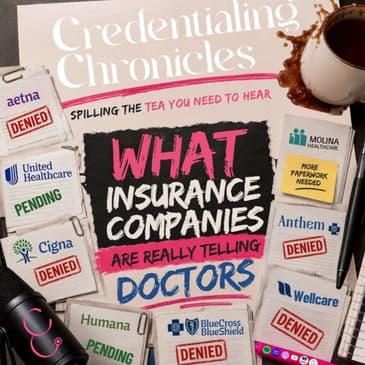
What Insurance Companies Are Really Telling Doctors
Prior authorization is supposed to help manage healthcare costs and ensure appropriate care. But what happens when the process becomes a barrier between doctors and their patients?
In this episode of Credentialing Chronicles, Shannen and Nyleen take a closer look at what the newly published data is revealing about prior authorization — including denial rates, appeals, retrospective denials, and the administrative burden placed on physicians and their teams.
We’re looking at the numbers coming out of Georgia, what they mean for providers and patients, and why transparency may be changing the conversation around insurance denials.
And there’s one statistic you’ll want to hear: 82% of appealed prior authorization denials are overturned.
So why are so few denials actually appealed?
🎧 Listen to this week’s episode of Credentialing Chronicles and hear what the data is really telling doctors.
If this episode makes you think of a provider, credentialing professional, or healthcare colleague who needs to hear it, share it with them — and don’t forget to follow Credentialing Chronicles for more healthcare tea. ☕️
Eliminate credentialing delays! Get 100% accurate, real-time license verification and monitoring.
Nimble:Surgical Revenue cycle Management
Accelerate growth. Leverage intelligent analytics. Achieve powerful financial results.
Advanced Quality Compliance & CVO
Credentialing. Contracting. Compliance. Handled. Completely. Concierge-level credentialing, payer e
MedElevate Solutions
Bridging the Gap Between Software and Clinical Reality E.L.E.V.A.T.E.™ your healthcare experience.
Disclaimer: This post contains affiliate links. If you make a purchase, I may receive a commission at no extra cost to you.
Resources Mentioned:
🔎 Verify Your Doctor’s Credentials
✔️ State-Specific Medical Board License Lookup:
Find your state’s board here:
https://www.fsmb.org/contact-a-state-medical-board/
✔️ Medicare Exclusions List (LEIE) – Check if your provider is federally excluded:
https://oig.hhs.gov/exclusions/exclusions_list.asp
✔️ Set Google Alerts on Your Doctor’s Name:
Create your own Google Alert here:
https://www.google.com/alerts
For Medical Staff Professional:
✔️ FSMB.org – Federation of State Medical Boards Physician Lookup:
https://www.fsmb.org/physician-license-lookup/
✔️ Hospital Websites:
Many hospitals have public directories listing credentialed medical staff. Look for a “Find a Doctor” or “Medical Staff Directory” page.
✔️ Set Google Alerts on Your Doctor’s Name:
Create your own Google Alert here:
https://www.google.com/alerts
Wanna know if your plastic surgeon is actually board certified?
Check for yourself right here:
👉 Verify a Plastic Surgeon
Open Payments
openpaymentsdata.cms.gov
Verify your Nurses' Credentials:
https://www.nursys.com/
🌐 Connection Zone
Stay plugged in with your peers, share resources, and nev...
[00:00:00] Welcome back to Credentialing Chronicles, where we spill the tea on the doctors you see. And we're spilling it baby all across America. Well Nyleen and Shannen sitting there talking about you while you pull up a chair. They holding everybody accountable.
[00:00:23] How are you? Oh you know life is lifing and uh every day I walk into work either at the hospital or at my clinic and I just get frustrated. I'm Shannen and I'm Nyleen. And Shannen, I've been dying to do this
[00:00:51] episode for a while because listen this isn't a story about doctors or a bad doctor or bad nurse practitioner because to be honest with you we have so many amazing doctors around and I want to talk about the system a little bit. And it's happening not only in Georgia, of course I'm experiencing it firsthand particularly with our local plans here in Georgia, but it's happening to real doctors and
[00:01:21] good patients all over the U.S. I'm just like this episode is going to be a little different I guess from our usual format Nyleen said. I mean we're not going to talk about no single villain here right we don't have a mugshot. But this is really let's talk about the retaliatory the the I don't even know what is the adjective we can put on it. The horrible process
[00:01:50] of prior authorization right? I mean let's talk about that process right really quick before Nyleen gets into it because she's got a million stories to tell you all. But that process you're ready and I know you're ready she's sitting already y'all she was telling me stories while we were getting ready to record. Okay so this process is where an insurance company okay has to approve a treatment before a
[00:02:14] doctor can provide it and what the actual published numbers say is happening right now to patients waiting on that approval in the United States. Nyleen? Yes all over the U.S. And I think we really need to get into it because we understand the role of health insurance companies
[00:02:41] and that people say oh I need health insurance of course in case of an emergency right. The problem is with so many people having to search for health care what they're not understanding is that health care companies are controlling where when and how they have to get prior um insurance companies are dictating
[00:03:06] where we as patients can obtain or not obtain health care and with whom. That's number one right that that's what they started with like the HMOs the family health the centers right I mean all of that right that's where they started restricting it yes. Right so before I get too crazy into this whole topic and into prior authorizations I want to take a
[00:03:32] minute to thank our sponsors and so this episode is sponsored by Nimble Solutions whether you lead an anesthesia service ambulatory surgery center orthopedic practice a private practice today's reimbursement environment is super complex and is dealing with so many nuances so keeping up with all of these requirements and coding changes and managed care contracts really collecting the right expertise and
[00:04:01] the right technology is really really difficult and it's only getting more difficult and it's only getting worse so organizations throughout the country are partnering partnering with nimble solutions that's because they are able to combine experienced revenue cycle professionals with intelligent technology and analytics to help really surgical providers strengthen their financial performance improve their operational efficiencies and maximize their cash per case so if you have any questions
[00:04:30] specific show notes go to nimble rcm.com and see how their services can help you increase your bottom dollar well if you didn't hear that nimble rcm.com thank you for sponsoring great chronicles we love you so let's define this for anyone who's never dealt with it directly and the reality is as credentialing experts a lot of
[00:04:55] the times we know about prior authorizations patients know about this thing called prior authorizations doctors obviously deal with prior authorizations but maybe nobody gets hand-on-hand first-hand experience so Shannon what is your opinion or what is your definition of prior authorization i look at it like another level of restriction right on the provider i i'm gonna keep going back to the different levels of restriction
[00:05:25] that the insurance companies put on providers right you're gonna talk about it all so i think your prior authorization is really the process where a health insurer you guys requires a provider to get approval before performing a procedure ordering a test prescribing certain medications y'all be even before the
[00:05:49] patient sometimes gets care not after so it's you know we're saying before okay and so in theory it exists to prevent unnecessary or ineffective procedures and control costs we understand that part but baby in practice nyleen you're you're you're going through it patient advocates physicians and increasingly regulators
[00:06:13] describe it as a confusing maze labyrinth of a process that denies or delays and puts burdens upon burdens of paperwork on physicians yes not only does it put a burden on physicians but it really delays the care that's necessary for the patient the patients stay in pain and stay having to do unnecessary and
[00:06:39] a lot of time to spend an ordinary give us an example i mean you have examples okay let me give you an example in orthopedics because girl i'm up to here i'm like literally i'm done yeah tell us i want to know patient comes in i have horrible shoulder pain i fell i twisted we get an x-ray because you always need an x-ray even though you don't need an x-ray but let's whatever we get an x-ray there's no fracture
[00:07:04] okay we need an mri we go you cannot see soft tissue okay without an mri okay so if you tore something inside of that like a muscle like or right your rotator cuff or any tendon exactly okay i can't see that on an x-ray right so what does the insurance company say no you need to go to six weeks of
[00:07:30] physical therapy i'm sorry let me get this right so if i have a torn tendon or a torn bicep or a torn anything you want me to exercise that area and agitate it more possibly even make it worse before you approve a scan to prove that i'm worse so i have to literally injure myself worse in order for
[00:07:53] me to get the care that i need and we all know physical therapy isn't cheap and so before the assessment is complete and we even know what is wrong we're prescribing like the the remedy right and then let's talk about well let's talk about and then let's talk about rural health care because guess what what if you go to a place that i may or may not mention that says i can't do physical
[00:08:21] therapy you have to change the doctor's script because the only employed people that i have are called occupational therapists so now i have to not only manipulate a script to say that a patient needs occupational therapy that they don't actually need because you don't have the coverage available so the patient gets some kind of therapy just to please the insurance company who has never evaluated a
[00:08:48] patient so can you explain that to me why are we accusing doctors of malpractice when insurance companies are the ones trying to quote-unquote practice medicine so does the doctor change the script well if the patient wants therapy unless they want to drive three hours away and there's no place else to do it oh my god that is literally in practice what we're talking about
[00:09:11] i mean oh my goodness and and you know just as of this year under a new federal rule called cms dash zero zero five seven dash f finalized back in january of 2024 medicare advantage plans and medicaid managed care plans and nyleen marketplace insurers are now required to publicly report their prior authorization approvals and denial rates every year the first reports covering calendar year of
[00:09:41] 2025 we're literally due this march okay so you're meaning to tell me that for the first time we can actually see some numbers instead of just hearing because girl just from my practice i didn't tell you the rate of denials is like 90 maybe office managers should start checking that right because if maybe all the office managers just got together and they could say hey what are you doing what are you doing what you know and then maybe you guys could come together and say hey this is happening in
[00:10:09] our area right well in georgia right did you find in georgia did you find anything in georgia no i well what we when we did you know looked up for the show notes because you know i just was wanting to be nosy there were 25 reporting health plans covering uh that did report out they were covering roughly 2.3 million enrollees across medicare advantage medicaid managed care and then
[00:10:33] exchange plans that are out there um and the state's mean standard prior authorization denial rate it was sitting at about 10.4 percent which is actually below you know the 11.6 percent of the national average i think the numbers are forged they're forged okay i'm sorry i get a whole lot more denials than 10 or 11 or whatever number they're claiming yes ma'am i just got two phone
[00:11:02] calls just today about oh my mri didn't get approved they want me to go to physical therapy i'm like sick of it and don't you call back to the insurance and say how or what does that no we go and send the patients to physical therapy because we can't fight with the insurance the doctor or is the patient gonna pay the doctor 300 for his time do we expect the doctor who had 11 surgeries today to
[00:11:29] stop doing surgery to call an insurance company to fight on your behalf who's paying for the doctor's time i'm sorry that's just my two cents because if an attorney had to do that you and shannon has been dealing with attorneys how much attorneys you have to deal with how much hours how many dollars per hour you got to deal with for an attorney to call and make even a phone call to see how you're doing and that's exactly where it gets interesting nyleen i mean you're right denial rates across these 25
[00:11:56] plans just in georgia alone range from a low of 2.0 percent i mean i just don't see how that's saying you know because it goes all the way up to 20.6 percent for like a united health care medicare united it's more like 80 percent than i already yeah and don't even get me started with united please i'm getting a lot of denials from everything and that's maybe only what they're reporting nyleen because that's
[00:12:23] more than tenfold percent of how often two different insurers say no to the exact same kind of request in the exact same state nyleen exactly so of course depending on which kind of plan the patient happens to have or happens to be enrolled in their odds of getting approved or not approved or being forced to do unnecessary procedures or additional treatment or spend more money can vary from one thing to the
[00:12:51] other well one in five you know this is the same regulatory environment and the same states and the same physicians in many cases submitting requests to multiple plants right so the variable isn't the medicine it's the insurer's internal criteria that is literally hurting the doctors oh and yes and let's before we get into my favorite subject i'm just going to say the place of service matters because
[00:13:18] there could be a patient i mean tell you a place a call phone call i just got today got a call and says well the patient lives in this town will approve the mri in this town but the patient works in another county and even though they want it in another county they can't have it in that county because they live in this county so they can do their mri in this county so we'll approve it for this facility but not that facility where you originally asked for so we had to change the
[00:13:46] order again because we had to change it to the other facility in order for the insurance because so the insurance is dictating what the patient can do neither the physician or the patient is allowed to choose their services and let's think real life now right so now the patient needs to take a whole day off correct to get it done right i mean that was the the the stronghold right you can't just do it on your lunch break and go back to work you need to take the entire day off now so the patient's losing losing
[00:14:14] losing losing losing and getting mad at the doctor for and it's not the doctor's fault oh my god nylee before we get any matter okay let's take a second just who lets you breathe you do some woosah and i'm gonna thank our sponsor baton health okay so as credentialing professionals tools like baton give us the ability you all to look scan and verify and be prepared for everything because accuracy of
[00:14:43] information is invaluable and patient safety baby is why we do this organizational integrity is at the top of all of that so when we're talking about verifying licenses verifying sanctions and deas in all 50 states in a one-time shop shop top top type of uh environment batonhealth.com is where you're gonna do that all right thank you baton we love you go ahead nylee you get as mad as you want now we
[00:15:10] already thanked our sponsors let's talk about what actually happens on the ground when a surgery gets denied on a patient because i honestly don't think that um msps or anybody outside of an rcm cycle anybody outside of a doctor's office sees what actually the whole view yeah or understands what
[00:15:34] happens when a surgery gets denied and that's your wheelhouse right i mean tell us i'm excited so you know here's a pattern i guess that shows up repeatedly in your pre-authorization reporting that we kind of seen i don't know if you see it in yours sorry but it's not unique to georgia so we're not like bashing on georgia because really nylee's talking about this nationwide but we're just kind of it really applies here right a denial isn't always the end you guys of the story
[00:16:02] and it isn't always at the top of the front end either you know one documented pattern involves what's called a retrospective denial we're gonna ask nylee if she's ever heard of that a patient gets pre-authorization you guys approved now this has the surgery and then months later you guys the insurer reviews the post-operative record and denies the claim anyway arguing literally you all
[00:16:27] that the procedure wasn't medically necessary after all because the procedure worked and the patients now healed nylee have you had that happen to you in your clinical life so yes i have had that happen i have also had a situation where we did based on the evidence that we had in front of us in other words
[00:16:50] based on the patient's mri scan let's just say there was one fracture that was able to be seen right let's just say but when the doctor opens the patient cuts the patient open we see multiple bone fragments so now it's a two-part fracture or a three-part fracture well each one of those fractures
[00:17:18] or bones um or tears are coded differently depending on the amount of fix fixing that needs to be done so perhaps you get more well yes but if we don't know that before it we can try yeah right or we can say
[00:17:43] oh the patient needs a knee scope because he has a meniscal tear but we find out it's a medial tear instead of a lateral tear or something like that the position of the tear all of these things matter in coding and cpt codes and all of these things well as a doctor you don't know right as a surgeon you don't know until you're actually in there so the case because it it's a different cpt code can get
[00:18:12] retrospectively denied and you can try to get an appeal and fight with them and say actually guys the patient actually needed xyz and then the insurance comes back and says yeah sorry i should have known because of course we have miraculous superman vision somehow and so we were supposed to know that so therefore we don't get paid for the surgery or they take their money back or they don't agree with it
[00:18:40] or uh my biggest one are shoulder arthroscopies so a shoulder arthroscopy a lot of times has multiple components to it and so it could require extra debridement or it could require a bicep team adhesis well because they consider it as part of the main procedure they automatically refuse or they automatically deny it so the doctor does the work because obviously it's the best thing for the patient
[00:19:10] but the surgery sent but the surgery denies it because we didn't ask for it because we didn't know that it was there nyleen this is literally a nightmare what you're talking about and the fact that it's happening in clinics all over nationwide and nobody is talking about it if you are going through this tap in below comment share this episode y'all because that's a nightmare scenario but let me tell
[00:19:36] you you said something serious you said about the appeal and it's exactly why the appeal documentation matters so much right because national data shows something that should honestly make every patient and every doctor furious more than eight out of ten prior authorization denials you guys that get appealed or overturned literally 82 percent nyleen so it's like they're using that process i mean can you
[00:20:06] appeal something more than once if i was you i would appeal it more the the health of the patient the care of the patient i mean the use of the art you're saying money you think but but who realistically how much money does it take to do that you have to pay imagine how many times you're using the hours of the billing personnel right to try and do the same thing over and can't you if you know that's a common denial
[00:20:32] maybe working in your system to be like this is already gonna happen yes but then you get into the risk of of fraud because then i'm asking to get a surgery approved and what if the patient doesn't have the tear now the insurance company is going to say oh you fraudulently said that the patient had a tear but he doesn't have a tear so you you know you're you're not billing correctly because you didn't identify the tear and since you identified a tear before and you went in there and it wasn't there now we're
[00:21:02] going to deny because you said that he had something he didn't have so you're a rock at a hard place correct so you can't you can't do anything and so before we get into there let's talk let it let's talk about georgia so georgia is one of the few states unfortunately that is still left with the con laws okay and that's a certificate of need law which means that in order to open up a surgery center it has to be single specialty okay there's all these rules we have to go through it's usually
[00:21:31] single specialty single practice and it's nearly impossible you've got to have you know 15 doctors before you can even think of a surgery center to financially afford that okay so not to mention that the local hospitals are going to yell at you and shut you down and not let you yeah yeah it makes sense yeah so real life scenario guys let me tell you what's actually happening since
[00:21:55] patients want surgery great you want surgery you have an insurance plan guess what i go to ask the insurance company hey mr smith needs this surgery insurance company says hey doctor you can't do this surgery because this surgery can be done at a surgery center so we reply uh sorry we don't have
[00:22:19] privileges at a surgery center because number one the closest surgery center is 45 miles away and 80 miles away for the patients uh and we don't have privileges it do you know what the insurance company responded oh my god i'm scared to ask they said contact a surgery center because we need we recommend that surgeons have privileges at more than one kind of facility even though it's 45 miles away
[00:22:48] right even though it's physically impossible for the physician or the patient to realistically do surgery when it takes two hours together yeah exactly and yeah oh my goodness man and again tap in if you guys are listening to this and we're gonna do a post wrap up in our vip t session where nyleen is just gonna spill it all and talk about who the biggest payers are yes i'm gonna white out the
[00:23:16] patients names and i'm gonna post it because it's literally disgusting i have the picture of the insurance response telling me that my doctor needs privileges at a surgery center that does not exist anywhere to have and that's just great and we need to get together as msps again because um if we're looking at patient safety this is part of patient safety right and when appeals are at 82 percent
[00:23:44] success rate you guys um this is the number that should really sit with you uh if you need a surgery you really need to think about it because you might be denied first or after or in the middle maybe you're in the middle of surgery and you know what we decided we don't want to pay for this nyleen uh because really only about 11 percent are actually denied after the appeal is appeal is all said and
[00:24:09] done yeah and so all of that all of the documentation all of the problems all of the peer-to-peers we have to suffer through this is where it ruins the patients and it hurts good doctors that are just trying to provide the best health care mm-hmm so a good doctor recommends the right treatment and the patient waits
[00:24:35] but guess what they could get denied they could get delayed they could get worse and there's absolutely nothing we can do about it that's not the doctors right nyleen that's the system correct and it is denying people you know that need these items and then you have ceos of organizations like nyleen that have to fight on behalf of the doctor and like she said she's not getting paid to fight she can't
[00:25:00] fight everyone i mean that is functionally what the numbers show is that people that are in the position that nyleen is in have to fight and insurers cite three main reasons you guys for initial denials you want to know what they are income incomplete documentation medical necessity criteria not being met according to their own internal rules you all and guess what else utilization management
[00:25:28] which is truly a polite industry term for cost control y'all and every one of those three reasons is more likely to hit a patient who doesn't have a well resourced practice like nyleen manager fighting for them or who doesn't know that they have the right to request a peer-to-peer review between their doctor and the insurances medical director listen to it again if this is happening
[00:25:57] to you you request a peer-to-peer review between your doctor and the medical director of the insurance well and be careful with that because the medical director may not even be within your specialty which is a lot of these doctors online that we're seeing you know they're an ent doctor they want to speak to another ent doctor they don't give them any ent doctor they give them a rheumatologist which doesn't even do procedures so that's not a peer-to-peer i need to speak to somebody that has done surgery that
[00:26:26] knows what my patient needs one time it was an ob talking to an ophthalmologist nyleen exactly what does the ophthalmologist know about anything ob on the one rotation they did during medical school i don't know yeah i mean it's peer-to-peer it should be specialty to specialty as well you know i mean when we're looking at that i mean because this is like you said it's ruining patients trust in health
[00:26:52] care it's hurting the good doctors that are out there that are trying to stop this and it's starting you know it's it's in this system creating this system that is literally just all about what money money and at the end of the day the physicians are there and they have they're ending up having to eat all these administrative costs and payments are going down reimbursements are going down and doctors
[00:27:20] are allowed less and less time and yet have to document that they've spent 45 minutes to get actually paid by an insurance company i mean come on the national physician survey data cited nyleen across this coverage okay puts the average time that physicians and people like you my love spend on
[00:27:41] prior authorization paperwork at 13 hours not a month nyleen a week you gotta have a whole needed to do this for you i mean is this crazy that's not treating patients that's fighting for permission and access to treat your patient that's what that is it's absolutely horrible so are we doing anything to
[00:28:06] fix it are the doctors complaining on instagram and tiktok and everywhere there are a lot more a lot more everybody's complaining we try to joke about it and say you know what are we doing to fix it so i know georgia has some legislation on this so do you have anything on that shannon are you happy with
[00:28:28] me or are you just upset now i'm so mad this this literally this topic literally boils my brain because i know we like talk about all this crazy stuff in health care but the reality is this boils me because it hurts our patients and credentialing people that work and when i mean credentialing i'm talking about the payer credentialing people that are enrolling with insurance companies and
[00:28:55] when we're fighting for contracts and changing our plans and doing all of that you know we work so hard and all of us in health care work so hard just to protect our patients and try to help our patients doctors study so many years only to not be able to actually practice medicine it breaks my heart so that's why i'm upset i'm really upset this topic like breaks my heart
[00:29:24] yeah i mean there is you know there is some people you know let's talk about it really quick as of recent tracking multiple states have passed what's called a goal card legislation and states like texas uh arkansas west virginia have been actively expanding their existing goal card programs this means that it's extending look back periods it's lowering requests to volume
[00:29:48] ratios and it's extending the privilege to an entire group practice instead of just individual providers for example texas law now evaluates providers over a full year of profit prior authorization history instead of just six months and it requires insurers to really provide at least 90 percent of a provider's request for that provider to earn goal card status wow well that's good news but
[00:30:17] there's a real debate about whether this gold carding actually delivers relief is there yeah i mean i think it's ridiculous that they need to have something called a goal card in order to give good good treatment i mean it makes no sense right it's like you have to be evaluated and deemed growled by the insurance company to get paid for treating patients now i mean it's just it's another obstacle right i mean we should be straight with our audience about one thing some health
[00:30:45] policy researchers have pointed out that that goal carding while in it feels appealing others limited relief in practice because insurers can still narrow the list of procedures you guys for eligible goal card treatments right it's all about the control um insurers can still narrow the list of procedures for go-car treatment sorry phil said that again or set thresholds for high enough set the thresholds high
[00:31:14] enough that few providers qualify and on the insurer side industry groups united have testified that restricting prior authorization broadly could increase premiums for people with one texas insurance trade association's estimate citing literally a potential five to sixteen percent premium increase if prior authorizations were meaningfully rolled back it makes no sense right so then there's tension there because
[00:31:45] not everything is a villain story right there's there's some move but there's truly a cost argument that we have on one side you have legitimate patient and provider you know needs or you can have harm like over utilization or ordering the wrong things so i know we're trying to really find the line between what's okay
[00:32:11] and what's not okay right yeah i mean that's fair that's fair my name you're right because it's important we say that clearly it's not clearly it's not clearly it's not clearly it's not clearly it's not clearly right because here's what i i think right is i i i most credentialing and compliance professionals kind of land here transparency is non-negotiable you know and first step it i mean really right
[00:32:32] regardless of where you fall on the underlying policy you know the cms 0057-5 reporting requirements you know it's the same one that gave it gave us the georgia denial rate data we uh talked about and what makes any of the compensation possible is the in the first place you know before this year none of these denial rates were public you guys patients and providers were negotiating literally in the dark
[00:32:59] and so i think it's important that we continue to talk about it i mean at the very minimum i think we should do another insurance episode before the year's out basically maybe comment below do you want to hear another one do you love it do you hate it share yes comment subscribe tell us your insurance horrible stories and now that that data is public it's fair game and i want all of you guys to look up this information patients can look up their own denial
[00:33:28] right show notes providers can go ahead and use it when they're trying to apply if they're in this gold card in the United States so all of these things is to say that you as patients you as physicians and us as credentialing or provider romance specialists really have to know our resources that are available to us and if you're a
[00:33:55] patient or provider dealing with a denial that you believe is truly wrong you have real options and most people don't use them nyleen i mean tell me a little bit about the appeal process uh well typically it's 60 to 180 days depending on the insurer you can request a peer-to-peer review between your physician and the medical director
[00:34:20] for urgent situations you can you know request an expedited appeal um which sometimes they approve within 72 hours or so they say but they usually don't they usually take the full time by that time either the patient's already too sick or had had too many other issues but the other issue that we run into is timely filing so by the time they approve or go through an appeal
[00:34:49] then they'll claim something oh it's timely filing so yes all these numbers are what they supposedly say but it's not actually what they do in practice so you have the option of appeals but there's a lot of little nuances and a lot of little uh tricks that people do in billing to try and get this actually passed well let me tell you if an appeal stalls because i'm always about well let's get it done however we
[00:35:17] got to do by all means necessary so if an appeal stalls or you believe that denial isn't being handled fairly you all you still have one last tool in your toolbox you can file a complaint directly with your state's department of insurance every single state has one even on my end i we do aqc does contracting for companies all over the united states and we do it really good and i try to make sure that we get approvals in 30 60 days from some insurance but when we have people that don't
[00:35:45] listen we literally are calling the department of insurance and saying hey this plan is not responding fast enough and they are putting some obstacles for access to care and so i just want y'all to know that that even on the patient end right they can call even providers right now yeah for providers if you're seeing um a pattern of inappropriate denials from a specific plan that pattern itself is documentation
[00:36:14] worth bringing to the state medical association and complaining um not sure that they actually listen but you know hey we gotta keep the data get the receipts you know help us join us because we can't be the only ones and there's a reason why doctors are going out here and just exposing this because it's hurting our patients say something appeal you know that you get it get your voice out there
[00:36:44] but ultimately what we you know what we want to say is stay credentialed y'all not canceled until next time oh shannon that was a lot of tea honey but have they subscribed yet to hear it next week on all of these platforms please subscribe like and follow us