
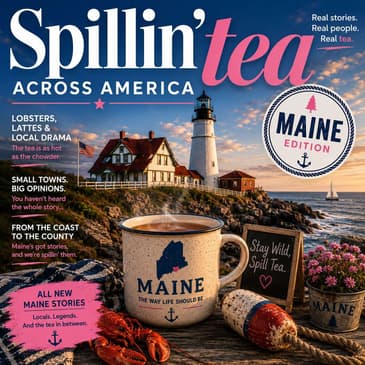
The tea is officially served, Maine.
And Tea Sippers... this state's tea is HOT.
This week, Shannen and Nyleen head to the Pine Tree State to unpack a series of healthcare stories that will have you saying:
"Wait... WHAT?!"
From a heartbreaking case that sparked serious questions about patient safety, to a multimillion-dollar settlement proving paperwork can carry a hefty price tag, to a trusted healthcare provider whose actions shocked an entire community—Maine delivers twists that are difficult to forget.
We'll be discussing:
☕ The case that left people asking: How was this missed?
☕ Why a single decision can change everything
☕ The shocking cost of paperwork gone wrong
☕ What happens when warning signs don't get connected
☕ The uncomfortable truth about trust in healthcare
☕ When systems designed to protect patients fail
☕ The red flags nobody wants to talk about
☕ Why some of the biggest healthcare scandals start with something seemingly small
☕ The question every healthcare organization should be asking
☕ Lessons that could impact providers, patients, healthcare leaders, and MSPs alike
Whether you're in healthcare or simply someone who trusts the healthcare system, this episode will leave you asking the same question we did:
How did this happen? 👀☕🔥
Because one thing became crystal clear: The most dangerous risks in healthcare aren't always the ones you can see coming.
And Maine? Let's just say the receipts were public. 👀
⚠️ Disclaimer: This episode discusses publicly available information and healthcare industry topics for educational and discussion purposes only. Allegations discussed are based on public records and reporting. References to settlements do not necessarily indicate admissions of wrongdoing.
🎙️ Subscribe for more Credentialing Chronicles: https://www.buzzsprout.com/2460053/support
Healthcare stories. Credentialing challenges. Compliance conversations. Patient safety lessons. And the real-world issues shaping healthcare across America.
Baton Health: Universal PSV in SecondsEliminate credentialing delays! Get 100% accurate, real-time license verification and monitoring.
Advanced Quality Compliance & CVO
Credentialing. Contracting. Compliance. Handled. Completely. Concierge-level credentialing, payer e
MedElevate Solutions
Bridging the Gap Between Software and Clinical Reality E.L.E.V.A.T.E.™ your healthcare experience.
Disclaimer: This post contains affiliate links. If you make a purchase, I may receive a commission at no extra cost to you.
Resources Mentioned:
🔎 Verify Your Doctor’s Credentials
✔️ State-Specific Medical Board License Lookup:
Find your state’s board here:
https://www.fsmb.org/contact-a-state-medical-board/
✔️ Medicare Exclusions List (LEIE) – Check if your provider is federally excluded:
https://oig.hhs.gov/exclusions/exclusions_list.asp
✔️ Set Google Alerts on Your Doctor’s Name:
Create your own Google Alert here:
https://www.google.com/alerts
For Medical Staff Professional:
✔️ FSMB.org – Federation of State Medical Boards Physician Lookup:
https://www.fsmb.org/physician-license-lookup/
✔️ Hospital Websites:
Many hospitals have public directories listing credentialed medical staff. Look for a “Find a Doctor” or “Medical Staff Directory” page.
✔️ Set Google Alerts on Your Doctor’s Name:
Create your own Google Alert here:
https://www.google.com/alerts
Wanna know if your plastic surgeon is actually board certified?
Check for yourself right here:
👉 Verify a Plastic Surgeon
Open Payments
openpaymentsdata.cms.gov
Verify your Nurses' Credentials:
https://www.nursys.com/
🌐 Connection Zone
Stay plugged in with your peers, share resources, and nev...
[00:00:00] Welcome back to Credentialing Chronicles, where we spill the tea on the doctors you see. And we're spilling it baby all across America. Well Nyleen and Shannen sitting there talking about you while you pull up a chair. They holding it. Welcome back to Credentialing Chronicles. Nyleen, bestie, how are you boo?
[00:00:27] Oh my goodness, so nice to talk to you as you continue to do your travels. I'm so excited for you. Girl, as we continue this traveling across America, I can tell you I'm excited to talk about our next state. The good old state of beautiful Maine, where the humpback whales go to mate. They do.
[00:00:57] And one of the parks, I can't remember, it starts with an A, but they have this big mountain and at the certain time of the year, you could go up there and like catch them mating. It's like crazy. Wow. That sounds so amazing. Well, before we jump into Maine's scandals, fraud lawsuits and all the tea we're about to spill. It's time for something I really want to highlight, which we haven't really done in a lot of episodes,
[00:01:22] but we're going to do some interesting stuff on this episode, really reminding the public that the receipts are available for all. They are public because tea sippers, if you've listened to us for an amount of time, you know that we're consistently telling people trust your doctor, but definitely verify, right? Verify, verify, verify. Google alert, right?
[00:01:47] I mean, and today we're doing what every medical staff professional secretly loves. You guys ready? A board website review. Okay. Ooh, yes, girl. Cause you know, nothing says excitement like a licensure verification. Nothing. Not in our, not in our book. We want to, and then when they have something attached, we're like, Ooh, come over here. Y'all look what happened.
[00:02:14] I mean, some, some MSPs are probably listening right now thinking finally, this is my Superbowl, right? Except we don't, we don't, but we don't have bad buddy. I'm sorry. Y'all we try. We still try to book that one. Yeah. So honestly, you're not wrong because one thing we do in every state is just ask a very simple question. True. True.
[00:02:38] And, and it, you know, if I was sitting on my couch in fuzzy socks at 10 o'clock at night, wondering like whether my healthcare provider is actually licensed. I mean, cause I have like an appointment with them tomorrow. You know, the big question is, could I figure that out? Can I do that? Right. Exactly. Because could an average patient navigate a website or could they even verify a doctor's license in the state where I'm at? Could they find a disciplinary action?
[00:03:08] Could they find a complaint or would they just end up like three hours later in like an internet rabbit hole wondering where their evening went? Exactly. Right. And still looking for their doctor. I mean, so, I mean, I think Maine is a good place. Like let's, let's see what Maine gives us. Well, first impression is actually pretty good because right on the homepage of the main
[00:03:32] board of licensure of medicine, there's a physician search function. So you don't have to create an account. There's no password. We don't have to pay for it. There's no security questions. Um, and so once you search, you can see whether a license is active, the license number, specialty information and disciplinary actions are there. And honestly, as a credentialing professional, I appreciate that information, you know, really quick. Yeah.
[00:04:02] So as a patient, you know, I don't need a doctorate right to navigate the just plain board website. So this is the question that I want to ask them. Can they see a disciplinary action, a board action, a did my provider get in trouble, Link? Okay. Well, you can, and that's important because many patients assume that if a physician has ever been disciplined, you know, somebody else will tell them, but that's not always the
[00:04:32] case. So at least you can find it on, on the website. You can. They definitely don't advertise it at the clinic. No, no, no, no, no. And then, right. The licensing board is often the first and of course the best publicly available source for that information. Tell me if I'm wrong, but before I choose a provider, I should probably spend at least maybe five to 15 minutes looking them up. Well, five minutes, right? And honestly, that's what it takes.
[00:04:59] And I'm going to do a little spilling of the tea, but anyway, five minutes could tell you whether a provider has restrictions, probation, disciplinary history, and a clean record. I mean, that's empowering information. I feel like, right? Mm-hmm. So I guess here's where things get interesting, right? Can we verify everybody from that one website? Yeah. Well, that's where it gets a little complicated.
[00:05:25] So what, explain it to me as if I'm a patient sitting on my couch with fuzzy socks on. Well, the physician board covers just doctors, meaning MDs, physicians and physician associates. So that's the PAs.
[00:05:44] So if you're looking up for like your family doctor that ends with an MD or a physician associate that ends with a PA, same website, easy find. Okay. I'm excited. I'm excited. So it's not one stop shop because what if my physician is a DO? Well, if they're a DO, unfortunately, it's a different website.
[00:06:11] Ooh, what if they stick me with an APRN? Different website. Okay. So what if my provider is a PT, physical therapist? Different website. Oh, Lord. All these are different websites. And so I guess maybe break that down, right? Because I guess all the nurses would maybe be under one website.
[00:06:35] Well, you know, Maine maintains a separate board of osteopathic licensure website. So that's all of your DOs. That's one website. The nurses are a different website. The doctors are a different website. And well, we haven't really reached dentists yet. So I'm right now I'm on what? Tab five on my Chrome browser.
[00:07:04] And now you're conducting a multi-agency license investigation. Now I am the FBI, right? Well, yeah. And then you forgot about one more. What did I forget? Podiatrist. Podiatrist. Yes. They are the doctor of the feed. Well, I mean, at this point, what are we thinking, Nyleen? I don't think that's very convenient or helpful for our patients, right? Right.
[00:07:34] So you might need like four or five browsers if you're going to verify a doctor in Maine. And maybe a high speed, high speed Internet? Yes. Well, but the good thing is that the information exists. The licenses are searchable. The complaint process exists. The disciplinary information is kind of accessible. But the challenge isn't necessarily finding the information. It's like knowing where to look. This is like the go Pokemon game, huh?
[00:08:04] Mm-hmm. Yeah. Let's find them all. It's kind of like putting on fake eyelashes. Mm-hmm. You know, like I always feel like they are so beautiful. They make everybody look so sexy. And they make them look so easy. But then when I actually tried to put the fake eyelashes on, they never stick. And they're always wonky. Oh, no. Stop it. I can't put those things on. I can't do it. And I want to. Yeah.
[00:08:33] So, you know, it's just like that. Like the people that know how to use those lashes, it works just fine. Right? So for us, for us MSPs, yes, we know there might be different websites. We know that we may have to go to more than one place. But it's not that easy for patients. No, it's definitely not. And I mean, really, even if, you know, a patient needs to file a complaint, I mean, were you able to like find an easy place for that, Nylene?
[00:09:01] Well, actually, the complaint process is pretty visible. Boards really provide instructions on how patients can submit concerns and what information should be included. But here's the important part. Filing a complaint doesn't automatically mean someone did something wrong. Very true. Very true. And that's very easy for MSPs, correct?
[00:09:24] Well, the board is going to investigate because the complaint process is kind of just like I'm notifying them of something, but then they're going to go through an investigation. They're going to gather the facts. They're going to interview and then they're going to do their whole due diligence. Now, let's talk complaints. I mean, because somebody listening right now is wondering, what if I have one? I mean, we're always telling people, if you feel something, say something.
[00:09:55] Yeah, you should absolutely report. And you know that at least in the state of Maine, there is a fairly simple way of submitting that report. Okay. Okay. So filing a complaint doesn't automatically mean something did something wrong, just like you said, right? So, I mean, you don't really want to weaponize the complaint process because somebody made you wait 45 minutes in the lobby. Exactly. So we're going to submit it and make sure.
[00:10:22] So let's just summarize for transparency. I'd give Maine a solid like B plus for physician verification, maybe like an eight out of 10 coffee cups because the information is there. The complaint processes are there. The disciplinary information is there and the websites actually function well. So it's not too bad. You just got to know the different websites, I guess.
[00:10:52] Yeah. I mean, you know, we're a CVO. So what we always tell people is say, you know, verify a blank in this state. So verify a physical therapist in Maine, you know, and then it's going to usually bring you out to that website. Because that's really, you know, the theme of today's entire episode, right? Trust, but always verify. Exactly.
[00:11:17] So board websites really should be designed, I think, for patients, not just credentialing professionals. Transparency is the one who's going to build the trust. So I don't know. What do you think, Shannen, about patients? Well, I guess the public assumes someone else has already checked, right? Sometimes they have, sometimes they haven't.
[00:11:42] And taking five minutes to verify license is one of the simplest, you know, patient safety tools that they have available. So like you said, it should be available, you know, and very easy for the public to do that. And if the receipts are public, you know, you should be able to read them, I think. Definitely. I mean, board websites should be designed for patients, not just credentialing, like you said.
[00:12:06] I mean, and for patients before selecting a healthcare provider, you've got to spend that five minutes reviewing the license status. Is it active? Have there been any board actions? And truly, are there any history of public disciplinary? Because healthcare is one of the few industries where you can literally verify who's taking care of you. And we should definitely be using those, like, you know, Nyleen called them public receipts. Yeah, and look at those credentials, like, look at the letters or the certification after your doctor's name.
[00:12:35] You can know whether it's a DPM, it's a podiatrist. You know, put those little details in there when you're searching the doctor's name or the physician's assistant name or the podiatrist name or the dentist name. Look at what their credentials are and that will direct you to the right site for your state. And in particular, Maine, since we're talking about Maine. But girl, let's get into some tea. I got my stories lined up. Well, like you said, honey, tea sippers. I want you to imagine being a parent.
[00:13:04] Your teenager doesn't feel well. Maybe she's tired. Maybe she's getting a headache, you know. Maybe something just feels off like we all. I mean, I have six daughters. Something always feels off, right? Nothing dramatic. I mean, nothing that screams, let's take her to the emergency room. But just enough to make you say, hmm, we should probably get this checked out. Well, that's exactly how so many health care tragedies begin. Not with like alarms, not with, you know, an emergency vehicle showing up.
[00:13:32] Not necessarily with all those flashing lights or a medical mystery nobody can solve. But they begin with like ordinary symptoms, like the kind of symptoms that, you know what? I'm just going to go ahead and schedule that appointment, you know? You know, nobody ever walks into a clinic thinking this appointment will determine the rest of my life. Could you imagine? Oh, my goodness. Exactly. Families actually go to doctors, right? Because we trust the system. We as patients, we go to see a doctor. We see what their specialty is.
[00:14:01] And we're like, oh, I'm going to trust this doctor, right? Trust that they're going to listen to me, that my concerns are going to be heard, that my warning symptoms are going to be recognized. And most importantly, they trust that if something serious is happening, somebody is going to go ahead and connect those dots for me. Say that. Say it. I mean, and you know, that's the crazy thing about this case, because according to allegations later presented in the court, the dots were never connected, Nyleen. You know, and a teenage girl literally lost her life. Oh, my goodness.
[00:14:30] Well, what happened was this patient was experiencing symptoms that her family believed needed medical attention. And according to the court filings, concerns were raised and evaluations happened. Opportunities allegedly existed to investigate this further. But what should have become a deeper diagnostic workup allegedly did not happen soon enough. Oh, here's the thing, right? That makes this story so haunting.
[00:14:59] We're not talking about a rare tropical disease or a rat disease on a boat. You know, we're not talking about an, you know, an alien parasite, the screw worm that nobody has ever heard before. I'm so tired of it all. I know, girl. We're talking about leukemia, a disease that's so often treatable when identified and managed appropriately. And I mean, everybody gets scared when you hear cancer, but there's a lot of treatment out there. I know, Nailene.
[00:15:28] And that's really, truly what makes this so heartbreaking is because the lawsuit wasn't built around the idea that medicine failed, right? I mean, it was built around allegations that the process failed. And again, that's what we see every time. Yeah. And that's the huge difference, right? Medicine is not perfect. Providers are not perfect. We do know their doctors, they are practicing medicine. They are literally practicing. Healthcare outcomes are not always predictable, but the expectation is that the process itself works.
[00:15:58] The evaluation, the follow-up, the testing, escalation, clinical decision-making. These are the safeguards that are put in place to catch serious illnesses before they become that catastrophic. Yeah, I mean, I totally agree. And yet, my love, according to the allegations, right, those safeguards allegedly broke down again. And while the specifications were heavily litigated, the jury ultimately heard enough evidence, Nailene,
[00:16:26] to literally return a verdict of approximately $25 million, mommy. $25 million? They said give them $25 million because it was that bad. Oh my goodness. But let me tell you, to be honest with you, any parent that's listening, even if you do hear $25 million, does that even make you feel like you won, though? Oh my God, exactly. I mean, people hear $25 million verdict and they think jackpot, right?
[00:16:56] But there's no jackpot when your child doesn't come home. I mean, that's, having your family safe is the true jackpot. Exactly. And so a verdict like that represents really something else. What it represents is the jury saying, we believe that something went terribly wrong. And I think you're completely right, Nailene. Now let's talk about the timeline, okay? Because honey, you know, I'm all about keeping the timeline. Timelines are where many healthcare stories,
[00:17:24] I mean, really all court stories, right? If you feel like you were wrong, keep, start with your timeline. Many healthcare stories become either success stories or tragedies because you got to figure out where all of the things lie on the timeline. Right. The question is whether healthcare providers recognize where the patient is on that timeline. Illness, diagnosis, treatment, like where are we? And when we think of like standing on a railroad track,
[00:17:52] far in the distance, a train is coming and at first it's small, hard to see, easy to miss, you know? But every minute that passes, guess what happens, baby? That train is getting closer and bigger. Louder, louder, more dangerous, Nailene. And that's how like when you're sick, that's what happens, right? You're literally, you think that it's something that you can barely see. It's just like a little headache, right? Or nothing. And then by the time you realize it,
[00:18:21] it's like the train is hitting you across the face, right? On the face. The train is there. Yes, the train is there and you're getting knocked over. Yeah, we did. I mean, we did, right? You know, the train is plowed into us. I mean, but you know, like according to the allegations in the case, by the time the correct diagnosis was ultimately made, the disease, Nailene, had literally advanced beyond the point where effective innervation could have saved her life. And like you said, this is something that could have been saved early intervention-wise. Wow.
[00:18:51] So that's crazy because, you know, they could have fixed it sooner. They could have caught it sooner. And it's really scary because those are the things that the parents are wondering. Like, did they just ignore this girl or her symptoms or saying it didn't matter and they could have actually caught it sooner? And those are hard questions to ask. I mean, again, that's why this story resonates so deeply throughout Maine because this wasn't a provider intentionally harming patients.
[00:19:17] I mean, this wasn't like fraud for $45 million. I mean, it wasn't criminal conduct. I mean, this wasn't even a pill mill, Nailene. And, you know, we talk about pill mills all the time, Mommy. Right, right. And that's why it's so uncomfortable, right? Because it's like a breakdown of clinical safeguards, like the very system that's intended to prevent the bad outcome. So, like, what was this doctor doing to prevent
[00:19:47] or to help prevent a kid dying, right? And honestly, those are often the most frightening questions, cases, right? Because everyone wants to believe the danger comes from the obviously bad actors that we always talk about. But sometimes it's not even like that. Yeah. Sometimes it's just like ordinary processes, right? Like what the doctor does every day. And the problem is that sometimes these ordinary failures, like little things that we miss,
[00:20:16] can produce extraordinary consequences, like somebody losing their life. Yeah. And I mean, that's the thing. Like you always hear these stories like, oh my God, I felt this. I was doing this. And they just said I was doing that. And then you come out and it was a big old tumor in the migraine in the brain, you know? And it just, it brings us always, always to one of our favorite questions. What does this have to do with credentialing? Well, I'd say everything. Most people listening are probably thinking this sounds like a malpractice case, you know, not a credentialing case.
[00:20:46] True. And the problem is that's why people sometimes misunderstand the role of an MSP because credentialing isn't just simply, oh, we're getting somebody through the front doors so they can start seeing patients. We're actually ensuring the competency from the inside out. We're analyzing all parts of what a doctor is doing and how they do it. Yeah. I mean, really, we, what we do is we take the doctor from the time they have left medical school and all of that practice
[00:21:13] and hospital affiliations, peers, malpractice, you know, all of those things. And then we're looking at it and holding it against CMEs, against case logs, against everything that we're verifying. And that's how they're really figuring, you know, is this doctor competent? Credentialing is never a one-time event. Exactly. Because the provider can have an active license, can be board certified, can have great references. But unfortunately, what we talked about,
[00:21:43] even in our last episode, this is why ongoing monitoring is so important because things change. They could be great the first year and then things change. I mean, things change in our lives, right? I mean, the healthcare changes, right? Practice patterns change. Performance changes. Outcomes change. I mean, everything changes. Like, that's the one thing that we can literally guarantee are that things are going to change, Nyleen. Absolutely. That's why things like OPPE, FPPE, peer reviews,
[00:22:12] quality reviews, case reviews, professional conduct reviews are so important. Like, this is why. Say it. And, you know, and that's why they should be done in surgery centers like Nyleen advocates for every single day. And all kinds of things. I mean, these aren't just accreditation buzzwords, you guys. These are safety nets. And these are what MSPs are trained for, baby. I mean, we love to find it. Yes. And the thing is,
[00:22:41] is every time peer review committee examines a case or a failure of protocol or a lack of following process, we're analyzing, like, why did this happen? Is it truly the doctor's fault? Sometimes it's not, right? Sometimes it's a process failure, an equipment failure. We want to give quality to where quality is due, but we want to recognize the most important thing is that peer review and ongoing monitoring is what it is, which is a safety net. Yeah.
[00:23:10] Transparency is a safety net, you know? And it's not a safety net for the purpose of let's find out what's wrong and punish these doctors and nurse practitioners. Yeah. I mean, no, it is like, let's be preventive. Let's be proactive. Oh my God, this happened. Let's, how do we make sure it doesn't happen with other people? If it happened with you and you're such a great person, it could probably happen. So how do we fix that? Right, Nailene? Yeah. We don't expect them to fail. We don't want to get them in trouble every time they do it because honestly, the patient's safety depends
[00:23:40] on making sure they don't do those things. We're just like, you know, helping them along. Yeah. And that's the difference between checking a box and really protecting a patient. I mean, really making sure that those, those areas are monitored and looked at. Right. So when we talk about credentialing, like the actual act of credentialing is not who sees the patient. It's the human behind that file that is actually seeing the patient. And that's why ongoing monitoring matters. I may say it again, sister. We need a t-shirt that says that. That's a good one.
[00:24:10] So sometimes the most, I guess, dangerous words in healthcare are what? We've always done it that way. That's what we always say, right? Yeah. But you know what? I'm going to answer to that. I'm going to say, well, then you know what? Maybe we should take a look at that process and look at it again. And see how we can make it better. Mm-hmm. Mm-hmm. Because, I mean, we just don't want to cost the organization $25 million, right? And one life, Shannon. And a life. Yeah. I mean, I think this was a really good episode to just kind of talk about, you know,
[00:24:39] the public. Everybody thinks that, you know, the doctors, the process, the healthcare industry is all doing all these checks and balances. And there really is a lot of checks and balances that are happening. But as a patient, you all need to be checks and balancing yourself as well. You're going to see a doctor, go check your doctor, Google alert your doctor. You know, make sure that you're protecting your family, your mother, your babies, you know, because time and time again, this is 2026 and these things are happening,
[00:25:09] you guys. Mm-hmm. That's right. So should we do an MSP, a doctor, patient wrap-up? What are you thinking? Well, three things, right? First, every complaint deserves an appropriate review. So, you know, we've already told you the board website, y'all can place a complaint. Definitely. Mm-hmm. Second, that documentation matters. So, Your timeline. Mm-hmm. And third, never assume that someone else is handling the concern.
[00:25:38] If something feels wrong, speak up. And if something looks unusual, document it. If a patient raises concerns, well, then obviously take them seriously. Did y'all hear her? Did y'all hear her? Because I was listening. I mean, really, patient safety, you guys, isn't one department's responsibility. It doesn't just belong to QI. It doesn't just belong to compliance. It doesn't belong to credentialing. It's everyone's responsibility. Mm-hmm. Exactly. And that's really going to be the biggest lesson, I think, from the story,
[00:26:07] is that the healthcare system protects patients when people are willing to ask the difficult questions. And sometimes, like, we don't want to say that we're, like, bothering the doctor, but it's like, we're not, right? Like, it's their job to listen to us, right? Yeah. Wow. So, even when sometimes we don't want to necessarily hear that answer or the answers are uncomfortable. Yeah, I mean, definitely. And if you look up your doctor and realize that your doctor has had a board action because he's hurt three or four people, I mean,
[00:26:37] you just sent me that story today. The guy killed eight patients and he's still practicing. Not in Maine, though. Not in Maine, but not in Maine. No, another state. But, because we're looking, y'all, we look at all the time. I mean, comment. If you got some stories, give them to us below. But, I mean, the thing about it is, is that the boards can still allow these people to practice. And so, you have to be on there looking it up and seeing, like, is my doctor? And if you see that, and let's say you really want to go see that doctor, then go to your doctor and be like, did you kill eight people?
[00:27:07] What is happening? I found this on the board. Like, can we talk about it? I mean, really, I mean, can you imagine if doctors showed, if patients showed up to the doctor's office and be like, your board report, I mean, how amazing would that be? Like, I heard it on Credentialing Chronicles. Pull up, right? Please let them know that. I heard it on Credentialing Chronicles and pulled up your board report. I know, right? Yes. Okay, but I mean, truly, that always brings us to our number one thing that we always say, stay credentialed and not what, Nailene?
[00:27:37] Not canceled. Ah, until next time, Nain, we love you. Ooh, Shannen, that was a lot of tea. Honey, but have they subscribed yet to hear it next week? On all of these platforms, please subscribe, like, and follow us. Oh.